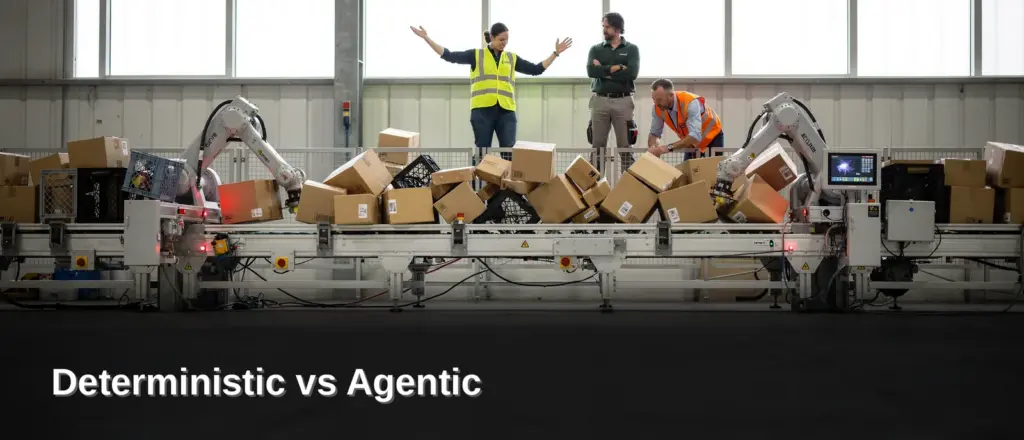

Prompts to AI agents is the upgrade path that matters: agents replace static prompts with autonomous, multi-step workflows that act on business systems directly. eMediaAI’s AI Opportunity Blueprint™ guides small businesses through this upgrade, with founder Lee Pomerantz’s fCAIO services delivering measurable ROI within 90 days.
AI workflow automation replaces one-off prompts with AI agents that reason, learn, and act across multi-step processes. We build these systems for SMB and mid-market teams through a 10-day AI Opportunity Blueprint, moving operations beyond copy-paste tasks into governed, autonomous execution that integrates directly with existing tools like GHL and HubSpot.
Key Takeaways
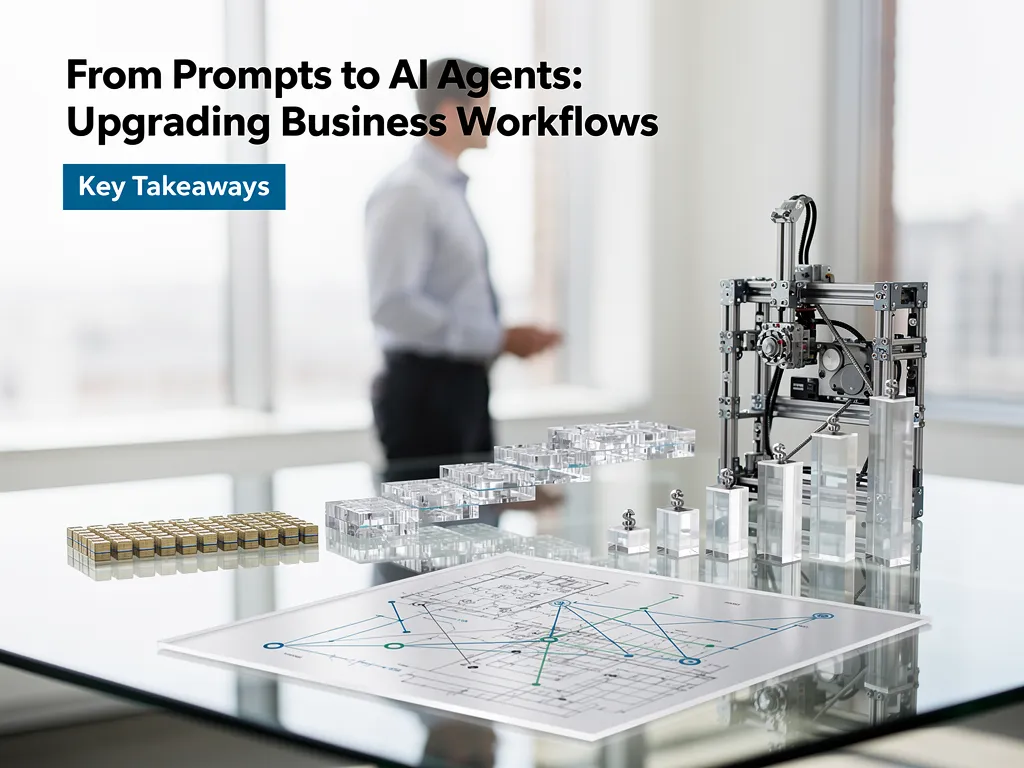
- AI agents automate complex workflows beyond simple prompts, delivering measurable ROI within 90 days.
- Prompts handle basic tasks; workflows manage multi-step processes; agents independently execute sophisticated business operations.
- eMediaAI’s AI Opportunity Blueprint™ identifies which approach, prompts, workflows, or agents, fits your specific business needs.
- Lee Pomerantz, Certified Chief AI Officer, guides small businesses through strategic AI implementation via fCAIO services.
Why Are You Still Just Prompting AI?
Prompting answers one question at a time. AI agents reason, learn, and act across a chain of decisions without someone retyping instructions at every step. We see this distinction trip up business leaders constantly: a chatbot that drafts an email is not the same system as one that monitors inventory, flags a reorder, and schedules the vendor call.
The gap matters because the clock is running. AI agents are already taking on more day-to-day work decisions as the technology matures, and CTOs are building toward that shift now, not later. SMBs that treat AI as a one-off typing assistant will fall behind competitors who move prompts to AI agents that run multi-step work without supervision.
Adoption pressure is not theoretical anymore. More and more solopreneurs and small business owners believe AI helps their business. That belief has to turn into something that actually reduces workload, or it is just another subscription nobody opens.
What’s the difference between a prompt and an agent?
A prompt produces a single response to a single input, like asking for a paragraph of copy. An agent coordinates multiple steps, decides what tool to use, and adjusts based on results. Businesses stuck on prompting get outputs; businesses running agents get finished tasks.
Why do so many small businesses stall at the prompting stage?
Most owners start with chat tools because they are familiar and low-risk. Building small business ai workflows that connect to real systems, calendars, CRMs, inventory, feels like a bigger elevator. That hesitation is understandable, but it is also where the time savings disappear.
Our position stays consistent: we build AI that saves time, reduces stress, and actually gets used by staff. An upgrade to agentic ai only counts if employees trust it enough to rely on it daily, not just experiment with it once.
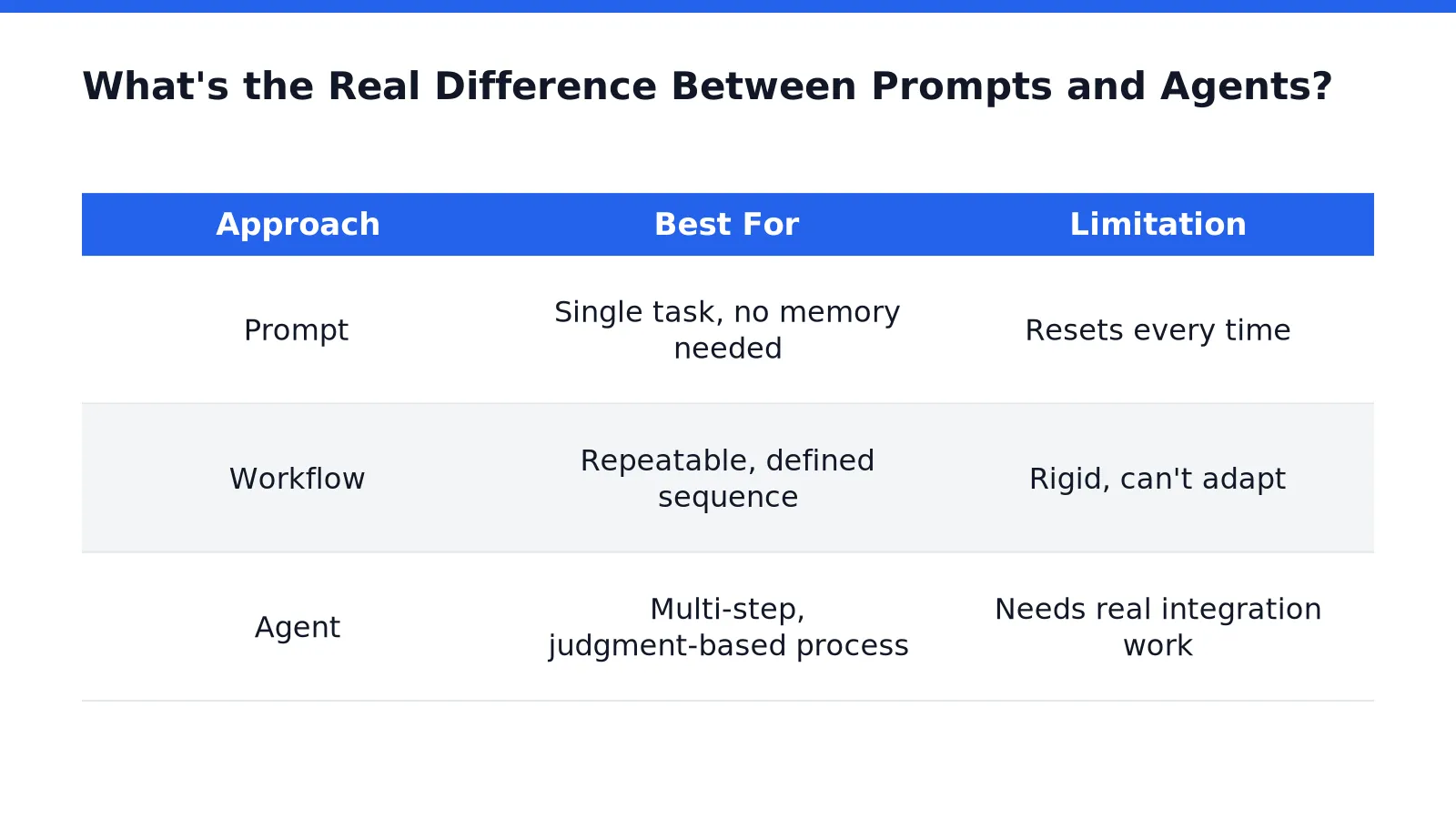
What’s the Real Difference Between Prompts and Agents?
A prompt produces one answer to one input. An agent reasons through multiple steps, uses tools, and keeps context alive across an entire task. We see this confusion constantly in our client conversations: owners think they’ve “done AI” because they typed a good prompt into a chatbot, when what they actually built is a single-shot interaction, not a working process.
Prompts to AI agents is the real upgrade path we walk clients through. Prompt-based systems represent the simplest form of AI interaction, producing one response for one request and nothing more. That’s fine for isolated, self-contained tasks. It falls apart the moment a job needs memory, sequencing, or judgment calls across steps.
When Should a Business Use a Simple Prompt Instead of an Agent?
Prompts work best for single, isolated tasks that don’t require ongoing context or multi-step reasoning. Drafting one email, summarizing one document, rewriting one paragraph: these are prompt jobs. Once a task needs to remember what happened three steps ago, a prompt alone can’t carry it.
The strongest small business AI workflows we build rarely rely on just one approach. Here’s how we break down the three building blocks:
Complex systems combine all three, layering prompts inside workflows that agents coordinate. That’s the real upgrade to agentic AI: not swapping tools, but connecting them. We handle that integration and deployment work directly, turning a single prompt into a connected, reasoning process that acts more like a capable employee than a chatbot.

How Do You Choose Prompts, Workflows, or Agents?
The right choice depends on how much judgment a task requires, not how impressive the technology sounds. Businesses new to generative AI often jump straight into full agent builds. The complexity outpaces their readiness almost every time. We see this constantly: a founder reads about upgrading to agentic AI and wants that capability on day one. The underlying process is even mapped.
That instinct costs time and money. A simple prompt or a clearly defined workflow often delivers real value without the overhead of a full agent build. If a task has one clear input and one clear output, a prompt handles it. If it requires several fixed steps in a known order, a workflow handles it. Only tasks that demand ongoing judgment, tool use, and adaptation justify an agent.
What’s the fastest way to tell which one a business actually needs?
Map the process before picking the technology. We run this diagnosis through our AI readiness, audit, and strategy work, which identifies which process needs an agent versus a simpler prompt or workflow.
Does every small business eventually need agents?
No. Many small business AI workflows stay productive for years on prompts and structured workflows alone. Our AI Opportunity Blueprint delivers a structured, 10-day roadmap that maps exactly which workflows justify the jump to agentic AI and which don’t.
That distinction protects budgets. It also protects staff from tools built for problems they don’t have.

What Makes an AI Agent Proactive, Not Reactive?

Proactive agents act without waiting for a prompt. Reactive tools sit idle until someone types an instruction. We see this distinction as the real dividing line in enterprise AI, not which model powers the system underneath.
A chatbot answers what we ask and stops. A proactive agent monitors conditions, flags problems, and takes the next step on its own. That difference separates companies seeing real P&L impact from companies still experimenting with prompts to AI agents as a novelty. Autonomous AI agents for small business work precisely because they close that gap between typing an instruction and getting a task actually finished.
Why Does a Reactive Tool Fall Short for Small Businesses?
A reactive tool only moves when someone feeds it an instruction. For a lean team already stretched thin, that means every task still depends on a human remembering to ask. Agents built for small business AI workflows close that gap by running checks, updates, and reports without a nudge.
The companies getting measurable results build intelligence that understands their business, operates inside their existing systems, and reports on its own progress. That is the practical test we apply: does the system wait, or does it work? One behaves like a tool. The other behaves more like a team member showing up and doing the job.
What Does It Take to Move From Prompting to a True Agentic Upgrade?
An upgrade to agentic AI requires more than swapping prompts for a fancier interface. It requires governance that keeps autonomous action aligned with business goals. We built our practice around that oversight: our founder’s Certified Chief AI Officer credential gives small businesses the structure to deploy proactive agents without surrendering control of the outcome.
How Do You Deploy Agentic AI Safely?

Safe deployment starts with scope, not software. We build every engagement around a single prioritized use case, structured governance, and a clear path to measurable return within 90 days. Skip that discipline, and businesses end up with agents that act on bad data, bypass approval steps, or erode staff trust before they ever deliver value.
Our Responsible AI Principles guide every build: fairness, safety, privacy, transparency, and governance come first, not as an afterthought bolted on after launch. That order matters. An agent handling customer data or financial approvals without privacy controls baked in from day one creates liability no ROI can offset.
What’s the first step before building an agent?
We start with an AI Opportunity Blueprint, a fixed-scope engagement that maps use cases before any build begins. It gives owners a deployment-ready roadmap and forces clarity on what the agent should actually do.
Who oversees the agent after launch?
Most small businesses can’t justify a full-time AI executive. Our Fractional Chief AI Officer service fills that gap, providing ongoing oversight and governance without the overhead of a permanent hire.
Three elements keep deployment grounded:
- A scoped blueprint before any upgrade to agentic ai
- Fractional governance to monitor outputs and risk
- Staff workshops that build trust in new small business ai workflows
Agents without oversight drift. Oversight without trained staff stalls. We treat all three as one system, not separate line items.
FAQ
What is the difference between a prompt and an AI agent?
A prompt produces a single response to a single input, like drafting one email. An agent reasons through multiple steps, uses tools, and keeps context alive to finish an entire task without retyping instructions.
How does eMediaAI help determine whether a business needs prompts, workflows, or agents?
The AI Opportunity Blueprint™ is a fixed-scope, 10-day engagement that identifies which approach fits your specific business needs. Lee Pomerantz, a Certified Chief AI Officer, guides this strategic assessment through fCAIO services.
Why do many small businesses stay stuck using simple prompts instead of agents?
Owners often feel chat tools are familiar and low-risk, while connecting AI to real systems like calendars or CRMs feels like a bigger elevator. This hesitation causes potential time savings to disappear.
Conclusion

In closing, the shift from prompts to agents represents more than a technical upgrade, it’s a fundamental reset of how small businesses allocate human effort. The organizations that win aren’t those chasing the latest model. They’re the ones building governed systems that return time to their teams and measurable value to their bottom line. The path forward demands strategy before tools, people before process, and clarity before speed. That’s where the real competitive advantage lives.
Ready to Move From Prompts to a Governed Agent?
If your team is still retyping instructions into a chatbot every day, the fastest way to find out what’s actually worth automating is our AI Opportunity Blueprint™, a fixed-scope, 10-day engagement that maps your highest-value use cases and hands you a deployment-ready roadmap. Lee Pomerantz, Certified Chief AI Officer, leads the assessment personally through our fCAIO services.
Call us at +1 260.673.0312 x300 or email [email protected] to start your Blueprint.