

Small businesses face growing pressure to adopt AI responsibly while generating measurable returns, and an AI strategy for small businesses defines the roadmap that turns experimental pilots into business value. This guide explains what an AI strategy is, why it matters for SMBs, and how leaders can prioritize high-impact use cases, build governance, and measure AI ROI in practical terms. Readers will learn how to run readiness assessments, choose quick-win automation and augmentation projects, and embed people-first Responsible AI principles to preserve employee well-being and customer trust. The article maps step-by-step actions across six strategic areas: the need for strategy, the 10-Day AI Opportunity Blueprint™, fractional CAIO leadership, people-first Responsible AI practices, an actionable AI roadmap, and pragmatic ways to overcome common adoption barriers. Throughout, we use terms like AI readiness assessment for SMBs, AI adoption roadmap for small business, and AI ROI for small business to keep the recommendations actionable and discoverable for search and implementation purposes.
Why is an AI Strategy Essential for Small Businesses?
An AI strategy for small businesses is a coordinated plan that aligns AI opportunities with business goals, prioritizes high-impact use cases, and sets governance to manage risk and value creation. This approach works because it converts scattered experiments into measurable initiatives through use-case identification, data readiness assessment, and an integration plan that targets ROI. Establishing a formal strategy reduces wasted spend, improves employee adoption, and accelerates measurable outcomes by focusing efforts on feasible, high-return projects. The next section breaks down the concrete benefits SMBs can expect when strategy replaces ad-hoc experimentation.
AI delivers operational and market advantages that compound quickly when guided by a clear strategy.
- Increased Efficiency: Automation of repetitive tasks reduces manual hours and error rates.
- Revenue Growth: Targeted personalization and sales enablement can lift conversion and average order value.
- Better Decisions: Analytics-driven insights shorten decision cycles and improve forecasting.
What Benefits Can AI Bring to SMBs?

AI strategy workshops for companies and AI implementation for SMBs often start by quantifying benefits so leaders can prioritize investments that generate tangible ROI. AI improves productivity by automating routine workflows such as invoicing, customer triage, and inventory forecasting, which commonly translate into measurable time savings and lower operational cost. AI-driven personalization increases customer engagement and can raise average order values through smarter recommendations and targeted outreach. Finally, predictive analytics helps managers anticipate demand and reduce waste, improving margins and resilience in volatile markets. These concrete benefits point directly to how SMBs should prioritize use cases that are low-complexity but high-impact, which the next section contrasts with the risks of ad-hoc adoption.
What Risks Do SMBs Face Without a Clear AI Strategy?
Without an AI strategy, small businesses risk wasting capital on pilots that never scale, exposing customer data through poorly governed models, and generating employee resistance due to unclear processes or unfair automated decisions. Poor vendor selection or inadequate data readiness often leads to integration failure and stalled projects, undermining senior leadership confidence in AI initiatives. Regulatory or reputational harm can arise when models behave unfairly or opaquely, and these are particularly costly for smaller brands with limited crisis capacity. Mitigation requires governance frameworks, transparency practices, and training—elements that a formal strategy builds into project lifecycles and that we explore in later sections.
How Does the AI Opportunity Blueprint™ Accelerate AI Adoption?
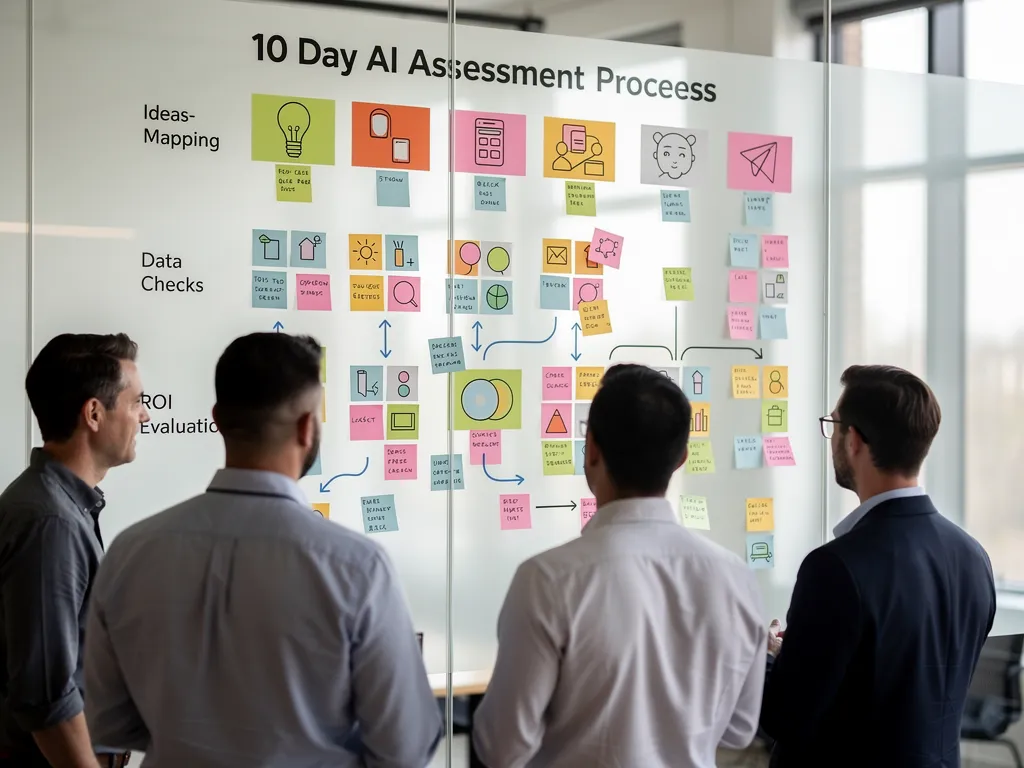
The AI Opportunity Blueprint™ is a structured 10-day process that assesses readiness, prioritizes use cases, and produces a short-term implementation roadmap designed for rapid ROI. This 10-day AI assessment method focuses teams on stakeholder interviews, data checks, and quick-win design so SMBs can move from ideation to pilot-ready plans without long procurement cycles. By using systematic use-case mapping and ROI quantification, the Blueprint aligns technical feasibility with business impact, reducing friction in vendor selection and initial deployments. Below is a day-by-day comparison of the Blueprint phases, activities, and expected deliverables to show how the process compresses discovery into executable outcomes.
The table below summarizes each phase of the 10-day process and the primary outputs that drive fast adoption.
This EAV-style comparison demonstrates how compressing discovery into defined phases delivers clear outputs, and the next subsection describes the activities and stakeholder roles you can expect during the Blueprint.
What is the 10-Day AI Opportunity Blueprint™ Process?
The 10-Day AI Opportunity Blueprint™ process begins with rapid discovery to align leadership on measurable outcomes, then moves through technical validation and quick-win design to produce a prioritized, implementable roadmap. Stakeholders typically include business owners, IT/data representatives, and operations leads to ensure use cases map to workflows and data availability. Deliverables include a prioritized use-case list, a data readiness assessment, integration recommendations, and a measurement plan that targets ROI in under 90 days. This compressed timeline minimizes disruption to daily operations while producing concrete plans that technical and business teams can act on immediately, which supports fast deployment and early measurement of impact.
How Does the Blueprint Deliver ROI in Under 90 Days?
The Blueprint accelerates ROI by prioritizing high-impact, low-complexity use cases and framing them with clear success metrics, deployment resource estimates, and measurement plans that focus on business outcomes. Rapid prototyping and integration-light approaches, such as using pre-built connectors or low-code automation, allow pilots to reach production quality quickly and begin delivering value. Training and change management are included to ensure users adopt solutions, and the ROI model ties expected savings or revenue uplift to a 90-day measurement cadence. Clients who follow this structure typically see clarified scope and faster vendor execution, enabling measurable returns within the three-month window.
What Role Does a Fractional Chief AI Officer Play in SMB AI Leadership?

A fractional Chief AI Officer (fractional CAIO) is a part-time strategic leader who provides AI governance, roadmap oversight, vendor orchestration, and performance measurement for SMBs that are not yet ready to hire full-time AI executives. This model works because it delivers senior-level strategy and governance on a flexible budget, bringing expertise in policy design, integration choices, and ROI frameworks without the cost of a full-time hire. Fractional CAIOs connect business objectives to technical execution, help set Responsible AI rules, and supervise early deployments so organizations scale responsibly. The following subsection lists the governance activities a fractional CAIO typically performs and why these matter for SMBs.
The importance of dedicated AI leadership and governance roles for SMBs is increasingly recognized in academic and industry discussions.
AI Governance Roles for SMBs While AI provides many business opportunities across industries, the organizational implications of AI are still largely unclear. We investigate governance roles related to AI use in practice, and undertake first steps to define the role profiles of a Chief AI Officer (CAIO) and an AI Risk Officer (AIRO). We base our inquiry on two sources: a literature review and evaluative interviews with nine AI professionals from small- and medium-sized companies. We find that, whereas the roles and activities associated with the CAIO and AIRO are commonly deemed relevant for such companies in the long run, today only a few companies have implemented them. Especially the creation of the CAIO position seems justified, due to the complexity of AI and the need for extensive interaction and coordination related to AI governance. AI governance: are Chief AI Officers and AI Risk Officers needed?, M Schäfer, 2022
A fractional CAIO centralizes oversight and brings disciplined measurement to AI initiatives.
- Policy & Governance: Design transparent policies for data use and model monitoring.
- Roadmap Oversight: Prioritize use cases, sequence pilots, and align budgets.
- Vendor Orchestration: Select partners and manage integrations to meet SLAs.
These responsibilities explain why smaller firms often prefer fractional leadership before scaling to in-house roles; the next subsection outlines when to consider engaging a fractional CAIO.
How Does a Fractional CAIO Support AI Governance and Strategy?
A fractional CAIO supports AI governance and strategy by defining policy for data access, establishing model performance metrics, and implementing monitoring procedures that align with business risk appetite. They establish vendor evaluation criteria and help manage third-party relationships to ensure compliance and technical fit, which reduces the risk of misaligned implementations. Additionally, fractional CAIOs run performance measurement frameworks so stakeholders can track ROI and model drift, and they coach internal teams through AI literacy programs to sustain adoption. This governance-first approach helps SMBs maintain agility while ensuring accountability and measurable business outcomes.
When Should SMBs Consider Engaging a Fractional CAIO?
SMBs should consider a fractional CAIO when they have multiple AI pilots, lack internal AI leadership, face governance gaps, or need rapid scaling without the cost of a full-time executive. Signs include inconsistent pilot outcomes, vendors delivering conflicting roadmaps, and leadership uncertainty about regulatory or ethical obligations. Typical engagement scopes range from a few months to an ongoing part-time relationship focused on roadmap execution, governance setup, and vendor orchestration. Engaging a fractional CAIO provides targeted leadership that converts experimentation into repeatable, governed practices, which reduces long-term risk and accelerates value capture.
How Can Small Businesses Implement People-First and Responsible AI Practices?

People-first AI and responsible AI for SMBs means designing systems that prioritize fairness, safety, privacy, and transparency while preserving employee agency and job quality. Operationalizing these principles requires clear policies, human-in-the-loop controls, documentation of model decisions, and regular training so staff understand how AI augments roles rather than replacing them. Responsible AI practices also include simple privacy-by-design steps—data minimization, role-based access, and audit trails—that protect customers and reduce compliance exposure. The next subsection defines core Responsible AI principles and how SMBs can apply each in practical ways.
Emphasizing the human element, a people-first approach to digital transformation ensures that technological advancements are inclusive and beneficial for all societal groups.
People-First Responsible AI Principles The PEOPLE-FIRST session aims to promote the development of digital and industrial technologies that are centred around people and uphold ethical principles. This session aligns with the overarching objective of building a strong, inclusive, and democratic society that is well-equipped for the challenges of digital transition. Session Position and Approach: PEOPLE-FIRST aims to embed ethical, inclusive innovation into the technological landscape. By bringing together stakeholders from ICT, STEM, and social sciences, we tackle the diverse societal impacts of digital transformation. This interdisciplinary collaboration ensures that technological advancements are accessible and beneficial, reducing inequalities and promoting inclusivity for all societal groups. At the heart of our initiative is the empowerment of end-users and workers, actively involving them in the development lifecycle of technologies, fostering a participatory design process. Digital Humanism: Towards a People-First Digital Transformation, 2025
Introducing ethics and human-centered design early reduces resistance and increases long-term adoption.
- Fairness: Ensure models treat groups equitably through bias testing and representative data sampling.
- Safety: Validate outputs and set human approval gates for risky decisions.
- Privacy: Apply data minimization and encryption to sensitive information.
- Transparency: Document model purpose and maintain clear user-facing explanations.
These principles form the foundation for training programs and governance, which we detail in the following subsection along with the role of workshops and education.
What Are Responsible AI Principles for SMBs?
Responsible AI principles for SMBs include fairness, safety, privacy, transparency, governance, and team enablement, each translated into practical controls that fit smaller teams. Fairness involves routine bias audits and dataset reviews so automated decisions do not disadvantage customers or employees. Safety and privacy are enforced through access controls, encryption, and incident response checklists that match the company’s risk profile. Transparency requires maintaining model documentation and providing understandable explanations for automated outcomes to stakeholders. Governance ties these practices together with roles and responsibilities, while team enablement ensures staff receive AI literacy workshops so they can use AI tools confidently and ethically.
How Does Ethical AI Adoption Improve Employee Well-Being?
Ethical AI adoption improves employee well-being by reducing uncertainty, preventing workload spikes from poorly designed automation, and increasing trust through transparent decision-making. When AI systems augment tasks with clear boundaries and human oversight, employees experience less stress and greater role clarity because responsibilities remain defined and supported. Training and change management—such as AI literacy workshops—help employees understand how models make recommendations and how to intervene, which fosters ownership and reduces burnout. Measuring well-being outcomes alongside productivity metrics ensures that efficiency gains do not come at the cost of morale or engagement.
What Are the Key Steps to Developing and Executing an AI Roadmap for SMBs?

An AI adoption roadmap for small business is a staged plan that begins with an AI readiness assessment, prioritizes feasible use cases, pilots validated solutions, and scales through iterative deployment while measuring outcomes. Building this roadmap requires combining technical checks—data quality, integration capability—with business criteria—value, complexity, and compliance risk—so leaders can sequence projects logically. The following numbered list lays out a practical sequence of steps to develop and execute a roadmap that balances speed with governance.
Use these steps to move from assessment to scaled outcomes.
- Conduct AI readiness assessment to evaluate data, skills, and process fit.
- Identify and prioritize use cases by ROI, complexity, and alignment to strategy.
- Pilot quick wins with clear success metrics and human oversight.
- Scale proven solutions while setting governance and monitoring.
- Measure and iterate using defined KPIs and continuous improvement loops.
These steps form the backbone of a roadmap; the next table breaks down expected timelines and owners for each major step.
This EAV-style comparison clarifies responsibilities and realistic timelines, which helps prevent scope creep and align expectations across teams.
How to Assess AI Readiness and Identify Use Cases?
Assessing AI readiness for SMBs starts with a checklist of data availability, data quality, stakeholder alignment, and operational integration capacity. Key questions include: Is the data accessible and labeled, are decision-makers prepared to change processes, and does the organization have basic monitoring in place? High-ROI use cases for SMBs often include customer service automation, lead scoring for sales, inventory forecasting, and routine document processing. Use simple ROI estimates—projected time saved or increased revenue over three months—to prioritize candidates, and select 1–2 pilots that are low complexity and high business impact to validate assumptions.
What Are Best Practices for AI Integration and Deployment?
Best practices for AI integration include starting with small pilots, keeping humans in the loop, validating model outputs before full automation, and using modular integration patterns that reduce coupling to legacy systems. Implement monitoring dashboards to track model performance and set alert thresholds for data drift or accuracy drops. Use iterative release strategies—pilot, measure, refine, scale—to limit operational disruption and incorporate user feedback. These deployment practices help SMBs move from prototype to production while maintaining control and ensuring measurable business outcomes.
How Can SMBs Overcome Common AI Adoption Challenges?

SMBs face common obstacles—skill gaps, fragmented data, and security/privacy concerns—that delay AI projects; addressing these systematically requires training, integration patterns, and governance frameworks. Skill gaps can be bridged with AI literacy workshops and fractional leadership, data fragmentation can be mitigated with middleware and ETL patterns, and security issues require access controls and vendor due diligence. Below is a problem–solution table that maps major challenges to business impacts and practical remedies, including services that small businesses can use.
Research further underscores the specific challenges and opportunities small and medium-sized enterprises encounter when considering AI-powered transformation.
AI Readiness & Adoption for Small Businesses This study was necessitated by the apparent hesitance of Small and Medium-sized Enterprises (SMEs) in West Africa to embrace AI for their transformation, prompting an examination of AI-powered business transformation in SMEs.Employing a qualitative research method, the study utilized secondary qualitative data and thematic analysis to identify key influencing factors and reviewed existing empirical evidence on challenges and opportunities. Findings revealed a significant awareness and usage gap among West African SMEs, with a high level of awareness of AI tools, which contrasts with minimal actual implementation. Despite this, SMEs hold a highly positive perception of AI’s potential benefits, including enhanced customer relationship management (CRM), improved content creation, and increased operational efficiency. However, widespread adoption is consistently hindered by certain barriers such as inadequate digital infrastructure, digital skill gaps, high financial costs, organizational Assessing the Technological Readiness of Small Businesses for Artificial Intelligence-Powered Transformation: A West African Context, AE Arachie, 2025
This table provides a concise reference so SMBs can match problems to solutions and decide which services to engage for rapid progress; the next subsections expand on training and governance tactics.
What Solutions Address Skill Gaps and Data Integration Issues?
To overcome skill gaps and data integration issues, SMBs should combine short, targeted training programs with pragmatic technical patterns and leadership support. AI literacy workshops build baseline knowledge across teams so staff can interpret model outputs and participate in pilots, while fractional Chief AI Officer services provide strategic guidance and vendor orchestration for integration. On the technical side, using middleware, ETL tools, and standardized APIs reduces friction when consolidating data across bookkeeping, CRM, and operations systems. Together, training and the right integration architecture reduce time-to-value and make pilots more likely to scale successfully.
How to Manage Security, Privacy, and Compliance Risks in AI?
Managing security, privacy, and compliance risks in AI requires a checklist-driven approach that includes data minimization, role-based access controls, encryption at rest and in transit, and logging for auditability. SMBs should conduct vendor due diligence to confirm contractual safeguards and request clear data handling practices. Implementing model monitoring and incident response procedures ensures rapid detection and remediation of issues, and governance routines—such as periodic audits and documentation—keep teams aligned on regulatory obligations. These controls protect customers and the business while enabling responsible deployment of AI.
For SMBs ready to move from planning to action, focused next steps can accelerate results with expert help. eMediaAI offers the 10-Day AI Opportunity Blueprint™ (priced at $5,000) to produce a prioritized roadmap and ROI model, fractional Chief AI Officer (fCAIO) services to provide governance and strategic oversight, and AI literacy workshops to raise internal capability while preserving a people-first approach. These services map directly to the solutions above and are designed to deliver measurable ROI in under 90 days when combined with disciplined execution.
- Start with an assessment to prioritize meaningful use cases.
- Engage targeted training and governance to reduce adoption risk.
- Use fractional leadership or the Blueprint to compress discovery and measurement.
This practical mix of internal work and selective external support helps SMBs capture the upside of AI while managing risk and protecting people.
Frequently Asked Questions
What are the initial steps for small businesses to start implementing AI?
Small businesses should start their AI adoption with an AI readiness assessment to evaluate their data quality, existing skills, and operational processes. This assessment helps identify gaps and opportunities for AI integration. Following this, businesses can prioritize use cases based on potential ROI and complexity. Starting with low-complexity, high-impact pilots allows for manageable implementation and quick wins, setting the stage for broader AI adoption as the organization gains experience and confidence.
How can small businesses ensure the ethical use of AI technologies?
To ensure ethical AI use, small businesses should adopt Responsible AI principles, which include fairness, transparency, and accountability. This involves conducting regular bias audits, maintaining clear documentation of AI models, and ensuring that decision-making processes are understandable to stakeholders. Additionally, implementing human-in-the-loop systems can help mitigate risks associated with automated decisions. Training employees on ethical AI practices fosters a culture of responsibility and helps maintain trust with customers and employees alike.
What role does data quality play in AI success for small businesses?
Data quality is crucial for the success of AI initiatives in small businesses. High-quality, well-structured data ensures that AI models can learn effectively and produce accurate predictions. Poor data quality can lead to misleading insights, ineffective automation, and ultimately, wasted resources. Small businesses should invest in data cleaning, validation, and management practices to enhance data quality. This foundational step is essential for achieving reliable outcomes and maximizing the return on AI investments.
How can small businesses measure the success of their AI initiatives?
Measuring the success of AI initiatives involves defining clear KPIs aligned with business objectives. Common metrics include time savings, cost reductions, increased sales, and improved customer satisfaction. Regularly tracking these metrics allows businesses to assess the impact of AI on their operations. Additionally, implementing a feedback loop where insights from AI performance inform future strategies can help refine processes and enhance overall effectiveness, ensuring continuous improvement in AI applications.
What are common pitfalls small businesses should avoid when adopting AI?
Common pitfalls in AI adoption for small businesses include lack of a clear strategy, inadequate data governance, and insufficient employee training. Without a defined roadmap, businesses may invest in AI projects that do not align with their goals or fail to scale. Additionally, neglecting data privacy and security can lead to compliance issues and reputational damage. To avoid these pitfalls, businesses should establish a comprehensive AI strategy, prioritize data governance, and invest in training to build internal capabilities.
How can small businesses foster a culture of innovation around AI?
Fostering a culture of innovation around AI involves encouraging experimentation and collaboration among employees. Small businesses can create cross-functional teams to explore AI applications and share insights. Providing training and resources gives employees what they need to engage with AI technologies confidently. Recognizing and rewarding innovative ideas can also motivate staff to contribute to AI initiatives. By promoting an open mindset towards technology and continuous learning, businesses can enhance their adaptability and drive successful AI adoption.
Conclusion

A well-defined AI strategy gives small businesses what they need to get real value from AI, driving efficiency, revenue growth, and informed decision-making. By prioritizing high-impact use cases and embedding responsible practices, organizations can mitigate risks while maximizing returns. Engaging with expert services like the 10-Day AI Opportunity Blueprint™ can streamline this process and ensure measurable outcomes. Take the first step towards transforming your business with AI by exploring our tailored solutions today.