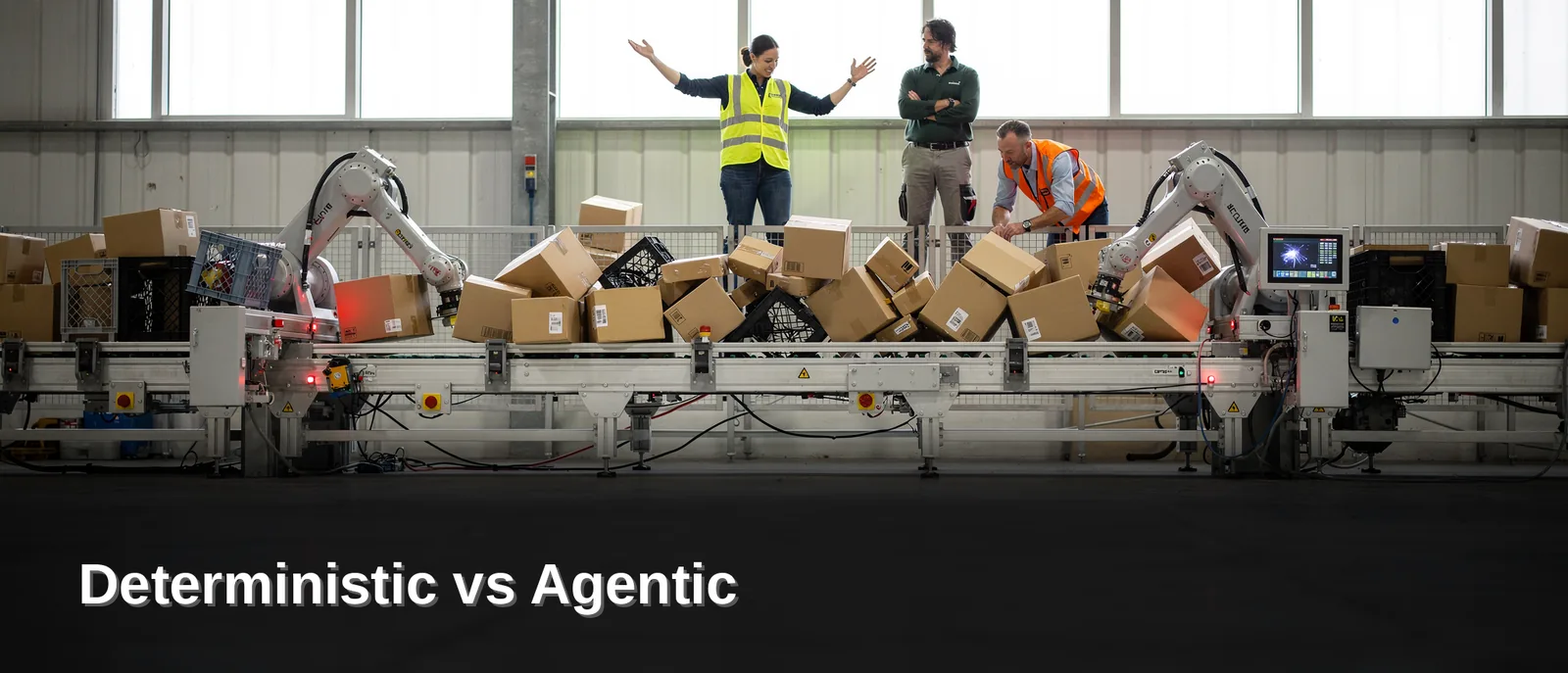
In the deterministic vs agentic debate, deterministic automation executes the same scripted path every time, like a midnight batch job. Autonomous decision loops let AI agents self-prompt and act without fixed logic. Fewer than 10% of enterprises run autonomous content pipelines without daily manual intervention; we provide solutions to improve this through governed, human-in-the-loop deployment.
Key Takeaways

- Fewer than 10% of enterprises maintain autonomous content pipelines without daily manual intervention.
- Deterministic workflows deliver predictable, repeatable results; autonomous agents require constant human oversight.
- 95% of production systems choose structured workflows over autonomous decision loops for reliability.
- eMediaAI’s fCAIO services guide enterprises toward automation architectures that achieve ROI in under 90 days.
Why Do Automated Pipelines Suddenly Fail at Scale?
Pipelines break at scale because self-directing agents run unchecked once volume exceeds a team’s capacity to supervise every output. Autonomous AI Agents in Content Automation found that fewer than 10% of enterprises run fully autonomous content pipelines without daily manual intervention, even though 90% of organizations had adopted agent-driven tooling by late 2026. That gap tells the real story. Software vendors promise full autonomy, but production environments often require ongoing maintenance.
We see the same pattern across our client base. Autonomous decision loops work in a demo because the demo controls every variable. Production does not. The same report describes self-prompting loops that stall or recurse endlessly once they hit unhandled API exceptions or hallucinated citations, with unbounded execution cycles that burn token budgets, clog network queues, and trip hard API rate limits without warning.
What actually breaks first when agents run unsupervised?
Token spend and request volume break first, long before output quality does. An agent stuck in a recursive loop keeps calling the same API, keeps paying for the same tokens, and keeps clogging the same queue until someone intervenes.
This matters most for CTOs already under pressure to deliver more with less as AI adoption accelerates. We don’t treat that pressure as a reason to automate faster. We treat it as the reason to build deterministic vs agentic boundaries into the architecture from day one. That adaptive AI workflows stay productive instead of becoming an unbudgeted liability.
What Separates Deterministic Automation From Agentic Loops?
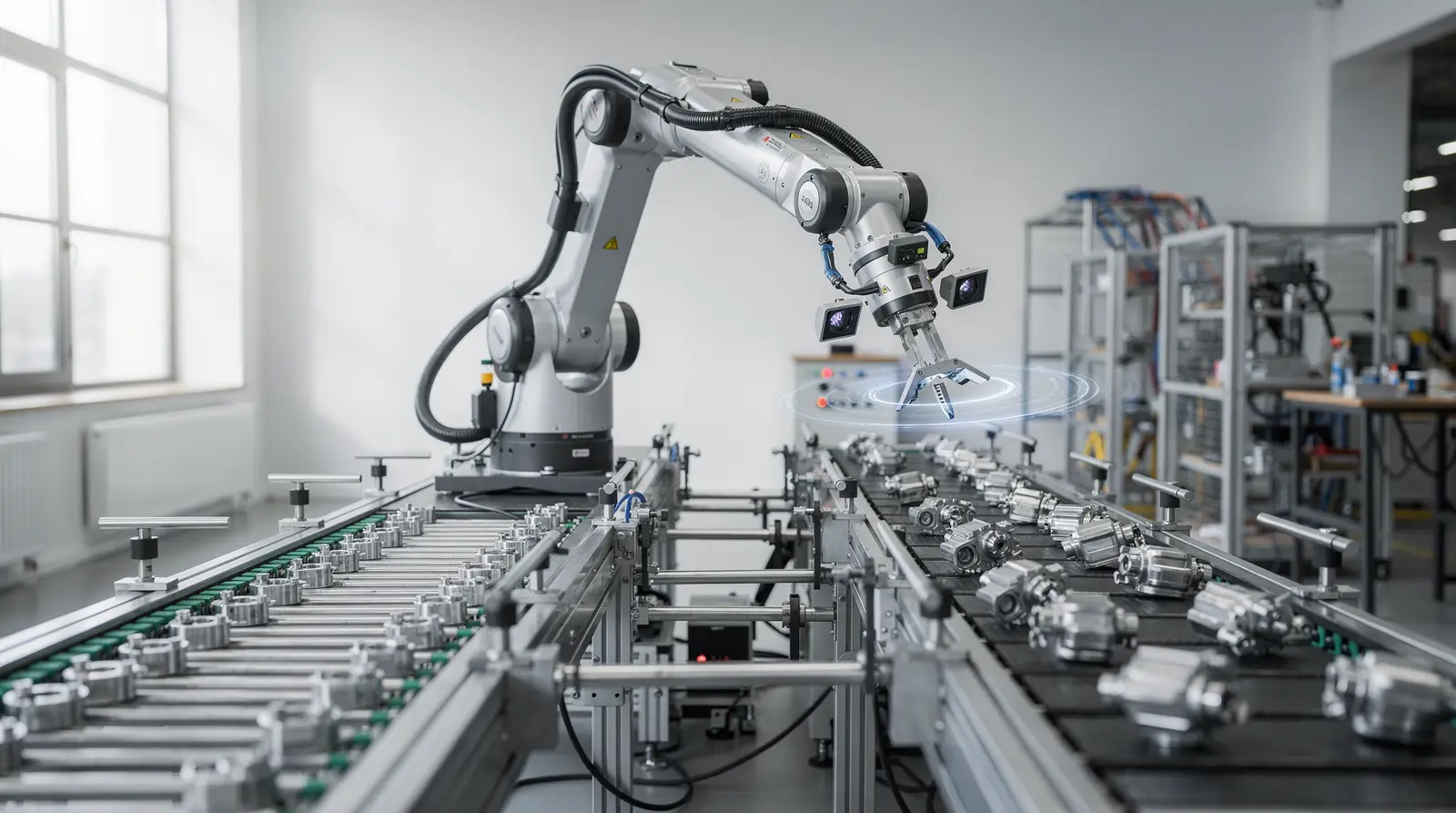
Deterministic automation executes a fixed sequence of steps and returns identical output every run. Agentic systems reason, adapt, and choose their own path toward a goal. The distinction between deterministic vs agentic execution sits at the center of nearly every production incident we review for clients. A midnight batch job built on deterministic logic follows the same route night after night, producing the same result every time. An AI agent behaves differently. Agents mark a shift from passive language models to autonomous systems that perceive their environment, reason about goals, take action, and learn from outcomes.
That capacity for independent judgment creates what we call autonomous decision loops: cycles where a system evaluates context, picks an action, and revises its own next step without a human approving each move. Loops like these pay off when the goal is fuzzy and the cost of a wrong branch is low. They become a liability fast when the goal is precise and the cost of error is high, which describes most enterprise finance, compliance, and customer-facing workflows.
Few organizations have closed that gap in practice. Organizations have not adopted AI or large language model workflows at enterprise scale. Governance readiness and integration complexity have not caught up with ambition.
Can deterministic and agentic systems work together?
Yes, and they should. The strongest production stacks we build pair deterministic guardrails with agentic reasoning only at the edges, producing what we call adaptive ai workflows. A deterministic backbone handles the steps that must stay exact, like data validation, approvals, and financial posting. An agent layer handles the parts that benefit from judgment, such as drafting or triage, inside boundaries the backbone enforces.
Who decides where that boundary sits?
Governance does, not the model. Our Responsible AI Principles build transparency and oversight into every automated decision point before an agent ever touches production data. Judgment stays accountable instead of improvised.
Where Should Autonomous Decision Loops Actually Run?
Autonomous decision loops belong at the specific branch points where uncertainty. Stakes are both high, not spread across every step of a workflow. We treat the rest of the process as fixed, scripted logic. Gartner names Agentic AI a top trend for 2025 and predicts daily work decisions will increasingly shift to AI agents. That shift is real, but it is far from total replacement of structured process.
We draw the line the same way a reliable production architecture does: reserve probabilistic reasoning for the branches that carry real ambiguity, dense semantics, or financial exposure, and hand everything routine to deterministic code. This is the practical core of deterministic vs agentic design. A model that re-plans every single step burns compute, drifts from intent, and produces results no auditor can reconstruct.
What belongs in a deterministic workflow versus an agentic branch?
Deterministic steps handle anything repeatable: data validation, routing, formatting, approvals with fixed criteria. Agentic branches earn their place only where judgment genuinely varies by case, like interpreting ambiguous customer intent or triaging an unclassified support ticket.
Adaptive AI workflows succeed by mixing both modes deliberately, not by defaulting to agents everywhere.
- Deterministic: scheduled jobs, compliance checks, data transformations
- Agentic: open-ended reasoning, exception handling, judgment calls under uncertainty
- Hybrid: the handoff layer that routes between the two
Tech executives already see where this is heading. Over half expect AI agents to become core to operations within two years, which raises the cost of getting the split wrong now. We build the integration and deployment work, the API connections, governance checkpoints, and routing logic, that puts this split-architecture approach into production rather than leaving it as a whiteboard diagram.
How Do Adaptive AI Workflows Stay Governed?
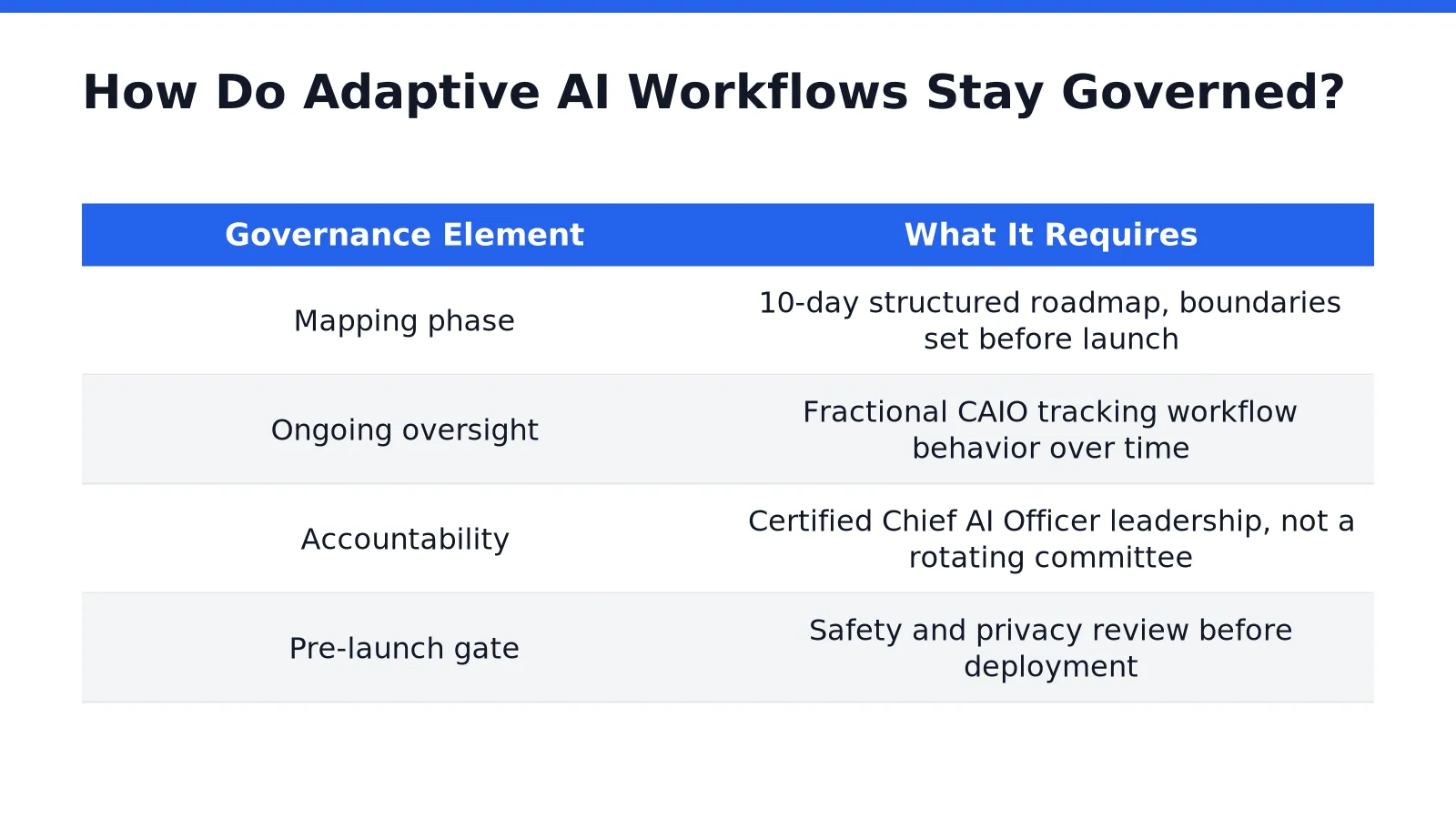
Governance starts before deployment, not after a system misbehaves. We map the boundaries of acceptable automation first, then let workflows flex within those limits. That sequence separates adaptive AI workflows that earn executive trust from the ones that generate unbudgeted risk six months later.
Our AI Opportunity Blueprint anchors this work. It compresses the mapping phase into a 10-day structured roadmap, identifying exactly where automation can safely bend without drifting into unsupervised territory. We don’t treat this as a one-time audit. Oversight continues through our Fractional Chief AI Officer service, which tracks how workflows behave as conditions shift and inputs change over time.
Who actually owns the governance decisions?
Someone with the credentials to make the call has to own this, not a committee that reviews logs after the fact. Lee Pomerantz, our founder, holds Certified Chief AI Officer credentials and anchors the governance process personally. That accountability matters more than any dashboard.
What stops a workflow from becoming an unmanaged agent?
Clear limits on autonomous decision loops stop drift before it starts. We apply Responsible AI Principles that demand safety and privacy controls before anything adaptive goes live, covering fairness, transparency, and people-first outcomes alongside technical guardrails.
This produces a comparison worth holding onto when evaluating any vendor’s claims:
Each layer reinforces the next. Skip one, and the others carry weight they weren’t built to hold.
What Should Executives Do Before Deploying Agents?

Executives run an AI readiness audit before any decision-loop goes live. We built our practice around this sequence because skipping it is how organizations end up with unbudgeted compute spend and no clear owner when something breaks.
An audit forces a hard question: does this process need deterministic vs agentic execution? Deterministic steps belong in fixed workflows. Judgment calls, the kind involving ambiguity or shifting inputs, are candidates for autonomous decision loops. Confusing the two is the single most common cause of failed deployments we see.
What belongs in an AI readiness audit?
An audit maps current workflows, flags where staff lose time to manual handoffs, and identifies which tasks tolerate variability and which don’t. It also sets a baseline for measuring return. We help clients target ROI within 90 days of deployment, and that clock only starts once the baseline exists.
How do we know if a workflow is ready for agents?
Readiness means the process has clear success criteria, bounded inputs, and a human checkpoint for exceptions. If those three conditions aren’t met, the workflow isn’t ready for adaptive ai workflows, regardless of what the vendor demo shows.
Before go-live, we recommend executives confirm:
- A named owner for every automated decision point
- A documented fallback when the model’s confidence drops
- A cost ceiling tied to token or compute usage, reviewed weekly
- Staff training that treats adoption, not deployment, as the finish line
Our mission stays simple: implement AI that saves time, reduces stress, and actually gets used. Audit first. Deploy second. That order is not negotiable.
FAQ
What is the main difference between deterministic and agentic automation?
Deterministic automation runs the same fixed sequence every time with identical output, like a midnight batch job. Agentic systems reason, adapt, and choose their own path toward a goal instead of following a scripted route.
Why do autonomous AI pipelines fail once they scale?
Self-directing agents run unchecked once volume exceeds a team’s supervision capacity. Agents stall or recurse endlessly on unhandled API exceptions or hallucinated citations, burning token budgets and tripping rate limits.
How does eMediaAI help enterprises deploy automation that works?
eMediaAI builds deterministic vs agentic boundaries into the architecture from day one and deploys governed, human-in-the-loop automation. Its fCAIO services guide enterprises toward automation architectures that achieve ROI in under 90 days.
Conclusion

In closing, the choice between deterministic automation and autonomous decision loops isn’t binary, it’s architectural. Deterministic systems protect brand integrity and compliance; autonomous loops drive velocity and adaptation. The organizations winning today build hybrid models: deterministic guardrails around high-stakes decisions, autonomous loops where speed and learning matter most. This requires governance, not just technology. The real competitive edge belongs to those who architect their AI stack with human judgment at the center, not at the margins.