
Mid-market companies save significant time and cost by buying over building. Custom AI agent development often requires six-figure budgets and 12+ months. EMediaAI’s $5,000 AI Opportunity Blueprint™ delivers measurable ROI in under 90 days through Fractional Chief AI Officer guidance.
Mid-market companies evaluating build vs. buy for AI agents typically avoid costly rebuilds by starting with a structured assessment: eMediaAI’s AI Opportunity Blueprint™, priced at pricing varies clarifies which path fits before committing resources, with clients seeing ROI in under 90 days through guided Fractional Chief AI Officer support.
Mid-market budgets determine the AI agent build-vs-buy equation: buying cuts first-cost and speeds time-to-value for standard workflows, while building demands continuous reinvestment as models and architectures shift. Our AI Opportunity Blueprint™ resolves this tradeoff in a 10-day, $5,000 engagement, mapping which agents warrant custom deployment versus off-the-shelf purchase before any budget commitment.
Key Takeaways

- Mid-market companies achieve ROI in under 90 days with strategic AI agent implementation and proper planning.
- Building custom AI agents requires ongoing maintenance costs that often exceed initial development expenses over time.
- eMediaAI’s AI Opportunity Blueprint™ costs $5,000 and identifies high-impact agent opportunities for your business.
- Fractional Chief AI Officer services provide expert guidance without the expense of a full-time executive hire.
Why Is the Buy vs Build Decision Harder in 2026?
Market maturity, not technology failure, makes the buy vs build AI agents call harder for mid-market teams this year. More agent tools now ship ready to deploy, so standard workflows no longer require custom development from scratch. That shift should simplify the decision. Instead, it multiplies the options executives have to weigh before committing budget.
We see the default shift clearly: for most standard workflows, buying should be the starting point, not the exception. Custom builds still make sense for business-specific logic or workflows tied directly to revenue. Those cases are narrower than most teams assume.
Why Doesn’t Traditional SaaS Math Apply to AI Agents?
Traditional software math breaks down here. With conventional SaaS, a company weighs upfront build cost against a smaller maintenance cost, or an ongoing subscription fee. AI agents complicate that comparison because the underlying models and architectures keep changing. A build decision made this quarter can look outdated within months, which raises the real cost to deploy AI agents beyond the initial price tag.
That volatility lands hardest on CTOs already asked to deliver more with less amid rapid technological change. Every buy-vs-build call now carries rebuild risk that didn’t exist in prior SaaS cycles.
The practical result for any SMB AI budget:
- Tool maturity has lowered the bar for buying standard workflows.
- Custom builds remain justified only for workflows touching core revenue or proprietary logic.
- Budget planning must account for model and architecture change, not just the original build cost.
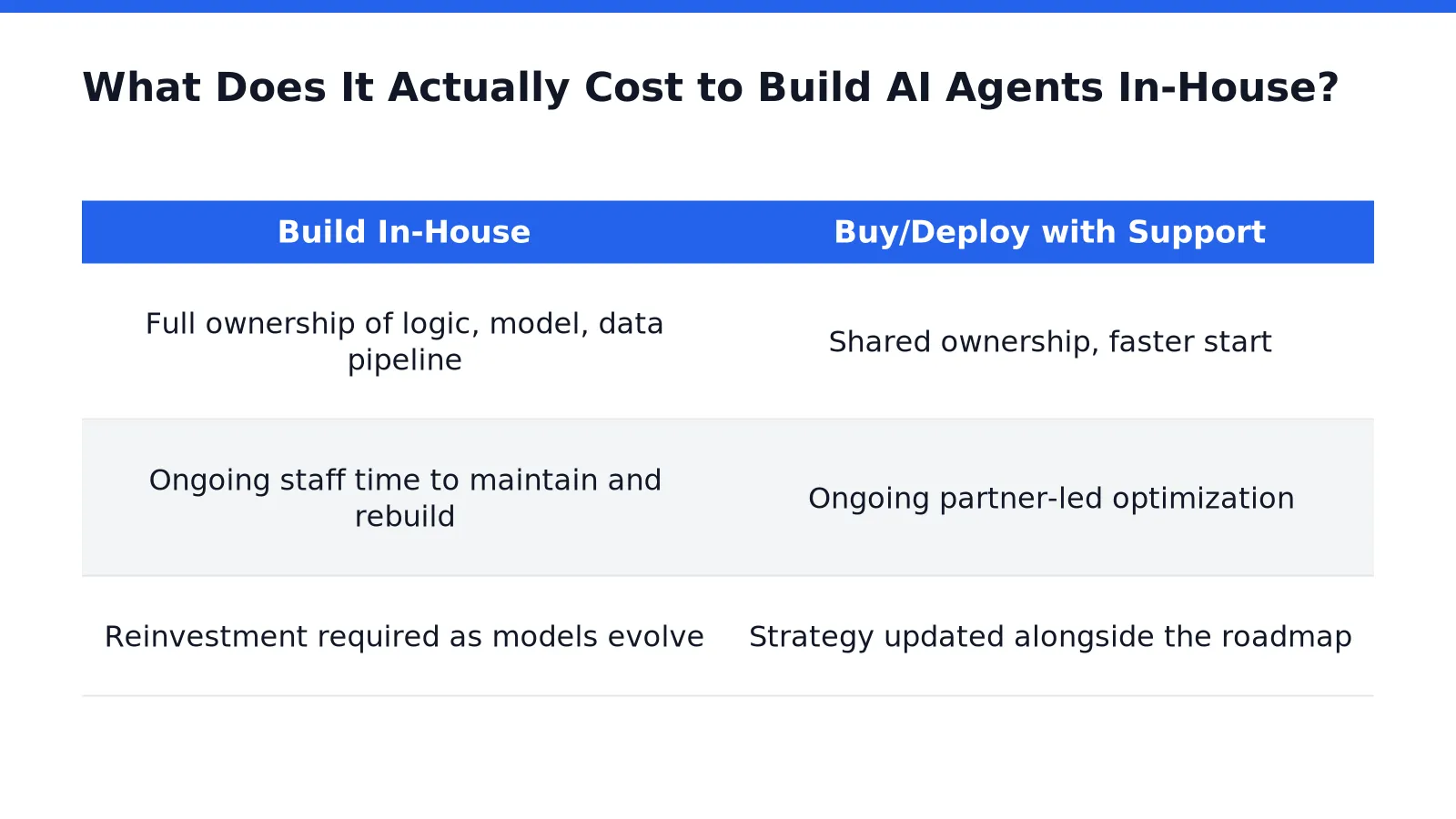
What Does It Actually Cost to Build AI Agents In-House?
Full control is the real price tag of building an AI agent from scratch. A company that builds in-house owns every decision: the logic, the model selection, the data pipeline, and the way the agent handles each customer interaction. No vendor roadmap gets in the way, but no vendor absorbs the workload either.
That control comes from somewhere. Someone on staff has to define the agent’s reasoning, pick and tune the model, and manage the data pipeline that feeds it. We think of this as the hidden line item in cost to deploy AI agents: dedicated technical hours that do not show up in a software quote but show up in payroll every month.
Does the Cost End Once the Agent Is Built?
No. Models and architectures keep changing, so a one-time build rarely stays competitive. Companies that build in-house have to keep reinvesting, and sometimes rebuild the agent completely just to hold their position. Budget for the build, then budget again for the rebuild.
This is where the buy vs build AI agents question gets expensive fast for a company sizing its SMB AI budget around a single upfront number. The real comparison looks like this:
We do not just automate a workflow and walk away. We provide the ongoing strategic leadership and technical execution, funnels, API integrations, Python scripts, that a build path actually requires. The investment keeps paying off instead of quietly decaying.

What Does It Cost to Buy AI Agents Off the Shelf?
Off-the-shelf pricing buys speed, not certainty. The cost to deploy AI agents through a vendor subscription stays lower upfront than a custom build. The workflow goes live faster, especially when the task is common across most companies. That trade-off looks attractive to any founder watching runway and headcount at the same time.
The catch shows up once the workflow stops being generic. A bought tool runs into trouble when the agent needs deep access to internal systems, business-specific logic, or role-based permissions tied to revenue, operations, or customer experience. At that point, the buy vs build AI agents question stops being about price and starts being about fit.
Is buying an AI agent always cheaper than building one?
Not once the workflow touches core business logic. A generic license costs less on day one, but the real custom ai agent vs off the shelf comparison only starts once a workflow gets specific. Custom development often creates more value than forcing a bought tool to approximate what the business actually needs.
We treat that fit question as the first budget decision, not the last. Before any SMB AI budget gets committed to a license or a build, we run readiness, audit, and strategy work to test whether the bought tool actually solves the problem at hand. That audit alone has saved clients from paying for software that solves the wrong problem.
Once a tool passes that test, the real cost is integration, not the license fee. We handle that connection work directly:
- Mapping the bought agent into existing systems and data flows
- Deploying the tool so it runs inside daily operations, not alongside them
- Closing the gap between a signed contract and a working process
Buying solves the easy half of the problem. Making it work inside the business solves the expensive half.

How Should Mid-Market Companies Set Their AI Budget?

Mid-market leaders set their smb ai budget by anchoring it to a fixed, known entry cost rather than an open-ended discovery process. We built our AI Opportunity Blueprint™ around that principle: a fixed-scope engagement priced at $5,000 that gives finance and operations leaders a single line item to approve before any build-or-buy spend begins. We treat this as a total cost of ownership ai agents question from day one, not a single purchase price. The Blueprint functions as an ai agent TCO framework that accounts for build, buy, integration, and reinvestment costs before a dollar moves.
Budget planning gets harder when timelines stay vague. That’s why we deliver the Blueprint as a 10-day structured roadmap. Ten days replaces months of discovery with a schedule a CFO can actually plan against. A COO can staff around.
How long until an AI agent budget pays off?
We target return on investment in under 90 days for our clients. That horizon matters because it gives finance teams a concrete window for evaluating whether agent spend is working, rather than an indefinite wait for results.
What’s included beyond the initial roadmap?
Budgets shouldn’t stop at the first engagement. Many mid-market companies need ongoing judgment without hiring a full-time executive. We offer Fractional Chief AI Officer services: strategic leadership delivered at a fraction of the cost of a permanent hire.
Three components belong in a mid-market AI budget line:
- A fixed-scope roadmap engagement with a known price and timeline
- Ongoing fractional leadership to govern build-or-buy decisions as they arise
- A revenue line, not just a cost line
That last point deserves weight. Well-governed deployments are designed to raise average order value and customer lifetime value, not just cut headcount hours. Budgeting only for cost avoidance misses half the equation.
How Does eMediaAI Help You Decide Faster?

We shorten the buy vs build AI agents decision by putting credentialed judgment ahead of guesswork. Lee Pomerantz, our founder, is a Certified Chief AI Officer, and that credential shapes every recommendation we give on build-versus-buy tradeoffs. Clients get an executive-level read on the decision, not a vendor’s sales pitch dressed up as strategy.
Our mission drives the recommendation itself. We implement AI that saves time, reduces stress, and actually gets adopted by the people using it daily. That mission rules out options that look cheap on paper. Create more operational drag than they remove, whether that drag comes from a rigid off-the-shelf tool or an overbuilt custom system nobody on staff can maintain.
What protections should a company demand regardless of path?
Our Responsible AI Principles apply the same whether a company buys a platform or builds custom agents. We hold every engagement to standards covering fairness, safety, privacy, transparency, and governance, mapped to ai agent governance NIST and EU AI Act priorities. Those principles protect a company’s data and its customers no matter which path wins the analysis.
Does location limit who can work with eMediaAI?
Geography never blocks the engagement. We operate out of Fort Wayne, Indiana, and serve mid-market clients across the United States. A company in any state can bring us its cost to deploy AI agents question and get the same scoping process.
Before committing any part of the SMB AI budget to a build or a purchase, companies can reach us directly:
- Email [email protected] to request a scoping conversation
- Share current workflow friction points for a faster initial read
- Get a cost comparison before signing a vendor contract or a dev sprint
FAQ
How much does eMediaAI’s AI Opportunity Blueprint™ cost?
The AI Opportunity Blueprint™ costs $5,000 and runs as a 10-day engagement, mapping which agents warrant custom deployment versus off-the-shelf purchase.
Why is buying AI agents often better than building for mid-market companies?
Buying cuts first-cost and speeds time-to-value for standard workflows, while building demands continuous reinvestment as models and architectures shift.
What hidden cost makes building AI agents in-house expensive?
Building in-house requires dedicated staff to define agent reasoning, select and tune models, and manage data pipelines, hidden technical hours beyond initial development.
Conclusion
In closing, the buy-versus-build decision hinges on your operational maturity and risk tolerance. Buy when speed and vendor support matter more than customization; build when your workflows demand proprietary logic and long-term control. Most mid-market organizations benefit from a hybrid approach, acquiring proven infrastructure while building governance. Integration layers that protect your data and align AI deployment with business strategy. The real cost isn’t the software or engineering hours; it’s the friction of misalignment between technology and people.