

Agentic AI deploys goal-driven agents that act with limited supervision, coordinating subtasks through AI orchestration instead of waiting on constant human prompts. We treat it as execution infrastructure, not a chatbot upgrade, built with governance and human-in-the-loop controls so autonomy strengthens operations rather than creating unmanaged risk across finance, operations, or customer workflows.
For executives, the practical question isn’t whether agentic AI works. It’s whether the organization can deploy it with enough discipline to trust the output. We’ve watched companies rush agents into production without defined escalation paths, then spend months walking back decisions no one can fully explain, a refund that should never have cleared, a vendor approved outside policy, a customer commitment nobody signed off on. Each of those incidents starts the same way: a team treats the agent like a faster chatbot instead of a decision-maker, and skips the oversight work a new hire would get on day one.
This guide lays out what agentic AI actually does, where the governance risk lives, and the sequence we use to move fast without losing control of the outcome. We wrote it for the executive who has to answer for the result, not just the team that builds it: the VP of Operations who owns the escalation path, the CFO who has to explain an automated decision to an auditor, and the CTO who has to defend the architecture when something goes wrong. If you read nothing else here, read the governance sections closely. That’s where most agentic AI deployments succeed or fail, long before anyone evaluates the model itself.
Key Takeaways

- Agentic AI systems accomplish specific goals with limited supervision through autonomous decision-making capabilities.
- AI agents coordinate through orchestration to perform subtasks and reach complex business objectives efficiently.
- eMediaAI’s AI Opportunity Blueprint™ costs $5,000 and delivers measurable ROI within 90 days.
- Fractional Chief AI Officer services from eMediaAI guide businesses through agentic AI implementation strategies.
What Does Agentic AI Actually Mean For Business?
Agentic AI describes systems that act, not just answer. Unlike a chatbot that waits for the next prompt, agentic ai for business applications perceive a situation, reason through options, and take action with limited human supervision. That distinction matters for executives weighing automation budgets, because the payoff isn’t faster answers. It’s fewer decisions that require a human in the loop at all.
We see this shift accelerating faster than most leadership teams expect. Over half of tech executives already expect these systems to become core to operations within two years. That timeline leaves little room for a wait-and-see posture.
Think about what actually happens inside a finance department today when an invoice exception pops up, or inside a support queue when a ticket needs three systems checked before it can be answered. A human handles the routing, checks a policy, maybe loops in a manager, then closes the loop. Agentic AI collapses that chain. The agent recognizes the exception, checks the policy itself, decides whether it falls inside approved parameters, and either resolves it or escalates it to a person with the context already attached.
That’s the real shift: work that used to require a person to notice, decide, and act now happens inside the system, with a person reviewing outcomes rather than performing every step. The business value isn’t that the AI is smarter than the employee. It’s that the employee’s time gets freed up for the judgment calls that actually need a human, not the routine ones that don’t.
This is also why the conversation has moved out of IT and into the C-suite. Agentic AI touches headcount planning, risk exposure, and customer experience simultaneously. A VP of Operations evaluating this isn’t just asking “can the software do this.” They’re asking who’s accountable when it does, and what happens when it’s wrong. Those are the questions this guide answers.
Consider the same dynamic across a few other departments. In procurement, an agent that reconciles purchase orders against contract terms removes the manual matching step that used to tie up a buyer’s whole morning. In HR, an agent that pre-screens applications against defined criteria frees a recruiter to spend the day on conversations instead of resume triage. In customer support, an agent that resolves a routine billing dispute on its own means a human only sees the cases that actually require judgment. None of these examples depend on exotic technology. They depend on an organization being clear about what the agent is allowed to decide, and what it has to hand off.
That clarity is also what keeps the economics honest. Agentic AI isn’t valuable because it’s cheaper labor; it’s valuable because it changes the ratio of judgment work to routine work that a team spends its day on. A department that automates the routine ninety percent without defining the other ten percent hasn’t saved money, it’s just moved the risk somewhere less visible, and that’s the gap this guide is built to close.
How Is This Different From Regular Automation Or Chatbots?
Traditional automation follows fixed rules; chatbots respond to queries one at a time. Enterprise ai agents operate differently: they set subgoals, adapt when conditions change, and complete multi-step work without constant check-ins. The difference shows up clearly when we compare the two models side by side:
A rules engine breaks the moment a situation falls outside the conditions someone coded for it. A chatbot breaks the moment a question falls outside its training. Agentic systems are built to handle the in-between cases: the ones where the right answer depends on context the system has to gather and weigh, not just match against a template.
That’s not a minor technical upgrade. It changes what the system is trusted to do. A chatbot answering a billing question is low-stakes; if it’s wrong, the customer asks again. An agent that approves a refund, reroutes a shipment, or adjusts a pricing tier is making a business decision. That’s exactly why the next question matters more than the technology itself.
The confusion we see most often comes from vendors blurring these categories to sell a bigger contract. A workflow automation tool with an AI label slapped on it is not an agent, no matter what the pitch deck calls it. The test is simple: can the system handle a situation nobody explicitly coded for, gather the context it needs, and make a defensible decision about what to do next? If the answer is no, it’s automation with a chat interface, not agentic AI, and it should be priced and evaluated accordingly.
What Should Executives Actually Do With This?
Leaders should treat agentic systems as a governance question first, not a tooling question. Deploying autonomous ai workflows without clear oversight creates exposure, not efficiency. We build ai agent governance into every rollout before velocity, not after, because unmanaged autonomy costs more than it saves once something breaks downstream.
In practice, that means three things happen before a single agent touches production data. First, someone names the processes where an agent is allowed to act without review, and the ones where it isn’t. Second, someone defines what “wrong” looks like for each process, so a bad outcome is caught by a rule, not by a customer complaint. Third, someone owns the decision to shut an agent off if it starts behaving outside those bounds.
Skipping any one of those steps doesn’t make deployment faster. It just moves the cost to later, when the problem is harder to trace and more expensive to fix. The executives who get the most out of agentic AI aren’t the ones who move first. They’re the ones who move with a governance structure already in place, so speed and accountability aren’t fighting each other.
We’ve sat in the room when one of those steps gets skipped. A team under deadline pressure decides the governance conversation can happen after launch, because the model works in testing and the business case is already approved. Three months later, an exception the agent wasn’t scoped to handle gets resolved anyway, because nobody told it where its authority stopped. Nobody notices for weeks, because nobody defined what “wrong” looked like for that process. Unwinding it costs more time than the governance conversation would have, and it costs something harder to recover: the leadership team’s confidence that the next agent is safe to deploy. That’s the real price of skipping the sequence, not a compliance footnote, a tax on every future rollout.

How Are Enterprise AI Agents Different From Bots?
Bots follow scripts. Enterprise AI agents reason, adapt, and pursue a goal with minimal supervision, which is a different category of software entirely. A chatbot answers the question it was trained to answer. An AI agent decides which steps get the job done, then takes them.
This distinction matters to anyone signing off on an automation budget. Traditional AI models operate inside predefined constraints and need a human to intervene at nearly every decision point. Agentic AI for business flips that model: the system exhibits autonomy, goal-driven behavior, and the ability to adapt when conditions change. That shift is why we treat agent deployments as operational decisions, not IT side projects.
We build this distinction into every agentic ai architecture we deploy, because it changes what governance has to cover.
Consider a procurement workflow. A bot can flag a purchase order that’s missing a field. An enterprise AI agent can check the vendor against an approved list, compare the price against historical contracts, confirm budget availability, and route the order for approval, or approve it outright if it falls within pre-set thresholds. The bot saves someone a lookup. The agent completes the decision.
That gap is why we don’t recommend buying an “agent” as a product the way a company might buy a chatbot license. The value comes from how the agent is scoped, what data it can see, and what it’s allowed to do without asking first. Two companies running the same underlying model can get completely different results depending on how carefully that scope was defined.
Scope is also where most agent projects quietly stall. A team buys access to a capable model, points it at a process, and discovers the model can technically do the task but has no reliable way to know when it’s looking at an edge case versus a routine one. The fix isn’t a smarter model, it’s a narrower, better-defined scope: fewer processes, clearer boundaries, and an explicit list of what gets escalated. An agent that handles eighty percent of a workflow reliably, with the other twenty percent flagged for a human, outperforms an agent that attempts the whole workflow and gets it wrong often enough that nobody trusts the output.
What makes an AI agent “autonomous”?
Autonomy means the agent sets intermediate steps on its own instead of waiting for instructions at every turn. In a multiagent setup, each agent owns a specific subtask, and an orchestration layer coordinates the handoffs between them. That coordination is what separates a single clever bot from true enterprise ai agents working as a system.
A useful way to picture it: one agent might own data gathering, pulling records from a CRM, an ERP, and a support ticketing system. A second agent reconciles that data against a business rule. A third drafts the resulting action, whether that’s a customer email, an internal alert, or an updated record. None of those agents needs a human to move from step to step. A person reviews the result, or reviews only the exceptions the system flags, which is usually a small fraction of total volume.
That’s the practical definition of autonomy we work with: not “the AI does whatever it wants,” but “the AI completes a defined chain of steps without needing a person to approve each one individually.”
The orchestration layer is the part that’s easy to underestimate. It’s tempting to think of multiagent systems as just running several single-purpose bots in parallel, but the coordination between them is where most of the engineering work actually lives. Someone has to decide what happens when the data-gathering agent returns incomplete records, or when the reconciliation agent flags a conflict the drafting agent wasn’t built to handle. Those handoff rules are what make the difference between a system that degrades gracefully and one that fails silently. We treat orchestration design as inseparable from governance design, because every handoff is also a decision point about who, or what, is accountable for what happens next.
Why does this matter for CTOs and operations leaders?
AI agents are autonomous software programs that reason, learn, and act, giving CTOs a practical answer to talent shortages and stretched resources. We don’t stop at the strategy deck. Our team builds the funnels, API integrations, and Python scripts that turn an agent strategy into a working deployment. The autonomy on paper becomes autonomous AI workflows running in production, under AI agent governance we design alongside the build. That’s governed velocity in practice, not a slide.
For a CTO specifically, the calculus is different than it is for the rest of the C-suite. The question isn’t just whether agentic AI delivers value, it’s whether the engineering team can support what gets built. An agent that works in a demo and then becomes unmaintainable six months later because nobody documented its decision logic isn’t a deployment, it’s technical debt with good PR. We build with that constraint in mind: every integration gets documented, every escalation rule gets written down somewhere other than one engineer’s memory, and every agent gets a clear owner inside the organization, not just inside our engagement. That’s what lets a lean IT team support a growing set of agents without the support burden growing linearly alongside them.
What Governance Risks Threaten Autonomous AI Workflows?
Three risks dominate: ungoverned data exposure, unchecked decision autonomy, and fairness gaps that surface only after deployment. Unmanaged autonomous ai workflows make decisions without a documented standard, leaving executives exposed when regulators or customers ask how an agent reached a conclusion.
We align every ai agent governance engagement with NIST and EU AI Act frameworks rather than the vague “best efforts” language common among consultants chasing speed over accountability. That distinction matters once an agent touches customer data, pricing, or hiring decisions. Undefined governance becomes a liability the moment something goes wrong.
Our Responsible AI Principles anchor every governance decision in people-first benefits, fairness, safety, and privacy, not just technical performance. An enterprise ai agent that executes flawlessly but erodes trust. Mishandles sensitive records, has failed regardless of the speed gained.
Each of these risks plays out differently depending on where the agent sits in the business. A procurement agent with loose data retention rules can expose vendor pricing it had no reason to retain. A hiring-support agent without a documented fairness check can systematically disadvantage a protected group without anyone noticing until an audit or a complaint surfaces it. A customer service agent with no escalation threshold can issue refunds or commitments a company never intended to make, at a volume no single reviewer would catch in time.
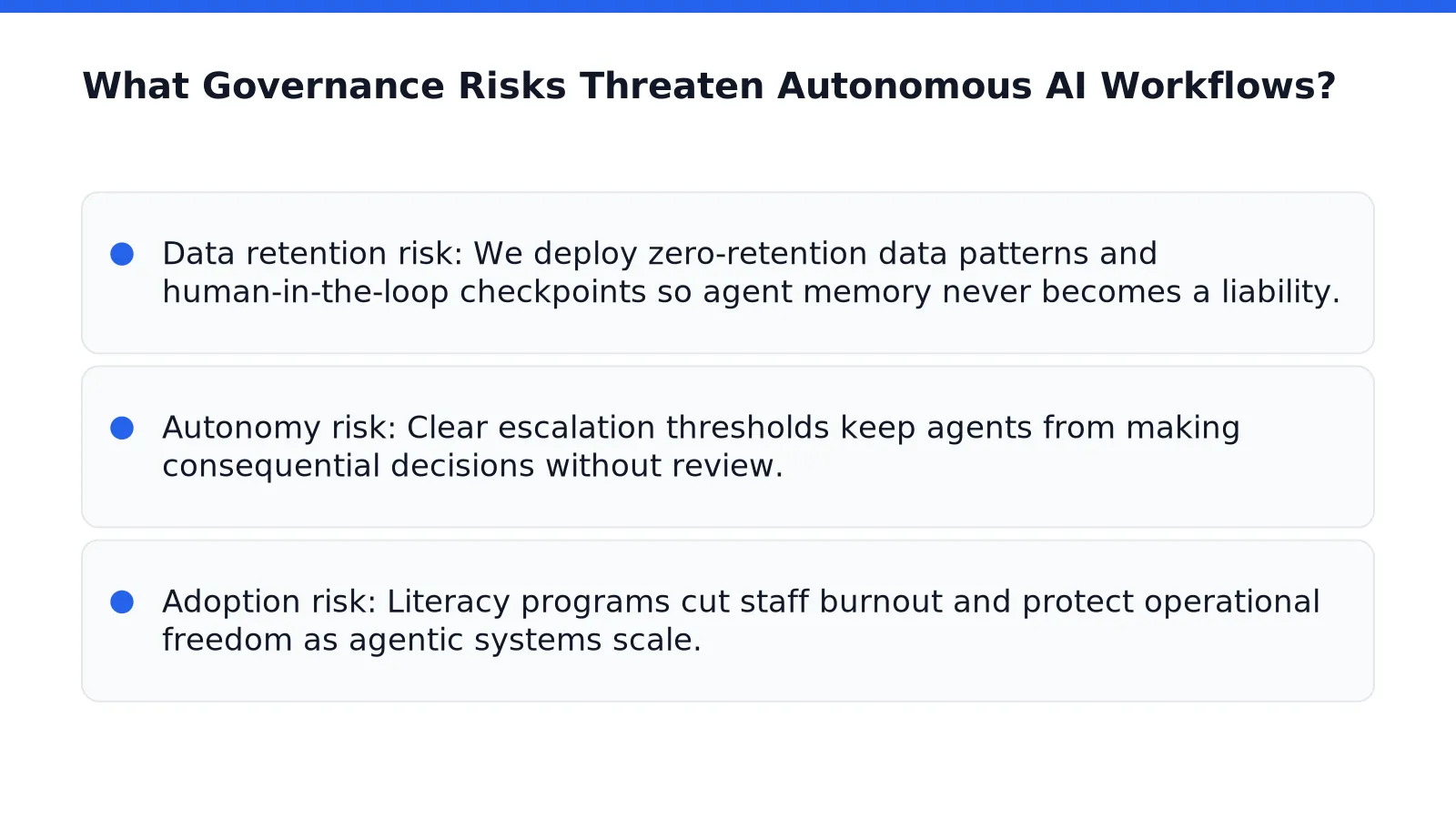
Three risk categories demand specific controls:
- Data retention risk: We deploy zero-retention data patterns and human-in-the-loop checkpoints so agent memory never becomes a liability.
- Autonomy risk: Clear escalation thresholds keep agents from making consequential decisions without review.
- Adoption risk: Literacy programs cut staff burnout and protect operational freedom as agentic systems scale.
None of these risks are hypothetical. They’re the predictable result of treating an agent like a faster version of existing software instead of a decision-maker that needs the same oversight a new employee would get on day one.
It’s worth sitting with the hiring-support example a little longer, because it’s the one leadership teams most often underestimate. A fairness gap doesn’t usually show up as one dramatic bad decision. It shows up as a slow, compounding pattern: an agent screening resumes slightly favors one type of background over another, nobody notices because the agent is accurate in the individual cases anyone bothers to spot-check, and six months later a demographic analysis of who got interviews tells a very different story than anyone intended. The fix isn’t a one-time fairness review before launch. It’s a recurring audit built into the governance plan from day one, because a model’s behavior can drift as the data it sees in production shifts away from the data it was validated against.
The same logic applies to data retention. A customer service agent that logs full conversation transcripts “just in case” isn’t being thorough, it’s accumulating a liability that grows every day it goes unaddressed. If that data store is ever breached, subpoenaed, or simply audited, the company has to explain why it kept information it never needed to keep. Zero-retention design isn’t a compliance nicety, it’s the difference between an incident that costs nothing because there was nothing to lose, and one that costs the company its customers’ trust.
Does faster AI deployment mean weaker governance?
No. Governed velocity means speed and oversight move together, not in opposition. We build agentic ai architecture with audit trails and fairness checks from day one. A compressed roadmap never sacrifices the accountability boards expect.
The mistake we see most often is leaders treating governance as a brake pedal, something that slows deployment down to keep the business safe. In practice it works the other way. A clear governance framework is what lets a team move quickly, because nobody has to stop and debate authority mid-deployment. The rules were already agreed on before the agent went live. Speed without that groundwork isn’t really speed; it’s a shortcut that creates rework later, when legal, compliance, or a customer forces the question anyway.
Think about how a well-run surgical team operates. Nobody would describe the checklist before an operation as something that slows the surgeon down. It’s what lets the team move fast once the procedure starts, because every role, every risk, and every contingency was already worked out beforehand. Agentic AI deployment works the same way. The governance conversation isn’t overhead bolted onto the project, it’s the thing that makes the project move at full speed without anyone having to stop and improvise accountability in the middle of it.
Who is accountable when an autonomous agent makes a bad decision?
Accountability stays with executive leadership, never with the model. Governance frameworks assign named owners, documented thresholds, and human review points before any agentic ai for business deployment goes live.

What Does Responsible Agentic AI Architecture Look Like?

Responsible agentic ai architecture starts with a map, not a live model running loose in production. We build that map before any autonomous ai workflows touch customer data, financial systems, or outbound communication.
Our AI Opportunity Blueprint™ gives executives that map as a fixed-scope, $5,000 engagement, delivered in 10 days. The sprint identifies which processes qualify for enterprise ai agents, which require human sign-off, and which stay fully manual. We hand over a deployment-ready roadmap, not a slide deck of possibilities.
The blueprint isn’t a theoretical exercise. It names the specific systems an agent would need to touch, the data it would need access to, and the failure modes worth planning for before go-live. By the end of the sprint, leadership knows exactly what’s being automated, what’s staying manual, and why, which is the groundwork every later governance decision depends on.
Ten days is a deliberate constraint, not an arbitrary one. A longer discovery process tends to drift into endless stakeholder interviews that never convert into a decision. A shorter one skips the due diligence that makes the roadmap defensible later. Ten days is enough time to map the real processes, talk to the people who actually run them day to day, and surface the failure modes that only show up when you ask someone who’s lived through the exception cases, not just the happy path.
Who Decides What an Agent Is Allowed to Do?
Governance decisions run through Lee Pomerantz, eMediaAI’s founder and a Certified Chief AI Officer. Pomerantz oversees every architecture decision tied to ai agent governance, from permission scopes to escalation triggers. That accountability sits with a named executive, not a committee.
That matters because a committee can diffuse responsibility until no one actually owns the outcome. A named decision-maker means there’s always a clear answer to “who approved this agent’s permissions,” which is exactly the question a regulator, auditor, or board member will eventually ask.
Fractional Chief AI Officer engagements exist for exactly this reason: most small and mid-market organizations don’t have, and don’t need, a full-time executive dedicated solely to AI governance. What they need is someone with that authority and that accountability sitting above the project, not buried inside it, making the permission and escalation calls with the same weight a CFO brings to a financial sign-off. That’s a different role than a vendor relationship manager or an IT director juggling AI alongside a dozen other responsibilities. It’s a named executive whose job includes being the answer to “who approved this.”
Once governance is set, we move into deployment work:
- Building the funnels that route leads and tasks to the right agent
- Writing the API integrations that connect agents to existing software stacks
- Scripting the Python logic that lets agents act, check their own work, and hand off to humans when confidence drops
That technical layer is where agentic ai for business stops being theoretical. That’s the real meaning of governed velocity: speed that never outruns oversight. Firms that skip the governance layer get neither the speed nor the protection.
How Should Your Business Start With Agentic AI?

Starting small beats starting big. We open every engagement with readiness, audit, and strategy work before anyone touches a deployment. A roadmap built on actual friction points outperforms one built on guesswork. For smaller organizations, agentic AI for business means technology that lets agents operate independently, think, decide, and set objectives with minimal human intervention. That capability only pays off when governance comes first.
Mid-market leaders tend to make one of two mistakes at this stage. The first is waiting too long, treating agentic AI as something only enterprise-scale companies with dedicated AI teams can responsibly deploy, and ceding ground to competitors who move earlier with a plan. The second is moving too fast in the opposite direction, buying a platform because a competitor announced one, without doing the audit work to know whether the processes it will automate are even the ones causing the most friction. Both mistakes come from skipping the same step: an honest look at where the organization actually loses time and money today, before deciding what to automate.
What’s the first step toward autonomous AI workflows?
The first step is an honest audit, not a tool purchase. We assess which processes actually qualify for autonomous AI workflows and which still need a person in the loop. Skipping this step is how organizations end up with expensive pilots that never reach production.
How fast should results show up?
Results should show up inside a single business quarter, not a multi-year transformation plan. We help clients see ROI in under 90 days from agentic AI deployments. A roadmap that takes six months to validate has already lost its usefulness.
A practical sequence looks like this:
- Audit and strategy: identify high-friction processes suited to enterprise ai agents.
- Literacy and workshops: build staff adoption before agents go live.
- Integration and deployment: carry the roadmap into working systems with ai agent governance built in.
That sequence is governed velocity: moving fast without skipping the controls that protect data, staff trust, and brand integrity. We design the underlying agentic ai architecture to support this pace from day one, not retrofit it after something breaks.
How Do You Measure Whether Agentic AI Is Actually Working?

Measuring agentic AI isn’t the same as measuring a software rollout. A traditional system either functions or it doesn’t; an agent can function correctly on paper while quietly making decisions that drift away from what the business actually wants. That means the metrics worth tracking go beyond uptime and task completion.
The most useful measure we’ve found is the escalation rate: what percentage of cases the agent handles on its own versus hands off to a person, and whether that ratio moves in the right direction over time. A rising escalation rate isn’t automatically bad; it can mean the agent is correctly recognizing more edge cases rather than guessing. A falling escalation rate only counts as progress if the exception cases it’s now handling alone were actually reviewed and approved for autonomous handling, not just absorbed silently.
Three other measures matter alongside escalation rate:
- Decision accuracy on reviewed cases: of the decisions a human spot-checks, how many would the human have made the same way. This is the clearest signal of whether trust in the system is justified or just assumed.
- Time-to-resolution: how long a workflow takes from trigger to close, compared to the pre-agent baseline. This is the number that shows up in a quarterly business review, but it only means something alongside the accuracy figure above.
- Exception pattern tracking: whether the same type of edge case keeps surfacing. A recurring exception usually means the agent’s scope needs to be redefined, not that the exception needs a one-off fix each time it appears.
We build these checkpoints into the 90-day window we target for ROI, not as a one-time report but as a recurring review. A deployment that looked good in week two and hasn’t been checked since isn’t a success story, it’s an unmonitored risk wearing a success story’s clothes. The organizations that get durable value from agentic AI are the ones that keep watching after launch, not just the ones that launch well.
FAQ
What makes agentic AI different from a chatbot?
A chatbot waits for prompts and answers queries one at a time. Agentic AI perceives a situation, reasons through options, and takes action with limited human supervision. It sets subgoals and completes multi-step work without constant check-ins.
Why should executives treat agentic AI as a governance issue first?
Deploying autonomous AI workflows without clear oversight creates exposure instead of efficiency. eMediaAI builds AI agent governance into every rollout before velocity, since unmanaged autonomy costs more than it saves once something breaks downstream.
How does eMediaAI help businesses implement agentic AI?
eMediaAI offers the AI Opportunity Blueprint™ for $5,000 and provides Fractional Chief AI Officer services, led by founder Lee Pomerantz, a Certified Chief AI Officer, to guide implementation strategies.
How long does it take to see results from an agentic AI deployment?
Most clients see measurable ROI within 90 days of deployment, not a multi-year transformation plan. The sequence that gets there starts with a focused audit of high-friction processes, moves through staff literacy and workshops, and ends with integration and deployment under defined governance. A roadmap that takes six months just to validate has already lost its usefulness to the business.
What’s the biggest mistake companies make when adopting agentic AI?
The most common mistake is deploying an agent into production before defining escalation paths and ownership. Companies that skip this step often have to walk back decisions later that no one can fully explain, which costs more time and trust than building the governance structure up front would have.
Conclusion

In closing, agentic AI succeeds when strategy precedes deployment and governance protects execution. The gap between vision and results narrows only when organizations align people, process, and technology in that order. The tools exist. The frameworks exist. What separates winners from the rest is the discipline to move fast without cutting corners, to build systems that give time back to employees while driving measurable business outcomes. That’s where agentic AI becomes real.
None of this requires a massive transformation program or a multi-year budget cycle. It requires an honest audit of where the friction actually lives, a named executive accountable for what the agent is allowed to do, and a willingness to measure results past the launch date instead of stopping at the demo. Organizations that get this right don’t treat agentic AI as a technology decision at all. They treat it as an operating decision, the same way they’d treat a new hiring policy or a new financial control, because that’s what it is. The businesses that move with that discipline now will be the ones setting the pace for everyone else in two years, not scrambling to catch up with a governance framework they should have built from the start.