

A fractional AI expert is a senior AI leader who provides executive-level strategy and hands-on guidance on a part-time or retained basis, delivering cost-effective executive AI leadership to organizations that cannot yet justify or find a full-time chief AI officer. This article explains what a fractional AI expert does, why small and mid-sized businesses (SMBs) choose part-time AI leadership, and how those engagements convert directly into faster ROI, stronger governance, and better employee outcomes. Many SMBs struggle with limited budgets, an AI talent gap, and the risks of poorly scoped pilots; fractional AI experts close these gaps by prioritizing high-impact use cases, overseeing vendor selection, and mentoring internal teams. You will learn clear definitions, practical benefits, an implementation roadmap, common challenges and solutions, and real-world examples showing measurable outcomes. The sections map to understanding the role, enumerating benefits, exploring a people-first approach, implementing fractional expertise, addressing SMB challenges, and reviewing success stories that demonstrate measurable value. Throughout, keywords like fractional AI expert, fractional chief AI officer, cost-effective AI leadership, and AI Opportunity Blueprint™ are used to help you evaluate whether part-time AI leadership is the right next step.
What Is a Fractional AI Expert and How Do They Support SMBs?
A fractional AI expert is a senior AI practitioner deployed on a predictable, limited cadence to provide strategic leadership without full-time overhead, enabling SMBs to access executive AI services while controlling cost and risk. They support SMBs by defining an AI roadmap, selecting vendors and tools, establishing governance and compliance guardrails, and running rapid pilots that prove value quickly. These engagements typically combine advisory strategy with implementation oversight and mentoring to build internal capacity; the result is faster decision cycles and clearer prioritization of AI investments. The next paragraphs define the Fractional Chief AI Officer role and contrast the fractional model with full-time alternatives to clarify when each model fits.
Definition and Role of a Fractional Chief AI Officer
A Fractional Chief AI Officer (fCAIO) is a part-time executive who defines AI strategy, creates roadmaps and governance documents, and supervises pilots and deployments so SMBs gain leadership-grade direction without full-time compensation. Typical deliverables include an AI roadmap, data governance templates, vendor evaluation criteria, and measurable pilot scopes; engagements run on monthly retainers or project-based cadences depending on organizational needs. An illustrative scenario: an SMB engages a fCAIO for a 30–90 day focused pilot to prioritize a single use case, produce measurable KPIs, and hand off operational procedures to internal teams. This role accelerates maturity and reduces risk by making leadership decisions explicit and auditable, and that governance foundation naturally leads into a discussion of how the fractional model differs from full-time leadership.
How Fractional AI Experts Differ from Full-Time AI Leaders
Fractional AI experts differ from full-time leaders by trading continuous in-house presence for targeted strategic impact, offering lower total cost of ownership while preserving access to senior decision-making and cross-industry experience. Compared with traditional consulting firms, fractional leaders embed longer-term accountability—mentoring and governance—rather than delivering only a one-off recommendation, and they combine executive judgment with practical implementation oversight. Pros and cons vary: fractional leadership provides faster time-to-value and budget flexibility, while full-time CAIOs provide continuous internal alignment and deeper day-to-day oversight; the choice depends on scale, pace of AI adoption, and organizational readiness. Understanding this contrast clarifies why many SMBs choose part-time AI leadership as a pragmatic step toward sustainable AI capability.
What Are the Key Benefits of Hiring a Fractional AI Expert?

Hiring a fractional AI expert delivers predictable executive leadership that reduces upfront cost, accelerates time-to-value, and builds internal capability—making it a pragmatic option for SMBs that need senior AI guidance without full-time expense. A fractional expert focuses scarce resources on high-impact use cases, enabling measurable ROI in compressed timelines through prioritized pilots, governance controls, and mentoring. The following list highlights primary benefits and their business consequences, and a compact EAV table summarizes mechanisms, timelines, and expected KPI impact for executive review.
- Cost-Effective Leadership : Access to senior expertise at a fraction of full-time compensation and overhead.
- Accelerated Time-to-Value : Rapid prioritization and execution of pilots that produce measurable results quickly.
- Talent Access and Mentorship : Mentoring and knowledge transfer that raise internal capability without long-term hires.
- Reduced Risk through Governance : Implementation of policies and compliance frameworks that limit operational and legal exposure.
This benefit list shows how fractional engagement converts strategic intent into concrete outcomes, and the table below provides a succinct comparison for executive decision-making.
This comparison makes clear how each benefit produces a measurable business effect and sets expectations for timelines and KPIs. The next section examines cost-effective leadership in more detail and shows how that benefit translates into ROI for SMBs.
How Does Cost-Effective AI Leadership Drive ROI for SMBs?
Cost-effective AI leadership drives ROI by replacing high fixed executive costs with targeted retained expertise that prioritizes only the most valuable use cases and then measures outcomes against clear KPIs. A concrete example: focusing on a single revenue-driving pilot (such as personalization or lead scoring) can produce payback inside 90 days when scope and success metrics are tightly managed. Fractional executives mitigate budget risk using phased pilots and milestone-based spending that ties vendor payments and internal investments to measured business impact. These approaches preserve cash while demonstrating proof points that justify subsequent scaling, and they naturally lead into tactics for accelerating innovation and flexibility.
In What Ways Do Fractional AI Experts Accelerate AI Innovation and Flexibility?
Fractional AI experts accelerate innovation by implementing rapid prototyping workflows—MVP pilots, quick vendor evaluations, and iterative model improvements—so teams learn from real-world data and pivot quickly. They act as a bridge between technical teams and business stakeholders, shortening decision loops and ensuring pilots align with measurable outcomes rather than theoretical possibility. By enforcing modular, vendor-agnostic architectures and staged rollouts, fractional leaders reduce lock-in and enable flexible scaling as business needs change. These mechanisms create a repeatable innovation cadence that both proves value and reduces long-term risk, setting the stage for a people-first implementation ethos.
How Does eMediaAI’s People-First Approach Enhance Fractional AI Services?
eMediaAI positions fractional AI leadership within a people-first, ethical framework that emphasizes employee well-being, governance, and measurable ROI to ensure AI adoption improves both business outcomes and workplace experience. As an owner-led AI consulting firm established in 2001, eMediaAI focuses on people-first, ethical AI adoption for SMBs and offers services including Fractional Chief AI Officer (fCAIO), AI Opportunity Blueprint™, AI Audit and Strategy, AI Policies and Compliance, AI Literacy, and AI Deployment. This philosophy embeds governance and literacy work up front, which reduces resistance and improves long-term adoption. The next paragraphs unpack the ethical principles that guide engagements and then explain how employee well-being is preserved during AI-driven change.
What Ethical AI Principles Guide eMediaAI’s Fractional AI Leadership?
eMediaAI’s fractional AI leadership is guided by core ethical principles—fairness, transparency, privacy, and accountable governance—operationalized through concrete policies, explainability practices, and data governance checklists. These practices include setting clear data usage boundaries, implementing explainability standards for models in production, and integrating compliance checkpoints into deployment schedules to mitigate legal and reputational risk. The firm’s services explicitly reference AI Policies and Compliance and AI Literacy as mechanisms for operationalizing ethical design, and those elements ensure that ethical safeguards are not an afterthought but part of delivery. Emphasizing these principles improves stakeholder trust and aligns AI outcomes with long-term business resilience.
How Does Employee Well-Being Factor into AI Strategy and Implementation?
Prioritizing employee well-being means designing AI to augment work, reduce repetitive tasks, and enable staff to focus on higher-value responsibilities rather than replacing people without planning. eMediaAI embeds training, mentorship, and human-in-the-loop models into deployment plans so staff learn alongside systems and gain skills that increase job satisfaction and productivity. Practical measures include task-mapping to identify automation candidates that free people for strategic work, a literacy program to raise confidence with AI tools, and monitoring metrics that measure both efficiency gains and employee experience. These practices reduce change friction and increase the odds that AI delivers sustainable business value while preserving workforce morale.
How Can SMBs Implement Fractional AI Expertise Effectively?
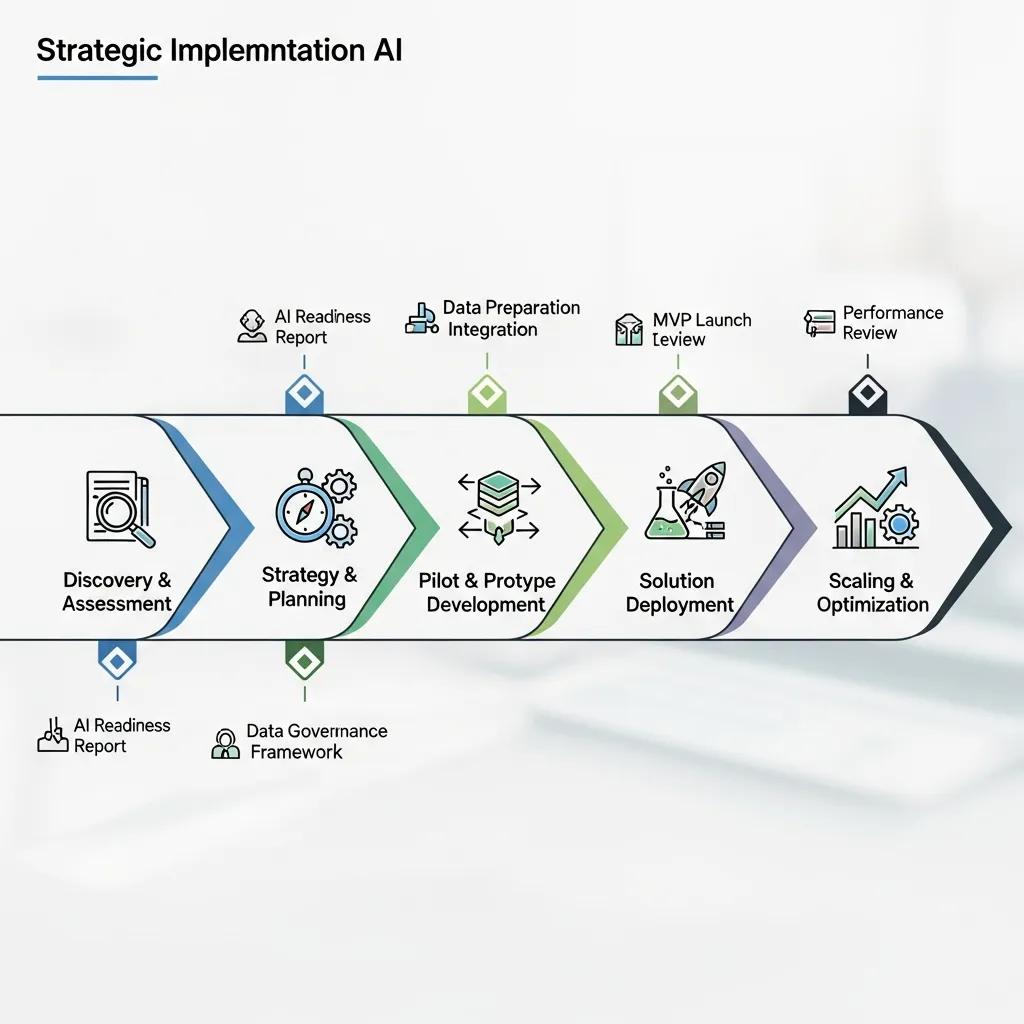
SMBs implement fractional AI expertise most effectively by following a clear, staged roadmap: assess current capabilities, run an AI Opportunity Blueprint™ to prioritize use cases, pilot focused MVPs, then scale with governance and training. This phased approach minimizes upfront risk while producing early wins that fund further investment and build internal capability. The AI Opportunity Blueprint™ is an ideal entry engagement that produces a prioritized, feasibility-scored roadmap and clear next steps; the following checklist and table outline a practical implementation path SMBs can follow.
- Assess : Map data assets, business processes, and pain points to identify potential AI use cases.
- Blueprint : Run a short, prioritized diagnostic to score impact, feasibility, and risk.
- Pilot : Execute an MVP with clear KPIs and short feedback cycles.
- Scale : Transition successful pilots into governed production with training and handoffs.
This stepwise plan clarifies how fractional leadership moves from assessment to sustained capability, and the table below compares common implementation offerings so executives can choose the right entry point.
The AI Opportunity Blueprint™ is a focused diagnostic that identifies, scores, and prioritizes AI use cases by impact, feasibility, and safety to produce a short, actionable roadmap for pilots and scaling. Typically executed as a compact engagement, the Blueprint maps data readiness, business value, compliance risk, and resourcing needs to ensure chosen pilots are both high-impact and realistic. Deliverables include a prioritized use-case list, an implementation sequence, governance checkpoints, and an estimated timeline for pilot MVPs; these outputs enable confident decision-making about which pilots to fund. Encouraging SMBs to book a Blueprint or consultation helps create an evidence-based entry point that reduces guesswork and accelerates early wins.
This approach aligns with broader findings that emphasize the value of AI-powered self-assessment tools in democratizing access to advanced innovation management for SMEs, bridging critical consultancy gaps.
AI Tools for SME Innovation & Consultancy Access
This study investigates the role of AI-powered self-assessment tools in enhancing innovation management for small and medium-sized enterprises (SMEs). The primary purpose is to provide SMEs with a cost-effective means to assess and develop their innovation capacities across eight key areas strategic orientation, innovation portfolio, innovation process, innovative talent and culture, innovation capabilities, technology adoption, strategic alliances, and innovation performance measurement. Findings reveal that AI-driven assessments based on data analysis, pattern recognition, and predictive modeling significantly benefit SMEs by offering actionable insights and recommendations, enabling efficient decision-making, and promoting competitive dynamism. The study discusses the impact of AI on reducing the “innovation divide” by democratizing access to advanced innovation management tools, thus supporting SMEs in achieving strategic growth and market adaptability. This research concludes that AI-driven tools represent a valuable asset for SMEs, bridging gaps in consultancy access, and fostering economic inclusivity.
Business innovation self-assessment with artificial intelligence support for small and medium-sized enterprises, JC Proenca, 2024
How Does Fractional AI Support AI Deployment and Internal Capacity Building?
Fractional AI support during deployment focuses on vendor selection, implementation oversight, operational handoff, and mentoring to create internal capability rather than permanent external dependence. Typical patterns include pairing external senior engineers or data scientists with internal staff, creating runbooks and governance templates, and establishing a mentoring cadence that moves responsibility in stages to internal teams. Key KPIs for capacity building include deployment velocity, reduction in external support hours, and internal adoption of governance practices. This structured handoff model ensures pilots become durable capabilities and that the organization gains the skills needed to sustain AI initiatives independently.
What Common Challenges Do SMBs Face and How Does Fractional AI Address Them?
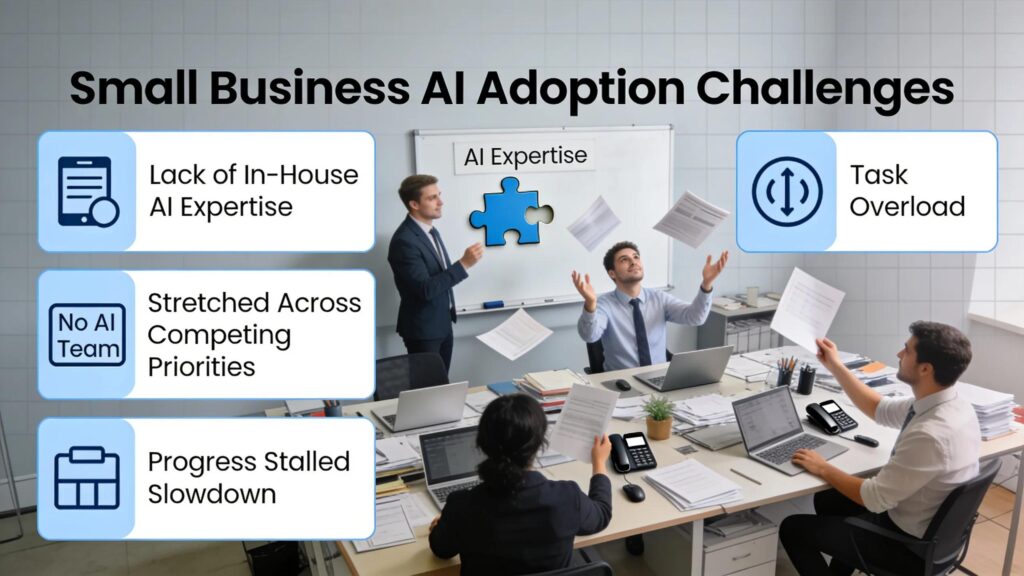
SMBs commonly face three core challenges—an AI talent gap, constrained budgets, and complexity or risk in production—and fractional AI addresses each through targeted leadership, phased financing, and governance frameworks that de-risk adoption. Fractional experts provide senior judgment and immediate capability to prioritize work, phased pilots align spend with results, and governance reduces model risk and operational surprises. The table below maps common pain points to concrete fractional AI solutions to help decision-makers quickly evaluate options.
Indeed, recent research underscores the growing trend of AI adoption among resource-constrained small and medium-sized enterprises, highlighting their strategic efforts to enhance competitiveness and operational efficiency.
AI Adoption & Impact in Resource-Constrained SMEs
This study investigates the adoption, implementation, and impact of artificial intelligence (AI) technologies in small and medium-sized enterprises (SMEs) across multiple sectors and regions. Using a mixed-methods approach combining surveys (n=583), semi-structured interviews (n=47), and case studies (n=18), we provide comprehensive insights into how resource-constrained businesses leverage AI to enhance competitiveness and operational efficiency. Results reveal a significant acceleration in AI adoption among SMEs, with 64.7% of surveyed businesses implementing at least one AI application—predominantly in customer service, marketing, and operations. Three distinct implementation approaches were identified: problem-first (63.8%), technology-push (24.7%), and competitive-response (11.5%), with the problem-first approach demonstrating superior outcomes. Despite persistent challenges in technical expertise and resource availability, successful SMEs employed strategic partner
Applications of artificial intelligence in small and medium scale business, M Kamruzzaman, 2025
This mapping clarifies how fractional engagements turn barriers into managed projects with measurable milestones, and the next paragraphs explain talent and budgeting solutions in detail.
How Does a Fractional AI Expert Bridge the AI Talent Gap?
A fractional AI expert bridges the talent gap by injecting senior skills temporarily while upskilling internal staff through hands-on mentoring, paired work, and repeatable templates that accelerate independence. Models include embedded mentorship, where a fractional leader codes and reviews early prototypes with internal engineers, and strategic hiring guidance that targets long-term roles only after capability has matured. Expected outcomes include measurable reductions in contractor hours, increased internal deployment velocity, and clearer hiring plans that reflect real product needs rather than speculative roles. These approaches reduce the risk of poor hires and create a sustainable path to internal ownership.
How Can Fractional AI Help Navigate Budget Constraints and AI Complexity?
Fractional AI helps navigate budgets by structuring work into prioritized, milestone-driven pilots that produce early revenue or efficiency benefits and by recommending phased investment schedules tied to KPIs. Budgeting patterns often include small pilot budgets followed by scale budgets contingent on measured success, which limits downside while preserving upside. Complexity and risk are managed with governance checklists, vendor-agnostic architectures, and staged rollouts that protect operations and data privacy. This combination keeps financial exposure low while enabling SMBs to learn and adapt, positioning them to scale responsibly when results justify further investment.
What Real-World Success Stories Demonstrate the Value of Fractional AI Experts?
Real-world engagements validate the fractional model: targeted leadership that combines strategy, implementation, and mentoring produces measurable e-commerce lifts and dramatic production efficiencies in AI video advertising when approaches are tightly scoped and governed. Case summaries below show how fractional AI leadership delivered outcomes like increased cart value and faster creative production, and they illustrate the methods—recommendation systems, targeted personalization, and automated video pipelines—that produced those gains. These examples demonstrate how small investments in senior guidance can unlock disproportionate returns.
How Did eMediaAI Improve E-Commerce Performance with Fractional AI Leadership?
In a typical e-commerce engagement, fractional leadership focused on personalization and conversion optimization by prioritizing three high-value use cases, designing a pilot for a recommendation system, and instituting KPI-driven A/B testing. The intervention combined a targeted model, email optimization, and frontend experiments overseen by the fractional AI leader, producing measurable uplifts in average order value and conversion within the pilot window. The fractional model enabled rapid iteration, and mentoring transferred experimentation skills to the internal marketing and engineering teams so gains became repeatable. These tactics illustrate how focused executive oversight produces concrete commercial outcomes and sets up broader scaling.
What Impact Did AI Video Advertising Solutions Have on Production Efficiency?
AI video advertising pipelines, when guided by fractional oversight, replaced manual creative steps with automated tooling and standardized templates, dramatically reducing production time and cost while maintaining or improving click-through rates. A fractional leader selected vendor tools, designed an automated pipeline, and set governance for creative testing that allowed teams to iterate faster and measure performance reliably. The result was faster turnarounds for ad variants and an improved experimentation cadence, enabling higher CTRs and lower production cost per variant. This outcome highlights how fractional leadership enables pragmatic tooling choices and efficient production models that deliver both performance and resource savings.
Frequently Asked Questions
What types of businesses benefit most from hiring a fractional AI expert?
Small and medium-sized businesses (SMBs) are the primary beneficiaries of fractional AI experts. These organizations often face budget constraints and a lack of in-house AI talent, making it challenging to justify hiring a full-time Chief AI Officer. Fractional AI experts provide the necessary strategic guidance and implementation support without the overhead costs associated with full-time executives. Additionally, businesses in sectors like e-commerce, marketing, and operations can particularly benefit from the rapid deployment of AI solutions that fractional experts facilitate.
How can SMBs measure the success of their fractional AI engagements?
SMBs can measure the success of fractional AI engagements through key performance indicators (KPIs) that align with their specific business goals. Common metrics include improvements in operational efficiency, revenue growth from AI-driven initiatives, and the speed of project completion. Additionally, tracking internal capability development, such as reduced reliance on external consultants and increased employee proficiency with AI tools, can provide insights into the long-term value of fractional leadership. Regular reviews and adjustments based on these metrics ensure that the engagement remains aligned with business objectives.
What are the potential risks of engaging a fractional AI expert?
While engaging a fractional AI expert offers many benefits, potential risks include dependency on external expertise and the challenge of integrating their strategies with existing company culture. If not managed properly, there may be a lack of continuity in leadership, which can lead to inconsistent implementation of AI initiatives. Additionally, if the fractional expert does not align well with the organization’s goals or fails to transfer knowledge effectively, it could hinder the development of internal capabilities. Clear communication and defined expectations can help mitigate these risks.
How does a fractional AI expert ensure compliance with data regulations?
Fractional AI experts ensure compliance with data regulations by implementing robust governance frameworks and data management practices. They establish clear data usage policies, conduct regular audits, and integrate compliance checkpoints into AI deployment schedules. By providing training on data privacy and ethical AI practices, they help organizations navigate complex regulatory landscapes. Additionally, fractional experts often collaborate with legal teams to ensure that all AI initiatives adhere to relevant laws and standards, thereby minimizing the risk of legal repercussions and enhancing stakeholder trust.
What is the typical engagement duration for a fractional AI expert?
The duration of engagement with a fractional AI expert can vary based on the specific needs of the organization. Typically, engagements can range from short-term projects lasting 30 to 90 days, focusing on specific pilots or use cases, to longer-term arrangements that may extend for several months or even years. The flexibility of fractional leadership allows businesses to scale their engagement based on evolving needs, ensuring that they receive the right level of support as they progress in their AI journey.
How can fractional AI experts help with talent development within an organization?
Fractional AI experts play a crucial role in talent development by providing mentorship and hands-on training to internal teams. They work alongside existing staff to build skills in AI implementation, data analysis, and governance practices. By creating structured learning opportunities, such as workshops and collaborative projects, fractional experts help employees gain practical experience and confidence in using AI tools. This approach not only enhances the organization’s internal capabilities but also fosters a culture of continuous learning and innovation.
Conclusion
Engaging a fractional AI expert provides SMBs with strategic leadership that is both cost-effective and impactful, enabling rapid ROI and enhanced internal capabilities. By prioritizing high-value use cases and implementing robust governance frameworks, these experts help organizations navigate the complexities of AI adoption with confidence. As you consider the next steps in your AI journey, explore how fractional leadership can transform your business outcomes. Connect with us today to learn more about our tailored solutions and start your path to sustainable AI success.