
To monitor AI agents effectively, eMediaAI’s Fractional Chief AI Officer service, led by Certified Chief AI Officer Lee Pomerantz, establishes real-time monitoring dashboards, audit logs, and permission thresholds that limit autonomous AI actions. This governance framework, built into the AI Opportunity Blueprint™, delivers measurable ROI within 90 days while maintaining strict oversight of AI decision-making.
Real-time governance requires tamper-evident audit trails capturing every agent decision, action, and tool call, not just outputs. eMediaAI’s Fractional Chief AI Officer service, led by Certified Chief AI Officer Lee Pomerantz, builds these monitoring and guardrail frameworks directly into your AI Opportunity Blueprint™, helping clients achieve ROI in under 90 days.
Autonomous AI governance in Real Time requires tamper-evident audit trails logging every agent action, data source, and decision rationale. We deploy NIST and EU AI Act-aligned human-in-the-loop controls that flag anomalous agent behavior, enforce approval gates on high-risk actions, and give engineering leaders a clear record of why an agent did what it did.
Key Takeaways

- Autonomous AI agents require complete audit trails documenting data used, decisions made, and actions taken in real time.
- Tamper-evident logging systems reconstruct any AI decision after the fact, enabling compliance with governance and security requirements.
- Real-time monitoring of autonomous agent activity shifts security focus from protecting users to protecting delegated intelligence systems.
- eMediaAI’s Fractional Chief AI Officer services help organizations implement audit frameworks that demonstrate ROI within 90 days.
What Do You Need Before You Start?
Readiness starts with a map, not a tool purchase. Autonomous agents behave nothing like the chatbots most teams piloted two years ago: they plan, call tools, and make independent decisions, which shifts the traditional security perimeter before a single workflow goes live. We treat that shift as the starting line, not a footnote, when we prepare organizations in Real Time for agent deployment.
What makes agent identity different from a normal user account?
An agent that autonomously touches a database, sends an email, or modifies a cloud resource sits in an identity gray zone. It isn’t a person, but it acts with the authority of one. Engineering teams in Real Time need to resolve that ambiguity in advance, because retrofitting identity controls after deployment costs far more than planning them first.
Before any agent touches production systems, we walk Real Time teams through a short prerequisite checklist:
- Inventory every system an agent could touch, including databases, email, and cloud resources.
- Define identity boundaries so each agent’s actions trace back to a specific owner and policy.
- Map governance requirements against the use cases the agent will actually perform.
- Assign accountability for reviewing agent decisions, not just agent outputs.
How long does it take to build this foundation?
We compress this groundwork into a 10-day structured roadmap we call the AI Opportunity Blueprint. It identifies use cases and governance gaps before deployment. Real Time organizations aren’t improvising controls after an agent is already acting independently.
Based in Fort Wayne, Indiana, we serve clients nationally, including organizations across Real Time building monitoring and governance into their autonomous AI systems from day one.
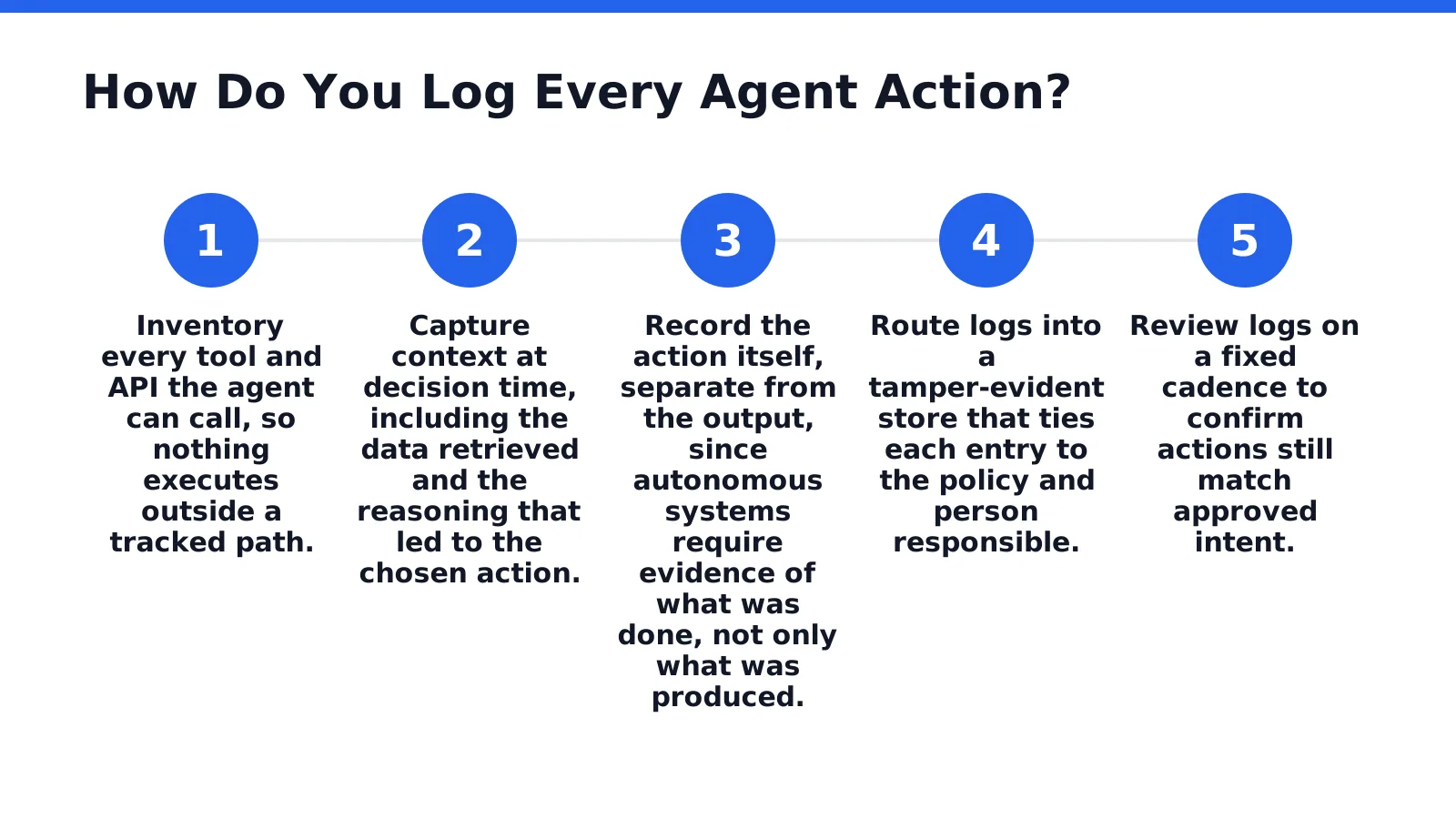
How Do You Log Every Agent Action?
Logging every agent action starts with treating the agent as a delegated decision-maker, not a script. For Real Time organizations running autonomous workflows, we build audit trails that capture the data an agent pulled, the decision it reached, and the action it executed, not just the final output. Before any logging framework goes live, we require a defined policy map: which systems the agent touches, which actions need sign-off, and who reviews the record.
With that prerequisite in place, we follow a repeatable sequence for clients across Real Time:
- Inventory every tool and API the agent can call, so nothing executes outside a tracked path.
- Capture context at decision time, including the data retrieved and the reasoning that led to the chosen action.
- Record the action itself, separate from the output, since autonomous systems require evidence of what was done, not only what was produced.
- Route logs into a tamper-evident store that ties each entry to the policy and person responsible.
- Review logs on a fixed cadence to confirm actions still match approved intent.
Why Won’t Standard System Logs Work for AI Agents?
Standard system logs tell engineering teams that a process failed, not why the agent triggered it. A database timeout or a server error shows a symptom. It never explains the reasoning behind the agent’s decision to act in the first place.
What Does Comprehensive Logging Actually Protect Against?
Comprehensive log data lets Real Time teams track autonomous actions across every connected resource. That coverage meets audit requirements while cutting both security exposure and operational risk. We treat this as the baseline for AI agent observability, not an add-on feature bolted on after deployment.

How Do You Build Real-Time Agent Observability?

Real-time observability starts with a forensic, chronological record of every decision an autonomous agent makes, not a snapshot pulled after the fact. For Real Time deployments, that record is the only way engineering leaders answer “what happened and why” once an agent has already acted on a database, an email, or a cloud resource.
We build this discipline for Real Time clients from our Fort Wayne, IN base, treating audit trails that audit autonomous actions as the evidence layer of governance rather than an afterthought. That evidence layer lets a Real Time team reconstruct any agent decision after the fact, prove the system behaved within policy, and answer a regulator without guessing.
Before deploying any autonomous agent into a Real Time workflow, confirm three prerequisites:
- A policy baseline defining what the agent is authorized to do
- A logging pipeline that captures decisions, data retrieval, and outputs in sequence
- An owner accountable for reviewing flagged actions
With those in place, we walk Real Time engineering teams through the build in order:
- Instrument every agent action point, not just the final output, so the record captures intent and context.
- Centralize logs into one chronological feed built for AI agent observability, so teams query a single source instead of hunting across systems.
- Set alert thresholds for actions that fall outside the authorized policy baseline.
- Review flagged events on a fixed cadence rather than ad hoc.
- Apply our Responsible AI Principles, people-first benefits, fairness, safety, privacy, transparency, and governance, to every logged workflow so leaders can monitor AI agents continuously rather than retroactively.
What should an AI agent audit log capture?
An audit log should capture the decision made, the data retrieved, the action taken, and the people or policies involved. Anything less leaves gaps that regulators and internal reviewers cannot close.
Why does observability matter for Real Time workflows specifically?
Agents now make and act on decisions at a scale no human team reviews live. Without a forensic record, Real Time organizations lose the ability to reconstruct a failure or satisfy an audit request after the fact.
How Do You Limit What Agents Can Do?
Limiting agent action requires explicit permission boundaries built into the deployment, not trust in model behavior. Engineering leaders running Real Time operations set hard limits on data access, financial actions, and system changes before any agent goes live. Auditing stops functioning as a compliance checkbox. Becomes the mechanism that lets an organization govern agents as their decision-making agency grows.
We treat scope-setting as a sequence, not a one-time configuration:
- Define which resources the agent may touch, including specific databases, APIs, and cloud services.
- Assign role-based credentials matched to the agent’s actual task, never broader access for convenience.
- Require logging for every action against those resources, regardless of whether access comes through console, API, CLI, or SDK.
- Build approval gates for high-risk actions, so a human reviews anything outside the pre-approved boundary.
- Review logs on a fixed cadence to catch scope creep before it becomes a liability.
What tools help track agent permissions over time?
Tracking permissions depends on ai agent observability, the practice of watching what an agent decides and does, not just what it outputs. Enterprise-grade audit services record every action against a resource no matter which interface triggered it. That coverage lets a team monitor ai agents across console, API, and automated pipeline access without gaps.
We build these controls during integration. Deployment work, writing the API connections that enforce the limits set with a client. Lee Pomerantz, our founder and a Certified Chief AI Officer, oversees this work. Permission design and the systems that audit autonomous actions stay aligned with governance requirements, not technical convenience alone. For organizations running agents across Real Time operations, we deploy and ship these controls wherever the work happens.
What Mistakes Undermine Agent Audit Trails?

Teams undermine their own audit trails by treating standard logging as sufficient. Standard logs record what an agent did. The reasoning behind that action disappears inside the model’s inference process, and no one can reconstruct it later. We see this mistake constantly when we help organizations serving Real Time monitor AI agents for the first time: the logs exist, but they answer the wrong question.
A second failure mode is confusing system telemetry with true AI agent observability. Infrastructure metrics tell a team a server responded slowly. They do not explain why a model chose to execute a specific command. Audit systems built for Real Time deployments need to capture intent and context, not just outcomes.
Why does missing context matter during an incident?
Context matters because regulators and executives ask one question after a failure: how was this decision reached? Without the reasoning captured alongside the action, the audit trail becomes the only honest answer a team has, and an incomplete one offers nothing.
Common gaps we flag when we audit autonomous actions for clients supporting Real Time operations:
- Logging outputs without logging decision inputs
- Storing timestamps but discarding model reasoning
- Treating application errors as equivalent to agent action records
Fixing these gaps first matters. Once monitoring, audit scope, and action limits are built correctly, governed agent deployments produce measurable return within 90 days.
FAQ
What should organizations do before deploying autonomous AI agents?
Organizations inventory every system the agent touches, define identity boundaries, map governance requirements against use cases, and assign accountability for reviewing agent decisions before any agent goes live.
Conclusion

In closing, real-time monitoring and governance of autonomous AI actions separate responsible acceleration from reckless deployment. The systems that protect your data, preserve your brand voice, and keep humans in control aren’t afterthoughts, they’re the foundation of sustainable AI operations. Build governance into your architecture from day one, audit continuously, and treat human oversight not as friction but as the engine of trust. That’s how AI becomes a competitive advantage instead of a liability.