
For human in the loop ai, effective guardrails for small teams combine clear escalation points, not constant human review of every AI action. We build human-in-the-loop checkpoints only where risk is highest, compliance, customer data, brand voice, using our 10-day AI Opportunity Blueprint™ to map those points before deployment,
Key Takeaways
- Human-in-the-loop AI governance prevents teams from stalling by eliminating unnecessary review bottlenecks at every step.
- Strategic guardrails focus human oversight on high-risk decisions, enabling autonomous AI operations for routine tasks.
- eMediaAI’s Fractional Chief AI Officer services establish governance frameworks that balance safety with operational velocity.
- Proper HITL architecture reduces review cycles, helping small teams achieve measurable ROI within 90 days.
Why Do Small Teams Need AI Guardrails Now?
Small teams need guardrails because the window for deploying AI without oversight is closing fast. Regulatory mandates like the EU AI Act, paired with mounting pressure to prove measurable ROI, are shrinking tolerance for ungoverned AI in production, according to a 2026 guide on human-in-the-loop workflows. That shift hits SMBs harder than enterprises. Fewer compliance staff means less room to absorb a costly misstep.
We built our Responsible AI Principles around this reality. Fairness, safety, privacy, transparency, and governance sit at the center, alongside a commitment to people-first outcomes rather than tech for its own sake. Without that structure, collaboration between human teams and AI agents introduces real risk: bias creeps into decisions, outputs become opaque, and compliance gaps surface when least expected.
What happens if we skip guardrails entirely?
Risk accumulates quietly, then surfaces all at once. Unmonitored systems can produce biased recommendations, obscure how decisions get made, and violate regulations before anyone notices. By the time leadership catches the problem, remediation costs far more than prevention would have.
Do guardrails slow down AI adoption?
Done right, they do the opposite. Our mission centers on implementing AI that saves time and reduces stress, not AI that adds risk and friction. Guardrails give teams the confidence to move fast because:
- Decisions stay explainable to regulators, customers, and employees
- Staff adoption rises when people trust the system behind the automation
- Governance becomes a growth lever instead of a brake
Human in the loop AI isn’t bureaucracy. It’s the mechanism that lets small teams move at speed without gambling the business.

What Does Human-in-the-Loop AI Actually Mean?
Human in the loop AI marks the exact point where autonomous action stops and a person takes over the decision. Human-in-the-loop (HITL) workflows define where AI acts alone and where judgment steps in, embedding that boundary directly inside the automation flow rather than bolting it on as an afterthought. Get this boundary wrong, and we’ve seen what happens: AI output ships without review, and the business owns the consequences.
A real HITL workflow isn’t a dashboard someone glances at once a week. It requires a person to actively approve, edit, or reject an AI output before that output produces downstream consequences. No approval step, no HITL. That’s the line we hold with every client.
Who Decides Where the Human Checkpoints Go?
We don’t leave that call to chance. Lee Pomerantz, our founder and a Certified Chief AI Officer, oversees how human checkpoints get designed into every deployment. He maps the friction points first, then decides which decisions stay fully automated and which ones need a human signature.
Does Staff Actually Know How to Use These Checkpoints?
Checkpoints fail when staff don’t understand their role inside them. That’s why we run AI literacy programs and workshops, so teams know when to approve, when to push back, and when to escalate.
HITL design, in practice, comes down to three questions we ask on every engagement:
- Where does the AI’s action become irreversible?
- Who has the authority, and the context, to intervene before that point?
- What happens to the output if nobody steps in?
Answer those honestly, and the rest of the governance structure follows.

Which Tasks Actually Need Agent Guardrails?
Reversibility decides the guardrail, not risk tolerance or company size. A small team gains nothing by stationing a human reviewer at every step. That habit stalls the shift toward autonomous operation, according to Human in the loop: Do you need it at every step? We agree, and we see the same pattern across the SMBs and mid-market operations we work with.
Where do most companies get guardrails wrong?
Most companies gate the wrong moment. They approve code merges and pull requests, because that review existed long before AI agent guardrails became a boardroom topic. That habit breaks the instant an agent takes action in production, deploying a service, touching a customer record, moving money, in ways no pull request ever covered.
The better test asks one question: can this action be undone? Human in the loop AI oversight belongs wherever the answer is no.
- Reversible, low-stakes actions: drafting content, tagging data, generating internal reports. These can run unattended.
- Reversible, customer-facing actions: sending a routine email, updating a status field. Light monitoring suffices.
- Irreversible actions: deleting records, issuing refunds, pushing code to production, committing spend. These require sign-off before they move forward.
That last category defines safe agentic deployment. Nothing irreversible proceeds without a human decision point built into the workflow itself.
We map this line through our AI readiness, audit, and strategy services, pinpointing exactly which tasks warrant a checkpoint and which can run free. Then our integration and deployment work builds those checkpoints directly into the production system, not as an afterthought bolted on once something breaks.
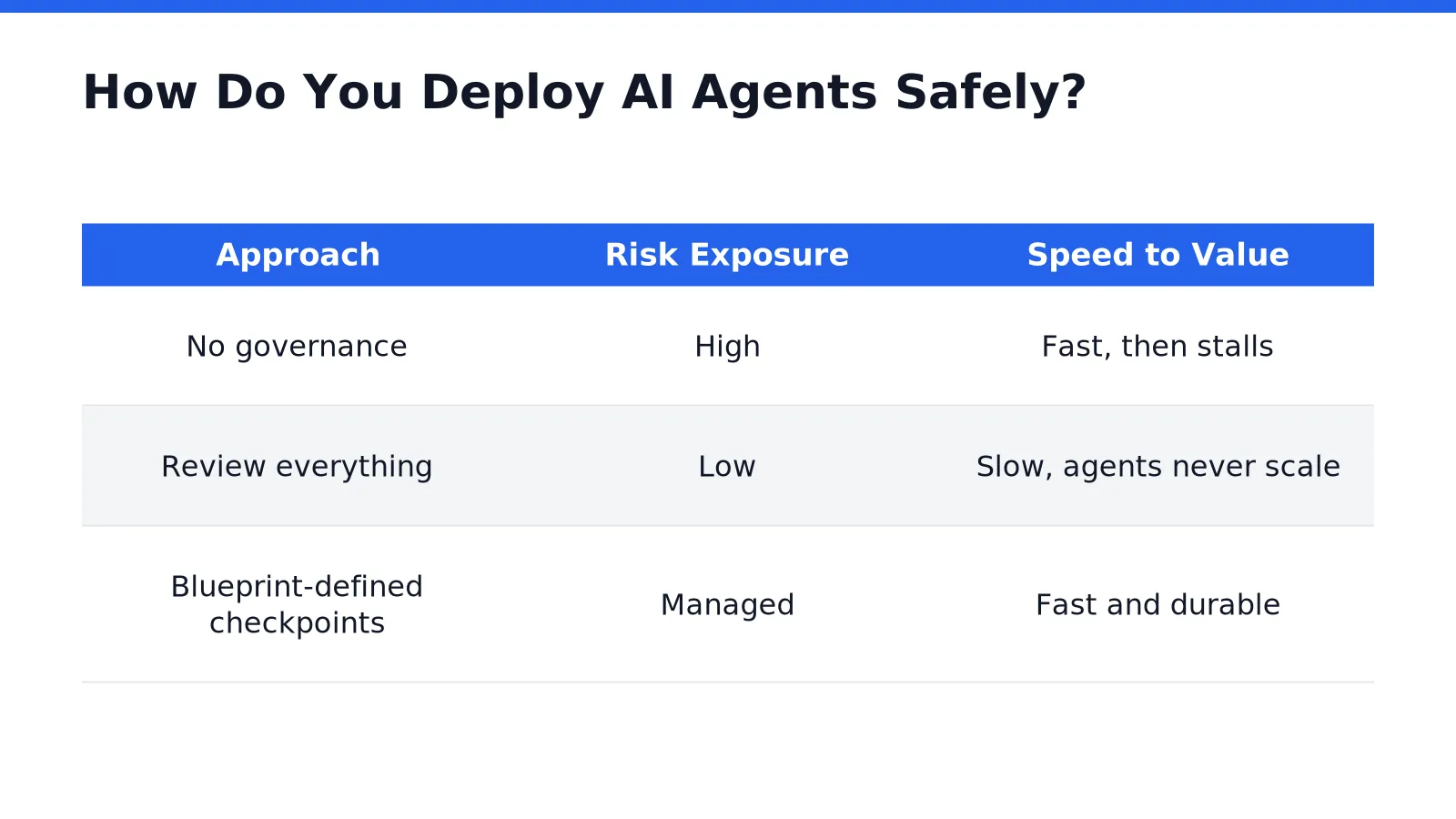
How Do You Deploy AI Agents Safely?
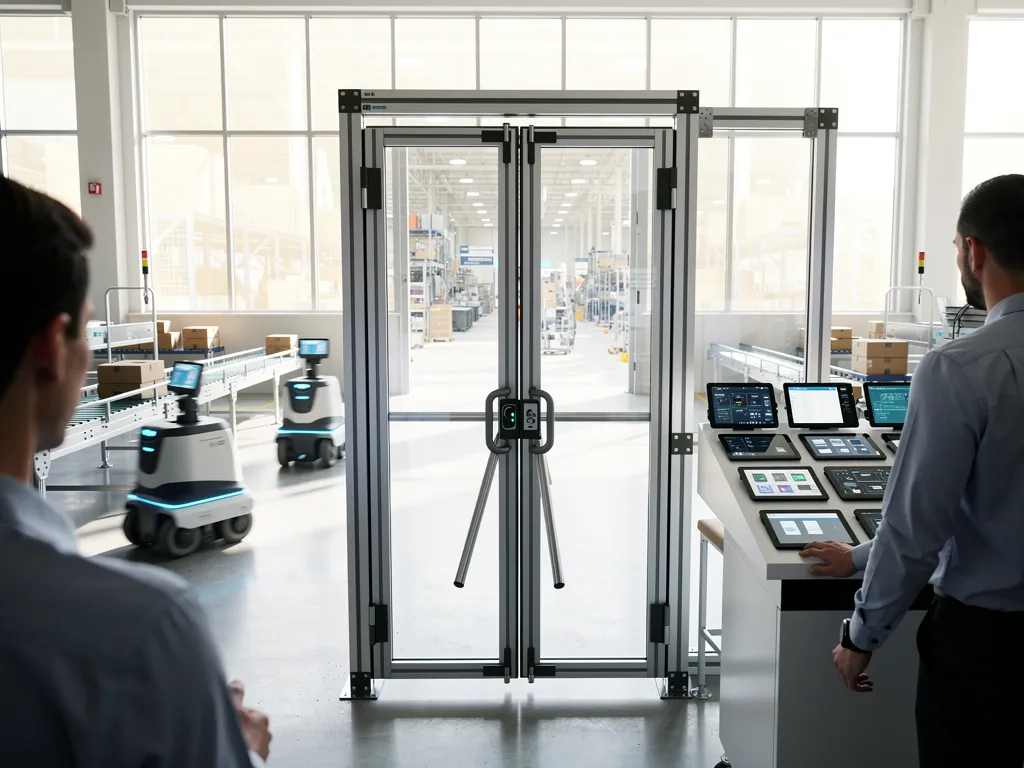
Safe agentic deployment starts with governance that exists before an agent touches production, not after. Agents move into live environments faster than most governance teams can define who reviews what, when a human steps in, and how risk gets managed across customer-facing work. We treat that gap as the first problem to solve, not a detail to clean up later.
Human in the loop AI gives that governance a structure. It is the architecture that determines whether agents produce measurable outcomes or quietly stall as permanent pilots nobody trusts enough to scale. Without defined review points, agents either get overcorrected into uselessness or left alone until something breaks.
What are AI agent guardrails, exactly?
AI agent guardrails are the explicit decision points that separate what an agent can act on alone from what requires a human sign-off first. They cover escalation triggers, approval checkpoints, and the specific conditions under which an agent pauses and waits. Without them, “autonomous” quickly becomes “unsupervised.”
Where should oversight actually sit?
Oversight belongs wherever risk, cost, or customer trust is highest, not everywhere by default. Our AI Opportunity Blueprint™ maps that out directly: a 10-day structured roadmap, priced at pricing varies that identifies high-impact use cases and builds the review points before any agent goes live.
We don’t sell oversight for its own sake. We build it so clients see return in under 90 days, with agents doing real work inside limits leadership actually set.
What Should Executives Do Next?
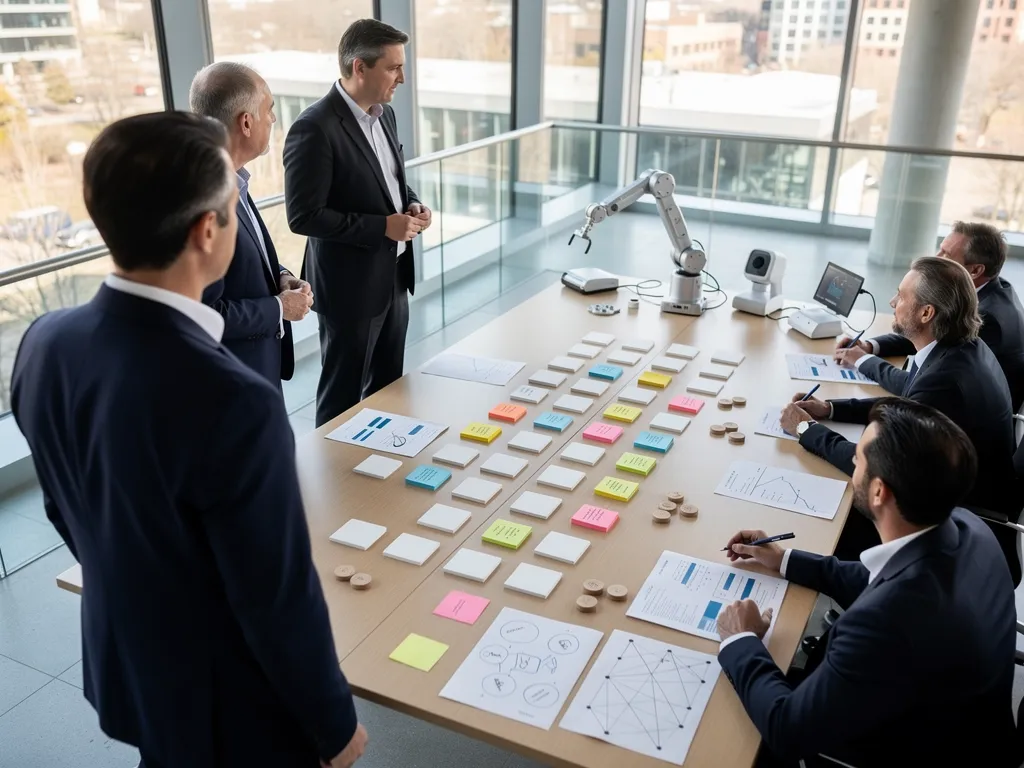
Executives move first on governance, not on tools. A structured, people-first discovery process accelerates measurable ROI while cutting the change friction that comes with new human in the loop AI controls. Skip that step and organizations pay for it twice: once in stalled pilots, once in rework.
Where do we start the governance conversation?
Start with discovery, not deployment. We’ve built our process around a people-first discovery sequence specifically because it surfaces where human review belongs before a single agent goes live. That sequence also exposes where AI agent guardrails need to sit inside existing workflows, rather than bolted on after launch.
Who owns governance once the system is running?
Ownership can’t end at go-live. We offer Fractional Chief AI Officer services built for exactly this gap, providing governance leadership after initial deployment is already running. Lee Pomerantz, our founder, is a Certified Chief AI Officer and leads this governance work directly for client organizations, rather than handing it off to a generalist account team.
Three moves separate executives who get safe agentic deployment right from those who stall:
- Commission a structured discovery before selecting any vendor or platform.
- Assign named governance ownership, not a committee, before agents touch production data.
- Keep that ownership in place continuously, not as a one-time audit.
We’re headquartered in Fort Wayne, Indiana, and work with clients nationally across the United States. Geography doesn’t limit who gets this discipline. The budget line executives should protect isn’t the software spend. It’s the governance leadership that keeps that software accountable.
FAQ
Why do small teams need AI guardrails now?
The window for deploying AI without oversight is closing as regulatory mandates and pressure to prove ROI increase. Fewer compliance staff leave small teams less room to absorb a costly misstep.
Do guardrails slow down AI adoption?
Guardrails do the opposite by making decisions explainable, raising staff adoption through trust, and turning governance into a growth lever. The mission centers on AI that saves time and reduces stress, not AI that adds friction.
What does human-in-the-loop AI actually mean?
It marks the exact point where autonomous AI action stops. A person takes over the decision, embedded directly inside the workflow. A real HITL process requires a person to approve, edit, or reject an output before it produces downstream consequences.
Conclusion

In closing, human-in-the-loop guardrails transform AI from a source of operational risk into a tool that amplifies human judgment rather than replacing it. Small teams gain the most from this approach: fewer people means each decision carries weight, and governance built into workflow, not bolted on afterward, protects both brand integrity and employee confidence. The goal is not to slow adoption. To accelerate it responsibly, giving your team the clarity and control required to move fast without breaking trust.