
Pre-built SaaS agents suit narrow, fast-deploy use cases. CrewAI and n8n fit organizations needing orchestrated, multi-agent reasoning or custom API integrations. We assess this tradeoff during our 10-day AI Opportunity Blueprint, matching architecture to actual friction points instead of defaulting to whichever framework generated the most hype that quarter.
Key Takeaways

- Custom agentic workflows require Python expertise; pre-built SaaS agents eliminate coding complexity entirely.
- eMediaAI’s AI Opportunity Blueprint™ costs $5,000 and delivers measurable ROI within 90 days.
- Code-driven frameworks demand ongoing maintenance; workflow automation tools reduce technical overhead significantly.
- eMediaAI’s Fractional Chief AI Officer services guide enterprise AI strategy without full-time hiring costs.
Why Does Choosing the Wrong Agent Model Cost You?
Wrong agent decisions cost mid-market organizations months of rework, not just budget. We’ve watched leadership teams pick a framework before they picked a strategy, and the technology choice rarely causes the failure. Most AI initiatives fail for lack of strategy, governance, and people readiness long before the first line of code gets written.
Gartner names Agentic AI a top trend for 2025 and projects AI agents taking on daily work decisions. That shift is coming whether or not a given organization has a governance model ready for it. Executives who treat the SaaS agents vs custom decision as a procurement question, rather than a strategic one, inherit risk they didn’t budget for.
Should we start with a prebuilt agent platform or build custom?
Start with the problem, not the tool. A fast-moving team running n8n agentic workflows can validate a use case in days. A CrewAI SMB deployment demands more engineering investment upfront for deeper customization.
What does a wrong choice actually cost us?
Rework, stalled adoption, and staff distrust in the system. Our model exists specifically to cut through this: we replace months of open-ended discovery with a fast, fixed-scope entry point paired with ongoing governance. The agent-model decision gets made with evidence instead of guesswork.
What Can Pre-Built SaaS Agents Deliver Today?
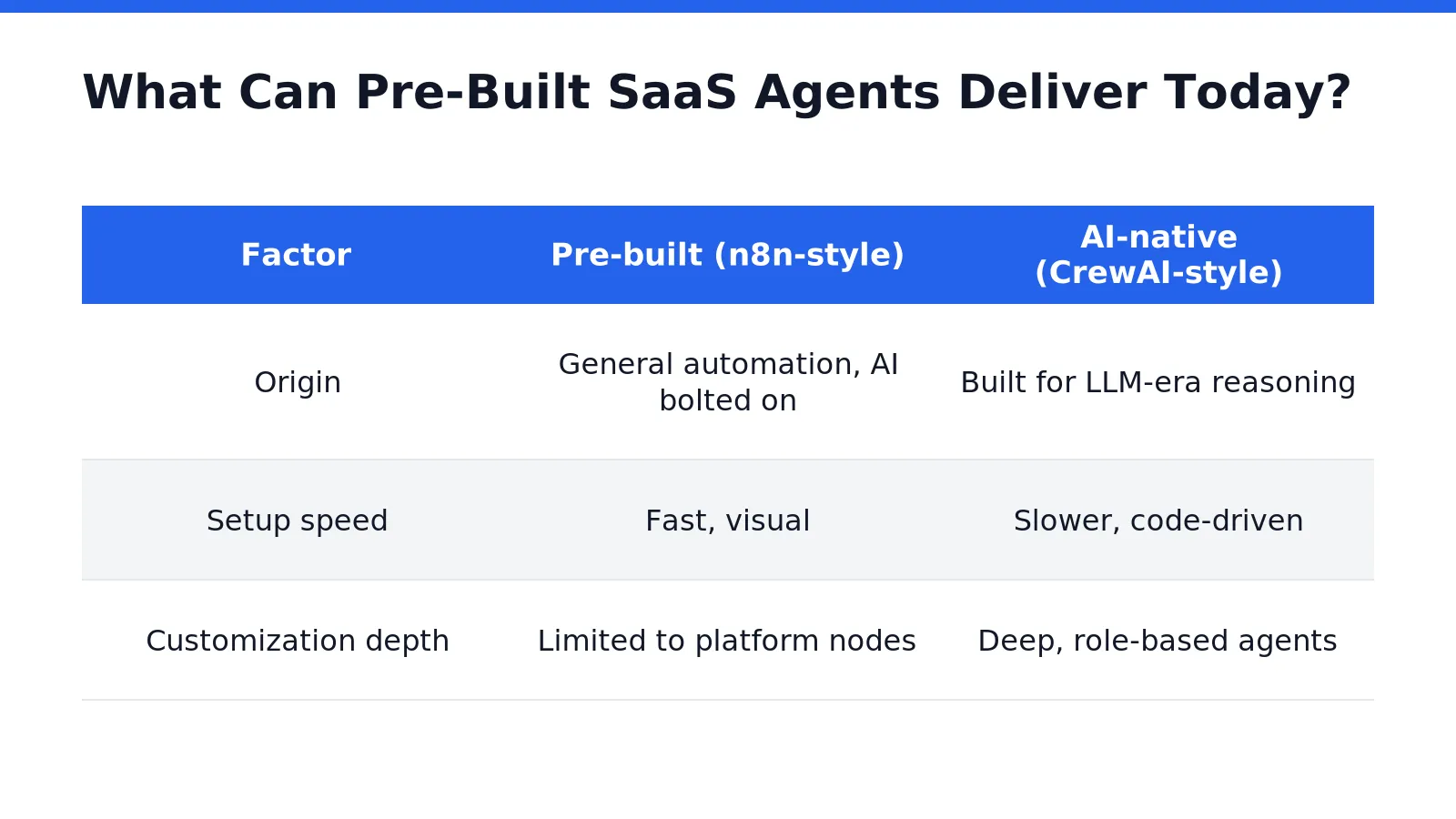
Pre-built agent platforms deliver fast setup, visual configuration, and immediate integration with existing software stacks. Teams drag, drop, and connect rather than write code. That speed carries a real tradeoff we see constantly in client engagements. Leaders deciding between SaaS agents vs custom builds need to understand it before signing a contract.
The category splits into two distinct lineages. N8N agentic workflows represent the pre-built, visual-first approach: a general automation tool that added AI features onto an existing platform rather than being designed around large language models from the start. Code-driven frameworks like CrewAI SMB deployments take the opposite path. CrewAI was built from the ground up as an AI-native framework for the large-language-model era, which changes what it can and cannot do out of the box.
The difference shows up in daily operations:
Is a pre-built agent enough for most SMB workflows?
Pre-built agents handle well-defined, repetitive tasks competently. They struggle when a workflow needs agents that reason, delegate, and adapt mid-process. More than half of tech executives already expect agents to become core to daily operations within roughly two years, which means the “good enough” platform chosen today may not hold up as expectations rise.
We run readiness audits specifically to answer this question before a dollar gets spent on software. Our work identifies whether a given workflow fits a pre-built tool’s constraints or demands the deeper control a custom framework provides. That audit, not the vendor’s demo, should drive the decision.

When Does a Custom Agentic Workflow Pay Off?
Custom pays off when a workflow needs orchestrated roles, not a single automated task. A Python-based framework purpose-built for multi-agent systems, the kind of architecture associated with CrewAI SMB deployments, organizes agents around specific roles rather than a single prompt-and-response loop. Each agent gets a defined goal inside a larger team structure, which matters when a process has distinct stages that require distinct expertise.
That distinction shapes the real question facing operations leaders: SaaS agents vs custom build. A pre-built agent handles a narrow task well. A custom crew of agents handles handoffs, research, drafting, and review as separate roles working in sequence. We see this choice most often in content operations, lead qualification, and multi-step research work where no single off-the-shelf tool covers the whole chain.
Is building a custom agent crew worth the engineering cost?
Only if the in-house cost gets counted honestly. Standing up a role-based agent system is not plug-and-play. It requires the same technical execution we deliver for clients: funnels, API integrations, and custom scripts tying everything together. Organizations that underestimate that build cost end up with half-finished pilots instead of working systems.
Does n8n agentic workflow design replace custom code?
Not for every case. n8n agentic workflows suit linear, trigger-based automation where visual nodes handle the logic end to end. They fall short once a process demands agents that reason across roles, hand off context, and adjust based on each other’s output.
We never deploy a custom build without our people-first principles: fairness, safety, privacy, transparency, governance, and employee empowerment. A technically correct agent crew that staff do not trust is not a deployment worth shipping.

CrewAI or n8n: Which Fits Your Team?

The right answer depends on what sits inside the building: integration needs or engineering capacity. n8n agentic workflows run on a visual platform built for teams that need to connect existing apps. Already have AI agent nodes wired in. CrewAI SMB deployments, by contrast, rely on a Python framework purpose-built for orchestrating crews of role-based agents, which demands a team that can write and maintain code.
We’ve watched mid-market leaders default to whichever tool their last vendor pitched, then wonder why adoption stalled. That’s backwards. The decision starts with headcount and skill, not feature lists.
Is n8n easier to deploy than CrewAI for a small team?
Generally, yes. A visual workflow platform lowers the barrier for operations teams without dedicated engineers. The agent logic lives in nodes rather than code. CrewAI asks more of a team upfront. It rewards that investment with finer control over how agents reason and hand off work.
Does CrewAI or n8n scale better for complex agent systems?
CrewAI’s code-first structure tends to scale more cleanly for multi-step, role-based agent orchestration. Engineers can version and test logic directly. n8n scales well for connecting more apps and triggers, but complex reasoning chains stretch its visual model.
The broader point: this isn’t a two-horse race with a permanent winner. The category has fragmented sharply over roughly the past year. SaaS agents vs custom builds will keep splitting into narrower use cases.
Whichever stack a company lands on, we insist on governance aligned to frameworks like NIST and the EU AI Act underneath it. Tooling changes. Oversight shouldn’t.
How Should You Move From Pilot to Scale?

We move clients from pilot to scale with a fixed roadmap, not another round of open-ended discovery. Our AI Opportunity Blueprint™ compresses that decision into a 10-day structured sprint, mapping which approach (packaged versus purpose-built) fits a specific workflow before a single line of code gets written.
Most mid-market teams never reach scale because they never resolve the core question: SaaS agents vs custom build. We settle that question inside the sprint, weighing a prebuilt platform against a tailored multi-agent system like CrewAI for SMB operations, or a visual, node-based approach using n8n agentic workflows. The output is a deployment-ready roadmap, not a slide deck.
How much does a roadmap engagement cost?
We offer the Blueprint as a flat $5,000 engagement. There’s no hourly meter running and no scope creep. Leaders get a fixed price and a fixed delivery date.
Who oversees the technical build?
Our founder, Lee Pomerantz, holds the Certified Chief AI Officer credential and oversees every engagement personally. That pairing of strategic judgment with hands-on technical build work matters once a pilot moves toward production traffic.
Our scale-up sequence follows three steps:
- Map the use case and pick the right agent architecture during the 10-day sprint.
- Build the integration under Pomerantz’s direct oversight.
- Track toward measurable ROI inside 90 days of deployment.
FAQ
How do we decide between a pre-built agent and a custom build?
Start with the problem, not the tool. n8n validates a use case in days, while CrewAI demands more upfront engineering for deeper customization.
What happens if we choose the wrong agent model?
Mid-market organizations lose months to rework, stalled adoption, and staff distrust. eMediaAI’s AI Opportunity Blueprint™ replaces that open-ended discovery with a fixed-scope assessment and ongoing governance.
What’s the real tradeoff between n8n and CrewAI?
n8n adds AI features onto an existing automation platform for fast, visual setup. CrewAI is built natively for LLM-era reasoning with deeper, role-based agent customization.
Conclusion

In closing, the choice between pre-built SaaS agents and custom agentic workflows hinges on your organization’s tolerance for constraint versus control. Pre-built solutions accelerate time-to-value but lock you into vendor assumptions. Custom workflows demand upfront investment but align precisely with your operational reality and governance requirements. The winning strategy pairs both, leveraging managed platforms for rapid wins while building proprietary automation that compounds competitive advantage over time. Governance and people readiness determine success far more than the tool itself.