
eMediaAI’s 10-day AI Friction & Opportunity Audit identifies workflow bottlenecks and automation gaps across daily operations, then maps findings into a prioritized roadmap. Fort Wayne-based eMediaAI, led by Certified Chief AI Officer Lee Pomerantz, delivers results through the $5,000 AI Opportunity Blueprint™, targeting measurable ROI within 90 days.
Audit sprints run over 10 focused days: map workflows, interview teams, and flag friction points where AI delivers measurable ROI. eMediaAI’s Certified Chief AI Officer leads this process from start to finish, so there’s always one accountable owner on our side.
Running a 10-day AI Friction & Opportunity Audit means executing eMediaAI’s AI Opportunity Blueprint™: a structured, fixed-scope sprint that audits operational friction, maps high-ROI use cases, and delivers a deployment-ready roadmap. We prioritize human-centered outcomes over hype, giving leadership a prioritized, executable plan without months of open-ended discovery or ambiguous vendor promises.
Key Takeaways

- Most AI projects fail because teams lack strategic maps; evidence-first diagnostics prevent costly missteps.
- While many generative AI pilots fail, eMediaAI’s Blueprint is designed to achieve measurable ROI within 90 days.
- Our AI Opportunity Blueprint™ identifies exact starting points for ROI within 90 days.
- Fractional Chief AI Officer services guide your team through friction audits and implementation strategy.
What Is a 10-Day AI Friction & Opportunity Audit?
A 10-day AI friction and opportunity audit is a fixed-timeline diagnostic that maps where work actually breaks down before any technology gets purchased. We built our version, the AI Opportunity Blueprint™, around a simple premise: most AI initiatives stall because teams start without a clear map of where friction actually lives in the business. Skip the map, and the project drifts.
The evidence backs this up. MIT’s analysis of over 300 enterprise deployments found that 95% of generative AI pilots deliver zero measurable P&L impact. That failure rate is not a technology problem. It is a sequencing problem. We run an ai opportunity audit first because most SMB leaders already know they need AI. What they lack is a clear, executable plan to capture measurable value quickly.
Our 10-day process compresses discovery into a structured, near-term action plan. We spend that time on friction point analysis: interviewing stakeholders, reviewing workflows, and ranking where delays, rework, and manual handoffs cost the most time.
How is this different from a standard AI consultation?
Standard consultations often run 3 to 6 months and end in a strategy deck. Our audit is a rapid AI assessment with a firm 10-day boundary and a deployment-ready output, not a slide show.
What does an SMB receive at the end of 10 days?
We deliver a prioritized shortlist of AI-ready use cases, scoped for near-term impact rather than theoretical transformation.

What Prerequisites Do You Need Before Starting?
Three things come before any tooling decision: an honest baseline, a named owner, and a scoping conversation. Skip any one of these and the audit collects data nobody acts on. We require all three before we open a single Jira board or workflow diagram.
An honest baseline means admitting where the organization actually stands today, not where leadership hopes it stands. Digital Colliers’ guide on running an AI audit puts the sequencing plainly: before buying tools, hiring an AI lead, or signing up for enterprise platforms, a company needs to understand its current state. We’ve sat across from executives who say, almost verbatim, that they know they should be doing more with AI but have no idea where to start. That admission is the prerequisite, not a disqualifier.
Who should sponsor the audit internally?
We ask for one accountable executive sponsor before day one, someone who can greenlight access to systems and staff. On our side, Lee Pomerantz, a Certified Chief AI Officer, oversees every engagement, giving that sponsor a credentialed counterpart rather than a vendor rep.
What services cover this prerequisite work?
We built dedicated AI readiness, audit, and strategy services specifically for this stage. They function as the structured entry point for an ai opportunity audit, friction point analysis, and rapid ai assessment. Leadership gets a map before anyone reaches for a shovel.
What Steps Make Up the 10-Day Sprint?

Ten working days separate a vague AI ambition from a ranked, deployment-ready roadmap. We built the AI Opportunity Blueprint™ as a productized discovery and roadmap process, not an open-ended consulting retainer. Every day has a deliverable attached to it. That structure is what lets us move from first conversation to prioritized use cases without the months of scoping calls typical of traditional engagements.
What happens in the first few days?
We spend the opening days running an AI opportunity audit against actual operational data, not assumptions. This stage borrows from rigorous friction point analysis: we look for where work gets stuck, repeated, or rerouted across teams, then flag each pattern as a candidate for automation or redesign. The goal is a defensible map of friction, not a slide deck of buzzwords.
How does the Blueprint turn friction into a plan?
Once friction points are mapped, we move into a rapid AI assessment of each candidate opportunity, scoring it for feasibility, cost, and realistic payback. Executives get a shortlist ranked by conservative ROI estimates and implementation risk, not a wish list of everything AI could theoretically touch. The remaining days build out the roadmap itself:
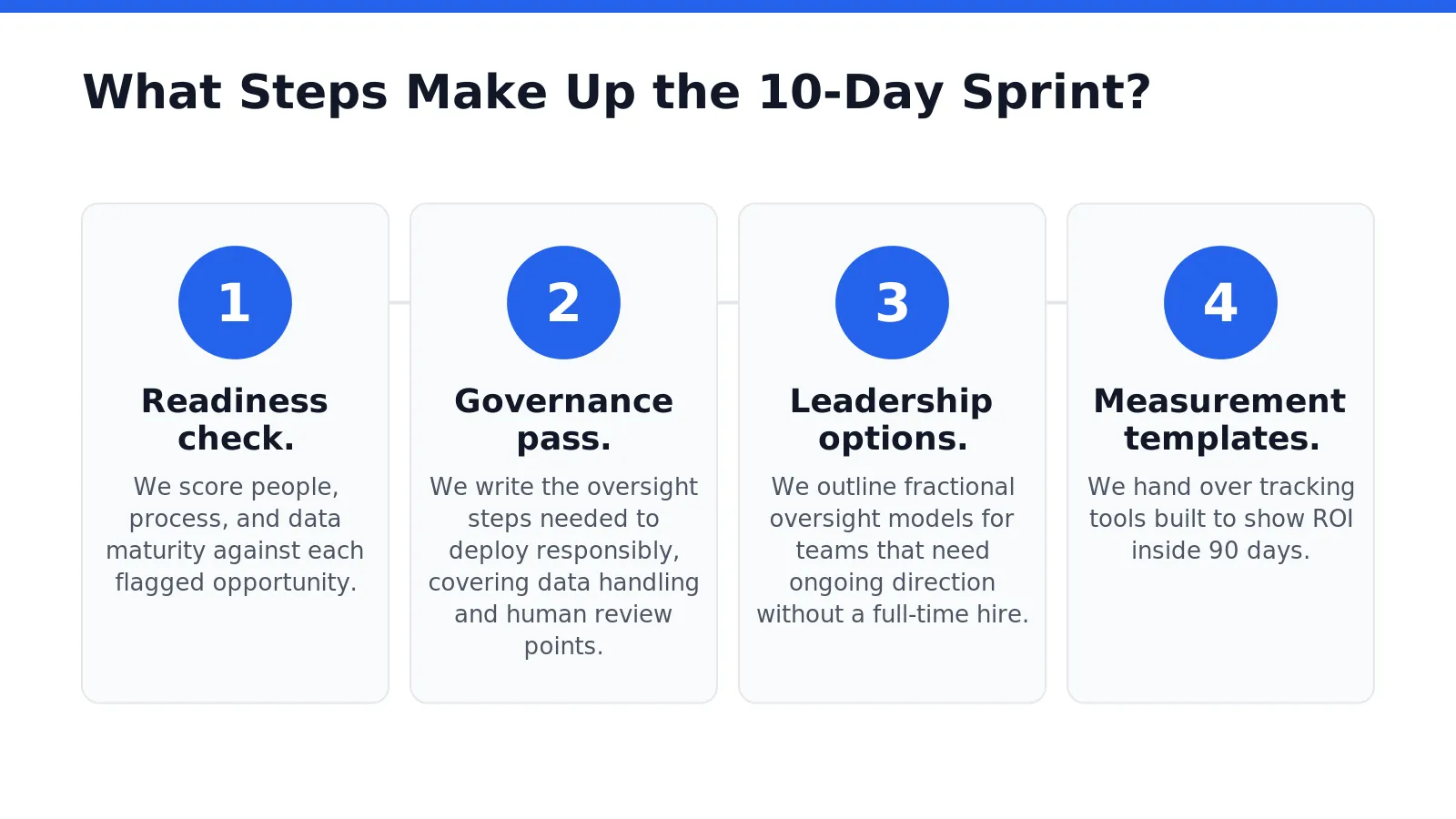
- Readiness check. We score people, process, and data maturity against each flagged opportunity.
- Governance pass. We write the oversight steps needed to deploy responsibly, covering data handling and human review points.
- Leadership options. We outline fractional oversight models for teams that need ongoing direction without a full-time hire.
- Measurement templates. We hand over tracking tools built to show ROI inside 90 days.
A structured, people-first discovery process like this reduces the change friction that normally slows adoption. Stakeholders co-design the priorities instead of inheriting them. Once opportunities are ranked, our integration and deployment work carries the roadmap into working systems rather than leaving it on a shelf.
How Do You Score and Prioritize Findings?

Scoring runs on structure, not gut feel. We apply use-case mapping, EAV tables, and KPI formulas to turn raw friction point analysis into a ranked, implementable AI roadmap, converting executive aspiration into sequenced projects with assigned owners and metrics.
Each finding gets weighed against two dimensions: business impact and implementation risk. We design this scoring inside the broader ai opportunity audit to put clients on a path toward ROI in under 90 days, so speed to value carries real weight in the ranking. A finding that looks impressive on paper but takes a year to deploy loses to a smaller win that ships in weeks.
Prioritization also runs through a governance filter. We weigh people-first benefits, fairness, safety, privacy, transparency, and governance alongside efficiency, rather than ranking purely on cost savings or speed. A use case that cuts headcount hours but erodes customer trust scores lower than one that frees staff time while protecting data integrity.
Why does sequencing matter more than tool selection?
Most companies already run AI somewhere in the business. Only 7% have scaled it across the organization, according to McKinsey’s research cited in Digital Colliers’ AI audit framework. That gap exists because leaders pick tools before they rank problems. Sequencing, not software, determines whether a pilot becomes a scaled asset.
What makes this a rapid AI assessment instead of a slow consulting cycle?
A rapid ai assessment scores findings against fixed criteria instead of open-ended discovery calls. We rank by:
- Revenue or cost impact
- Deployment speed
- Governance and privacy risk
- Staff adoption burden
Running this scoring before spending a dollar on implementation remains the highest-ROI move a company makes, and most skip it entirely.
What Mistakes Derail an AI Audit?

Three mistakes derail most AI audits: skipping structured diagnosis, trusting vendor pitches over data, and walking away without ongoing oversight. RAND Corporation puts the broader AI project failure rate at 80.3%, double the rate of non-AI IT projects. We treat that number as the cost of guessing instead of measuring.
Why do companies trust vendor promises over their own data?
Vendors show up promising transformation, but none of them show how their tool fits a specific operation. That’s the trap: a demo looks impressive. It skips the friction point analysis that would tell leaders where the actual bottleneck sits. We run the ai opportunity audit first precisely because vendor claims rarely survive contact with real workflow data.
The second failure mode shows up after delivery, not before. A roadmap without a named owner rarely gets implemented. We pair every rapid ai assessment with Fractional Chief AI Officer oversight, because findings without accountability rarely survive budget season.
Common derailers we see repeatedly:
- Chasing vendor demos instead of auditing internal workflow data first
- Treating the audit as a one-time event with no owner for follow-through
- Measuring adoption by pilot launches instead of staff usage months later
- Skipping the human-cost question: does this save time, or just add a dashboard
Our mission stays fixed on outcomes that reduce stress and get adopted, not pilots that sit unused.
FAQ
What is a 10-Day AI Friction & Opportunity Audit?
A fixed-timeline diagnostic called the AI Opportunity Blueprint™ that maps where work breaks down before any technology purchase, using interviews and workflow reviews to rank friction points by cost and impact.
How does this audit differ from a standard AI consultation?
Standard consultations often run 3 to 6 months and end in a strategy deck. This audit holds a firm 10-day boundary and produces a deployment-ready roadmap instead of a slide show.
What do I receive at the end of the 10 days?
A prioritized shortlist of AI-ready use cases scoped for near-term impact, led by eMediaAI’s Certified Chief AI Officer, Lee Pomerantz, rather than a theoretical transformation plan.
Conclusion

In closing, a ten-day friction audit transforms AI from abstract possibility into operational reality. You walk away with a deployment-ready roadmap, governance guardrails, and clarity on where your organization gains time and revenue. The work ahead requires discipline, but the foundation is solid. That’s the difference between strategy and execution.