
Agentic AI removes repetitive, manual work by interpreting natural-language requests and completing multi-step workflows autonomously across systems, unlike brittle rule-based automation. For 10-100 person teams, we deploy human-in-the-loop controls. Employees shift from constant task-switching to judgment work, cutting the interruptions driving burnout and reclaiming hours
Key Takeaways
- Agentic AI eliminates repetitive manual tasks, freeing teams to focus on high-value strategic work.
- AI agents handle 24/7 customer service workflows autonomously, reducing employee burnout across departments.
- Organizations implementing agentic AI demonstrate measurable ROI within 90 days of deployment.
- Teams of 10 to 100 people experience significant productivity gains through autonomous workflow completion.
Why Is Burnout Rising In Small Teams?
Small teams absorb more interruption per employee than large ones, and that math drives burnout. Fewer hands mean each repetitive task, escalation, or manual handoff lands on the same people, repeatedly. We see this pattern across every function we audit: service, operations, and engineering alike.
Frontline and customer-facing staff feel it first. Customer experience expectations keep falling, and frontline teams face rising strain as they scramble for better tools and faster answers. That pressure compounds when leadership expects more output with the same headcount, especially as technology shifts faster than teams can retrain.
What tasks cause the most burnout?
Manual, repetitive work causes the sharpest drain. Constant interruptions from routine tasks, approvals, and follow-ups pull attention away from meaningful work across every department, not just one.
Is burnout worse in technical roles?
Yes. Engineers and operations staff often spend long hours on incident firefighting, manual escalations, and system monitoring. That leaves little room for the higher-value work that actually grows the business.
Three pressures combine in lean organizations:
- Volume without relief: repetitive tasks never stop, and no one is reassigned to absorb them.
- Rising expectations: leaders push for more output during periods of rapid technological change.
- No buffer staff: small headcounts mean burnout spreads fast once one person falls behind.
We treat this as an operational design problem first. Reducing employee burnout with AI starts with naming where the interruptions live, not with buying software.
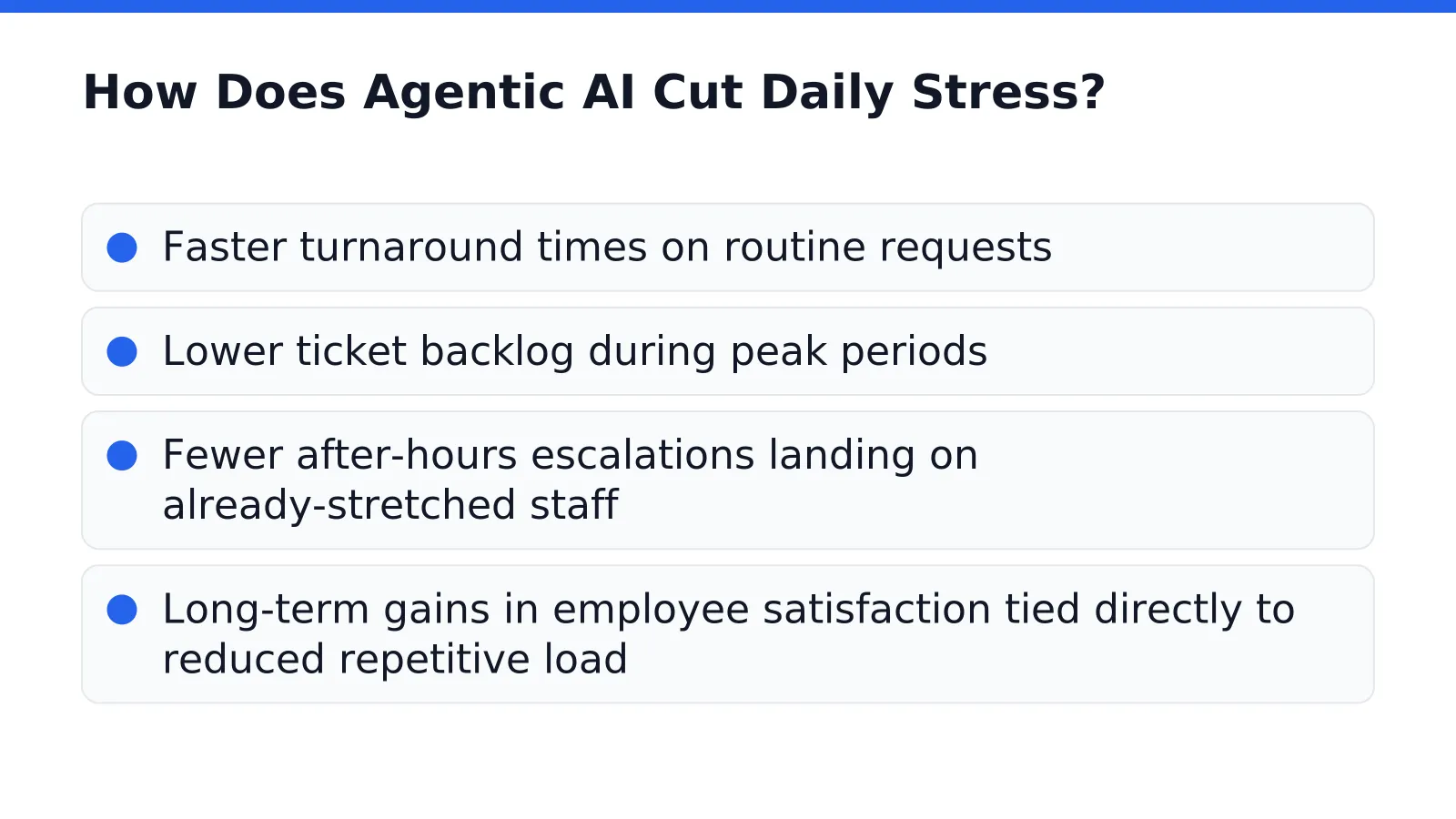
How Does Agentic AI Cut Daily Stress?
Agentic AI cuts daily stress by taking over multi-step workflows that once consumed hours of staff attention. These systems reason, learn, and act on their own, completing tasks without constant human direction. For a VP of Operations watching a team drown in ticket queues, that distinction matters more than any demo.
Standard software automation follows fixed rules. Agentic AI makes judgment calls across a workflow, which means it can automate repetitive tasks that used to require someone checking a box, forwarding an email, and updating three systems by hand. We built our practice around this gap because we watched too many SMB teams buy automation tools that still needed a human babysitter.
Why Does 24/7 Availability Matter for Burnout?
Agents never clock out, never get frustrated, and never need a break after a difficult interaction. That constant availability frees employees to spend their energy on the interactions that actually require judgment, empathy, or negotiation. Instead of triaging every incoming request themselves, staff get to focus on the cases where their skill makes a real difference.
The result shows up in measurable terms, not just morale surveys:
- Faster turnaround times on routine requests
- Lower ticket backlog during peak periods
- Fewer after-hours escalations landing on already-stretched staff
- Long-term gains in employee satisfaction tied directly to reduced repetitive load
What Does eMediaAI Prioritize When Deploying These Systems?
Our mission is not automation for its own sake. We deploy AI to save time, reduce stress, and achieve real adoption among the people who have to live with it every day. A system nobody trusts or uses is not a win, no matter how clever the engineering.
That is why reduce employee burnout ai strategy sits at the center of every deployment we scope, not as an afterthought bolted on after the technical build. Workforce ai adoption only succeeds when the people doing the work believe the system makes their day easier, not harder.

Which Tasks Should Small Teams Automate First?
Small teams should automate multi-step, repetitive workflows first, not simple one-step tasks already handled by basic tools. Rule-based automation breaks down the moment a process branches, requires judgment, or involves an ambiguous request; it cannot adapt mid-workflow. That brittleness is exactly why so many automation pilots stall inside enterprises that tried to scale beyond simple triggers.
We look for processes where a request comes in plain language and requires several coordinated actions across systems. Agentic AI reasons through that kind of request, decides the right sequence of steps, and completes the workflow without a human re-entering data at every stage. For small teams, that difference separates a quick fix from a tool that automates repetitive tasks at the root.
What Processes Carry the Highest Burnout Risk?
Burnout concentrates in roles where employees repeat the same manual steps dozens of times a day with no room for judgment. We run an AI readiness audit before any deployment specifically to find those processes. The audit maps where friction and fatigue sit inside daily operations, not just where automation looks easy.
Candidates worth prioritizing typically include:
- Ticket triage and routing across support or operations queues
- Multi-step data entry spanning CRM, billing, and reporting systems
- Status updates and follow-ups that require pulling information from several tools
- Scheduling and approval chains with recurring back-and-forth
Does Automation Stop at the Pilot Stage?
A pilot that never connects to real systems delivers no lasting relief. We treat integration and deployment as the real work, wiring agentic workflows directly into the platforms teams already use. That connection is what turns workforce AI adoption into daily operational freedom instead of a demo that gets shelved.

Who Should Own Workforce AI Adoption?
Ownership of workforce ai adoption belongs with a named executive sponsor, not a committee. Most SMB and mid-market leadership teams split this work between someone who owns strategy and someone who owns daily execution, and both roles need a clear mandate.
A Chief AI Officer leads the organization’s AI strategy, oversees initiatives across departments, and makes sure deployments stay ethical and effective. Most small and mid-market companies cannot justify that as a full-time seat. We solve this through a Fractional Chief AI Officer model: ongoing strategic leadership, delivered at a fraction of a full-time executive’s cost. Operations and HR leaders get real oversight without a bloated org chart.
Does a small company need a full-time AI executive?
No. A fractional engagement gives small teams the same strategic direction a full-time Chief AI Officer would provide, scaled to budget and headcount. Industry momentum backs this urgency: over half of tech executives already expect AI agents to become core to operations within two years, which means waiting on governance costs more than acting on it.
Ownership also extends past the executive suite. We pair strategic leadership with AI literacy and workshops. Staff comfort with new tools is what converts a pilot program into adoption that sticks across the floor. Without that layer, even a well-governed strategy stalls at the rollout stage.
Every ownership structure we build runs on principles designed to protect people first:
- People-first benefits over cost-cutting alone
- Fairness and safety in how tools are applied
- Privacy and transparency in data use
- Governance that holds leadership accountable, not just the technology
What’s The Next Step For Leaders?
Leaders need a plan, not another pilot project. We built the AI Opportunity Blueprint™ as a 10-day structured roadmap precisely because open-ended discovery wastes quarters that SMB and mid-market teams don’t have. Ten days in, you have a deployment-ready plan instead of a stack of slide decks.
That compressed timeline matters for a second reason: it protects the budget. We structure engagements so clients see return on investment in under 90 days, which keeps finance comfortable and keeps the project from turning into an open-ended consulting retainer.
Does automating repetitive work mean losing control?
No. The opposite happens. As agents take on more of the execution, people gain more room to direct the work, make the calls, and own the outcomes. That shift is the real case for workforce AI adoption: it’s not about replacing judgment, it’s about freeing it up.
Who should actually run this?
A small operations team rarely has a Chief AI Officer on staff, and shouldn’t need one to get executive-level guidance. Our founder is a Certified Chief AI Officer, which means the strategy behind the roadmap carries that same level of rigor without requiring a full-time executive hire.
Three things separate a real next step from another AI experiment:
- A fixed 10-day timeline with a concrete deliverable, not a discovery phase with no end date
- A path to ROI inside 90 days, measured against operational goals set upfront
- Leadership that treats automating repetitive tasks as a way to give employees more agency, not less, and to reduce employee burnout AI can actually address at the root.
FAQ
What makes agentic AI different from standard automation?
Standard software automation follows fixed rules, while agentic AI reasons and makes judgment calls across a workflow. It interprets natural-language requests and completes multi-step tasks autonomously across systems without a human babysitter.
Why do small teams experience more burnout?
Small teams absorb more interruption per employee than large ones. Fewer hands mean each repetitive task, escalation, or manual handoff lands on the same people repeatedly. This pattern appears across service, operations, and engineering functions.
How does 24/7 agent availability reduce employee stress?
Agents never clock out, get frustrated, or need breaks after difficult interactions, so they absorb constant task-switching. This frees employees to focus their energy on interactions requiring judgment, empathy, or negotiation.
Conclusion
In closing, agentic AI succeeds not by replacing people but by returning time to them. Teams of ten to one hundred operate at their highest capacity when routine cognitive work, content drafting, data synthesis, customer segmentation, flows through intelligent systems governed by human judgment. The result is measurable: reduced burnout, faster output, and employees who spend their days solving problems instead of executing them. That shift from friction to flow is where sustainable growth begins.