

AI Opportunity Blueprint: A Comprehensive Review and Comparison of AI Consulting Solutions for SMBs
Introduction
The AI Opportunity Blueprint is a time-boxed, people-first 10-day roadmap that identifies high-ROI, ethical AI use cases for small and mid-sized businesses (SMBs). It combines rapid discovery, prioritized use-case selection, and measurable ROI validation so leadership can decide quickly and confidently whether to pilot automation or scale responsibly. Many SMBs struggle with unclear AI priorities, limited budgets, and adoption risk; the Blueprint addresses those by focusing on human-centric outcomes, governance checkpoints, and a fast path to measurable value. This article explains the Blueprint’s design, compares its effectiveness to conventional AI consulting approaches, and outlines practical tactics SMBs can use to overcome adoption barriers while preserving employee wellbeing. Readers will learn the Blueprint’s core deliverables, expected ROI timelines, ethical controls, operational playbooks for lean teams, how fractional CAIO services support scaling, and anonymized case evidence that demonstrates financial and human ROI.
What is the AI Opportunity Blueprint and How Does It Serve SMBs?
The AI Opportunity Blueprint is a structured, 10-day engagement that maps an SMB’s processes to prioritized AI and automation opportunities, validates ROI assumptions, and delivers an implementation roadmap with ethical and adoption controls. It works by combining focused discovery sessions, lightweight data readiness checks, and rapid modeling of expected outcomes so decision-makers see the probable value and risks within a short, predictable window. The primary benefit for SMBs is lower decision risk—leaders receive a prioritized list of people-first use cases and an evidence-backed path to pilots that fits limited budgets and staffing. The following subsections break down the Blueprint’s concrete outputs and its built-in human-centric safeguards that improve adoption rates and trust.
What are the key features and deliverables of the 10-day AI Opportunity Blueprint?
The Blueprint produces discrete artifacts designed for quick decision-making: a discovery findings summary, prioritized use-case list with impact-effort scoring, ROI validation models, a risk assessment, and an actionable implementation roadmap. During discovery the team collects lightweight inputs—sample data extracts, process maps, and stakeholder interviews—to assess feasibility without heavy engineering. Prioritization uses clear criteria (expected ROI, implementation effort, employee impact, and compliance risk) so teams can pick pilots that maximize benefit while minimizing disruption. The deliverables are structured to be vendor-agnostic and include next-step recommendations, pilot success metrics, and a plan for change management to ensure adoption. These outputs enable SMBs to compare options and allocate limited resources toward the highest-probability opportunities.
- The Blueprint’s deliverables include discovery findings, prioritized use cases, ROI models, a risk assessment, and an implementation roadmap.
- Each deliverable is designed to be actionable and compatible with existing tools and staffing constraints.
- Outputs are structured to support rapid pilot launches and to provide governance checkpoints for human-centric adoption.
This list clarifies the practical outputs you can expect and leads into how the Blueprint embeds ethical and people-first design across those deliverables.
For SMBs seeking a concrete offering aligned to this model, eMediaAI offers the AI Opportunity Blueprint™ as a 10-day, fixed-scope engagement priced at $5,000 that delivers the artifacts above and a prioritized path to measurable pilots.
How Effective is the AI Opportunity Blueprint Compared to Other AI Consulting Services?

The AI Opportunity Blueprint delivers measurable, time-boxed value by focusing on prioritized use cases, ROI validation, and people-first adoption—rather than long, open-ended discovery that delays decisions. Because the engagement is both fixed-duration (10 days) and fixed-scope, SMBs gain budget predictability and faster decision cycles than many conventional approaches that bill hourly or expand scope as discovery reveals complexity. The Blueprint’s emphasis on workforce impact and ethical controls increases adoption likelihood, translating to faster time-to-value and fewer stalled pilots. Below we quantify expected outcomes and contrast the Blueprint’s model with typical consulting patterns.
What measurable ROI can SMBs expect from the AI Opportunity Blueprint?
SMBs can expect a validated path to measurable ROI within 90 days when pilots are executed against the Blueprint’s prioritized use cases; the Blueprint’s ROI validation report lays out KPI targets such as revenue lift, time-saved metrics, and error reduction. Typical KPIs include conversion and average order value improvements, production time reductions, and efficiency gains in content or operations workflows; the Blueprint provides conservative estimates and sensitivity ranges to inform pilot sizing. Measurement relies on clear pre/post metrics and a lightweight baseline collected during the 10-day engagement so teams can track progress quickly. By anchoring pilots to defined KPIs and governance, SMBs reduce the risk of unfocused projects and accelerate measurable impact.
- Revenue lift, conversion improvement, and time-saved are common KPI targets identified in the ROI validation.
- The Blueprint emphasizes measurable pilots designed to achieve validated KPIs within a 90-day window post-engagement.
- ROI models include sensitivity analysis to help SMBs set realistic expectations and pilot scope.
These KPI-focused practices show why a time-boxed blueprint produces clearer, faster results than less-structured options, which leads into the pricing and model comparison.
How does the Blueprint’s fixed pricing and duration compare to generic AI consulting?
The Blueprint’s 10-day, fixed-price model reduces the financial and scheduling uncertainty common in open-ended consulting by providing a predictable cost and a deliverable list at engagement close. Conventional consulting often uses variable pricing, longer timelines, and exploratory phases that expand scope—creating higher sunk costs and slower feedback loops. The trade-off is that time-boxed blueprints prioritize rapid validation and prioritized pilots, while longer engagements may offer deeper engineering work up-front. For SMBs, the Blueprint’s predictability, lower upfront investment, and emphasis on people-first adoption usually align better with lean budgets and the need for quick, evidence-based decisions. The final choice depends on whether an organization needs immediate prioritization and pilot guidance or a multi-quarter implementation program.
| Comparison Area | AI Opportunity Blueprint | Conventional AI Consulting |
|---|---|---|
| Duration | 10 days | Variable / multi-week to multi-month |
| Price Model | Fixed ($5,000 for the Blueprint phase) | Variable (hourly, retainer, project) |
| Deliverable Type | Prioritized roadmap + ROI validation | Often deeper implementation + variable deliverables |
| People-Centric Design | Built-in human-centric checks | Varies by provider |
| Expected Time-to-ROI | Under 90 days (pilot-dependent) | Often longer due to implementation timelines |
This table clarifies how the Blueprint reduces early-stage risk and sets expectations for time-to-value, which naturally leads to why human-centric design matters for sustained adoption.
Why is Human-Centric and Ethical AI Implementation Critical for SMBs?

Human-centric and ethical AI fosters trust, improves adoption rates, and reduces operational and reputational risks that can derail automation projects. Implementing AI without explicit controls for fairness, transparency, and employee impact often creates pushback from staff and unpredictable outcomes for customers. For SMBs operating with limited HR and governance resources, embedding simple, practical ethical checks—explainability, privacy safeguards, role augmentation plans—improves both uptake and long-term sustainability. The next subsections lay out the specific Responsible AI Principles used in practice and how human-centered measures translate into workforce wellbeing and faster adoption.
Indeed, research consistently highlights the critical nature of addressing ethical considerations for successful AI integration.
Ethical AI Adoption: Challenges & Best Practices for Businesses
This study explores the ethical challenges and best practices surrounding the adoption of AI in various business contexts. The study finds that following ethical concerns are the hinderance in the adaptation of AI in business (Privacy and data protection, bias and fairness, transparency and explainability, job displacement and workforce changes, algorithmic influence, and manipulation, accountability, and liability, and ethical decision making).
A study on ethical implications of artificial intelligence adoption in business: challenges and best practices, M Maiti, 2025
What are eMediaAI’s Responsible AI Principles and their practical application?
eMediaAI operationalizes Responsible AI through six principles: fairness, safety, privacy, transparency, governance, and empowerment. Fairness is enforced via bias checks in prioritized models; safety is addressed through risk assessments and fallback procedures; privacy is protected by minimizing data collection and using aggregated or anonymized inputs when possible. Transparency is delivered via explainability artifacts and stakeholder briefings, governance by clear ownership assignments and decision gates, and empowerment by designing AI to augment roles rather than displace staff. These principles are applied practically within the Blueprint’s deliverables—each recommended use case includes a short ethical controls checklist and adoption plan to ensure the pilot respects both employees and customers.
- Fairness:
bias assessments and mitigation steps included in use-case artifacts.
- Privacy:
data minimization and anonymization practices specified for pilots.
- Governance:
assignment of ownership, decision gates, and audit checkpoints.
This explanation of principles sets up how human-centric strategies improve employee outcomes, the focus of the next subsection.
How does human-centric AI improve employee well-being and adoption success?
Human-centric AI improves wellbeing by prioritizing augmentation—streamlining repetitive tasks while preserving meaningful work—and by embedding training and involvement during discovery so staff feel consulted rather than replaced. Practical mechanisms include role-based adoption plans, hands-on training sessions outlined in the roadmap, and iterative pilots that incorporate employee feedback before scaling. Measured outcomes typically include higher adoption rates, reduced resistance, and improved productivity metrics because employees experience tangible relief from low-value tasks. Building in these human-centered practices during the Blueprint phase lowers friction and creates champions who support broader deployment, which naturally connects to addressing SMB adoption challenges next.
Studies further emphasize that a human-centric approach, including upskilling and addressing staff concerns, is vital for successful technology adoption in SMEs.
Human-Centric Digital Transformation & AI Adoption in SMEs
Thematic analysis of the collected data reveals the level of tech adoption in SMEs and identifies challenges in technology adoption, including lack of vision and strategy, staff attitudes, costs, and time constraints. The study highlights the need for improving digital skills utilization in businesses through digital uplift and upskilling.
A Human-Centric Approach to Digital Transformation, M Parkinson, 2024
- Choose low-friction solutions and minimal viable scope to reduce operational load.
- Appoint a cross-functional champion to coordinate stakeholders and adoption.
- Use staged rollouts with clear KPIs and short retrospectives to iterate quickly.
What Challenges Do SMBs Face in AI Adoption and How Does the Blueprint Overcome Them?
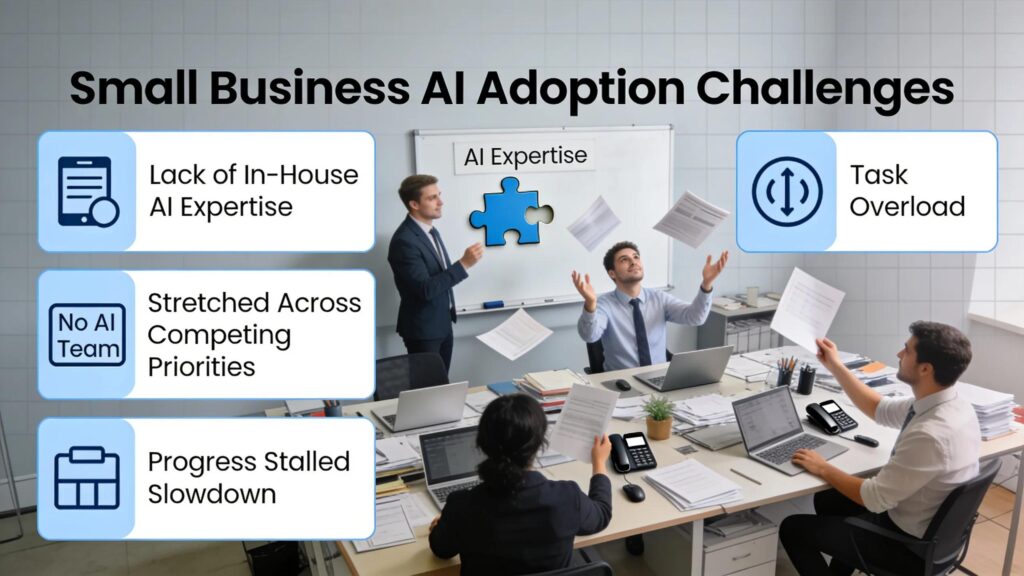
SMBs commonly face four barriers: skill gaps, uneven data readiness, constrained budgets, and small teams that cannot support complex rollouts. The Blueprint addresses these constraints by delivering prioritized, low-friction pilots; providing clear data readiness criteria; recommending minimal viable datasets; and specifying role-based training and fractional leadership options for oversight. By producing a sequence of staged pilots and practical operational playbooks, the Blueprint helps lean organizations adopt AI within existing capacity while limiting risk. The following subsections map specific SMB challenges to concrete Blueprint responses and outline tactical strategies for smooth integration.
This perspective is reinforced by studies showing that many small businesses hesitate to expand AI investments due to various challenges, including ethical and cybersecurity risks.
Strategic AI Adoption for Small Businesses: Challenges & Opportunities
Even as interest in AI grows among businesses, only 2% plan to expand their AI investment next year due to ethical concerns and cybersecurity risks along with difficulties
TRANSFORMING THE FUTURE: STRATEGIC AI ADOPTION FOR SMALL FOOD & BEVERAGE BUSINESSES, 2025
How does the Blueprint address skill gaps, data readiness, and budget constraints?
The Blueprint uses a data readiness checklist to gate use cases—ensuring a minimum viable dataset, clear data lineage, and required access before proposing a pilot. Skill gaps are mitigated through a “done-with-you” approach that pairs in-house staff with external expertise, and through concise upskilling plans focused on the specific tools and processes required for the pilot. Budget constraints are handled by prioritizing low-effort, high-impact pilots, recommending phased spending, and presenting a clear ROI model so leadership can finance pilots with projected near-term returns. These targeted remedies reduce the likelihood of stalled projects and provide SMBs with a realistic path to scaled automation.
| Challenge | Attribute | eMediaAI Blueprint Response |
|---|---|---|
| Skill gaps | Lack of in-house AI expertise | Done-with-you support, upskilling path, pilot pairing |
| Data readiness | Incomplete or messy datasets | Minimum viable dataset checklist, preprocessing plan |
| Budget constraints | Limited capital for experimentation | Prioritization for low-cost/high-ROI pilots, staged funding |
| Lean teams | Limited capacity for implementation | Role-based adoption plans, lightweight pilots |
This table shows how the Blueprint converts common constraints into manageable actions, leading to operational tactics that minimize disruption for small teams.
What strategies ensure smooth AI integration for lean SMB teams?
Smooth integration relies on low-code or API-first solutions where feasible, a single cross-functional champion to coordinate pilots, staged rollouts with clear acceptance criteria, and lightweight governance for monitoring performance and bias. Tactical steps include selecting minimal viable scope for first pilot, automating data pipelines that require minimal maintenance, defining adoption KPIs tied to daily workflows, and scheduling short retrospectives to iterate quickly. These tactics reduce overhead and make it possible for small teams to run pilots alongside normal operations. Adopting these operational patterns increases the odds that pilots move from experimentation into reliable, scalable improvements—preparing the organization for longer-term oversight.
How Does the Fractional Chief AI Officer Service Complement the AI Opportunity Blueprint?
A fractional Chief AI Officer (fCAIO) provides continuous governance, strategic continuity, and vendor oversight after the Blueprint phase, offering SMBs executive-level guidance without the commitment or cost of a full-time hire. The fCAIO role aligns pilot outcomes with organizational strategy, manages ethical oversight, and helps scale successful pilots into production while ensuring data governance and vendor selection adhere to Responsible AI Principles. For many SMBs, pairing the Blueprint’s rapid prioritization with fractional leadership provides both an immediate path to value and a sustainable governance framework. The subsections below outline the practical benefits and specific oversight activities an fCAIO provides.
What are the benefits of fractional CAIO services for sustained AI leadership?
Fractional CAIO services deliver cost-effective executive expertise that helps SMBs convert Blueprint outputs into a coherent AI program. Benefits include strategic continuity across pilots, rapid access to senior decision-making for vendor negotiations, and oversight of measurement frameworks to ensure pilots meet their ROI targets. Fractional leadership is especially useful when organizations need intermittent but high-level guidance—such as setting policy, approving scaling plans, or managing cross-functional trade-offs—without the overhead of a permanent executive. This approach preserves budget flexibility while maintaining the governance necessary to scale responsibly.
- Cost-effective access to senior AI strategy and governance.
- Continuity across pilots to ensure consistent measurement and scaling.
- Executive oversight for vendor selection, policy, and governance decisions.
How does the fCAIO service support scaling and ethical AI oversight?
An fCAIO establishes policies, runs periodic risk and bias audits, manages vendor performance and contracts, and sets up routine monitoring to detect drift or compliance issues as models scale. Operationally, this includes defining audit schedules, approving access controls, enforcing data governance standards, and ensuring ongoing transparency and explainability for stakeholders. By tying these governance activities back to the Blueprint’s Responsible AI Principles, the fCAIO ensures that scaling preserves human-centric design and measurable outcomes. This governance layer reduces model risk, protects employee welfare, and sustains the ROI discovered during the pilot phase.
| Governance Activity | Purpose | Example Outcome |
|---|---|---|
| Policy establishment | Define standards for model use and data handling | Consistent deployment rules across pilots |
| Risk and bias audits | Detect and remediate performance disparities | Lowered compliance and reputational risk |
| Vendor oversight | Ensure third-party solutions meet standards | Better SLAs and accountability |
This governance focus prepares organizations to scale responsibly and leads into evidence that these approaches produce measurable, human-centered results.
What Real-World Results Demonstrate the AI Opportunity Blueprint’s Impact?
Anonymized case studies indicate that prioritization, ethical controls, and focused pilots can produce rapid financial and human ROI when executed as recommended by the Blueprint. Examples include measurable lift in key performance indicators, dramatic reductions in production time for content workflows, and meaningful employee time savings that improve morale and capacity. The following subsections summarize representative anonymized case outcomes and synthesize lessons that validate the Blueprint’s people-first approach and measurable ROI claims.
Which case studies highlight measurable ROI and employee benefits?
Selected anonymized examples show diverse, metric-driven outcomes from Blueprint-guided pilots: an e-commerce pilot that achieved a +35% increase in average order value after targeted personalization measures; a media production workflow that delivered 95% faster content production cycles through automation and role augmentation; and an editorial process where a pilot reduced specific production time by 93% while retraining staff to focus on higher-value tasks. Each case began with the Blueprint’s prioritized roadmap, used conservative ROI modeling to size pilots, and applied ethical checks and training to ensure employees were part of the transition. These results demonstrate that when pilots are tightly scoped, ethically governed, and adoption-focused, SMBs can realize both financial and human ROI quickly.
| Case Study | Problem | Blueprint Solution | Quantified Result |
|---|---|---|---|
| E-commerce personalization | Low AOV, limited segmentation | Prioritized personalization pilot | +35% AOV |
| Media production | Slow production cycles | Automation + role augmentation | 95% faster production |
| Editorial workflow | High manual production time | Targeted automation, retraining | -93% production time |
This table highlights how concrete metrics align to Blueprint tactics, which leads into why these stories validate the people-first method.
How do these success stories validate the Blueprint’s people-first approach?
The success stories consistently show that pairing technology with role-preserving adoption plans and ethical controls produces sustainable improvements rather than short-term efficiencies that create long-term problems. In each instance, employee involvement during discovery, clear training, and incremental pilots created internal champions who ensured that automation complemented rather than replaced human expertise. The measurable benefits—revenue lift, time savings, and faster production—were durable because the organization had governance, KPIs, and a fractional leadership path to sustain progress. These lessons underline that rapid ROI and ethical adoption are mutually reinforcing when the initial roadmap prioritizes people alongside metrics.
- People-first pilots yield higher adoption and more sustainable ROI.
- Training and involvement create champions who aid scaling.
- Governance and fractional leadership maintain ethical and operational continuity.
These final insights end the article after the last heading and leave SMB leaders with a clear path: prioritize rapid, ethical pilots, measure impact, and sustain gains with governance and fractional executive support.
Frequently Asked Questions
What types of businesses can benefit from the AI Opportunity Blueprint?
The AI Opportunity Blueprint is designed primarily for small and mid-sized businesses (SMBs) across various industries. These businesses often face unique challenges such as limited budgets, skill gaps, and the need for quick decision-making. The Blueprint helps them identify high-ROI AI use cases tailored to their specific operational needs. Industries such as retail, media, and manufacturing have successfully implemented the Blueprint to enhance efficiency and drive growth, making it a versatile solution for diverse business contexts.
How does the AI Opportunity Blueprint ensure ethical AI implementation?
The AI Opportunity Blueprint incorporates ethical AI principles throughout its process. It emphasizes fairness, transparency, and employee impact by embedding ethical checks in each recommended use case. This includes bias assessments, privacy safeguards, and role augmentation plans to ensure that AI technologies enhance rather than replace human roles. By prioritizing ethical considerations, the Blueprint fosters trust among employees and customers, which is crucial for successful AI adoption and long-term sustainability.
What role does employee training play in the AI Opportunity Blueprint?
Employee training is a critical component of the AI Opportunity Blueprint. The approach emphasizes a “done-with-you” model, where in-house staff collaborate with external experts to build skills relevant to the AI pilots. This includes hands-on training sessions and role-based adoption plans that ensure employees are equipped to work alongside new technologies. By involving employees in the training process, the Blueprint not only enhances their capabilities but also increases buy-in and reduces resistance to change.
How can SMBs measure the success of AI pilots implemented through the Blueprint?
SMBs can measure the success of AI pilots by establishing clear Key Performance Indicators (KPIs) during the Blueprint phase. These KPIs may include metrics such as revenue lift, time savings, and efficiency improvements. The Blueprint provides a structured ROI validation report that outlines expected outcomes and allows businesses to track progress against these metrics. Regular assessments and feedback loops help ensure that pilots are aligned with business goals and can be adjusted as needed for optimal results.
What are the common challenges SMBs face when adopting AI, and how does the Blueprint address them?
Common challenges for SMBs in AI adoption include skill gaps, data readiness issues, and budget constraints. The AI Opportunity Blueprint addresses these by providing a clear data readiness checklist, recommending low-cost, high-impact pilots, and offering a “done-with-you” support model that pairs internal teams with external expertise. By focusing on manageable, phased implementations, the Blueprint helps SMBs navigate these challenges effectively, ensuring a smoother transition to AI technologies.
How does the AI Opportunity Blueprint support long-term AI strategy for SMBs?
The AI Opportunity Blueprint not only provides immediate guidance for pilot projects but also lays the groundwork for a sustainable long-term AI strategy. By integrating a fractional Chief AI Officer (fCAIO) service, SMBs gain ongoing governance and strategic oversight to scale successful pilots into broader initiatives. This ensures that AI implementations remain aligned with business objectives, ethical standards, and operational efficiency, fostering a culture of continuous improvement and innovation.
Conclusion
Implementing the AI Opportunity Blueprint empowers SMBs to navigate the complexities of AI adoption with confidence, ensuring ethical practices and measurable outcomes. By focusing on prioritized use cases and human-centric design, businesses can achieve rapid ROI while fostering employee engagement and trust. Embrace this structured approach to unlock the full potential of AI in your organization. Discover how our services can guide your journey towards successful AI integration today.