

Autonomous AI agents handle ai invoice processing by eliminating manual invoice reconciliation, cross-checking vendor invoices, matching transaction IDs, and flagging discrepancies across disparate file formats automatically. Accounts payable teams currently lose up to 30% of their time on manual matching, per the Institute of Finance and Management. We deploy governed agent workflows that remove that burden and restore accuracy to financial operations.
Key Takeaways

- Finance teams waste 30% of monthly time on manual invoice reconciliation tasks requiring human intervention.
- AI agents automate 60–80% of accounts payable work by reading, reasoning, and matching invoices to orders.
- eMediaAI’s AI Opportunity Blueprint™ identifies financial automation opportunities and delivers ROI within 90 days for clients.
- Lee Pomerantz, Certified Chief AI Officer, leads eMediaAI’s Fractional Chief AI Officer services for finance transformation.
Why Is Manual Invoice Reconciliation Draining Your Team?
Manual reconciliation drains finance teams because accounts payable staff spend their days cross-checking invoices instead of analyzing results. The Institute of Finance and Management’s 2023 study found that accounts payable professionals spend up to 30% of their time on manual reconciliation tasks, matching vendor invoices, tracking transaction IDs, and flagging discrepancies by hand. That share of the work week comes directly out of the hours controllers need for forecasting, variance analysis, and closing the books.
The root cause isn’t a lack of effort. Invoice processing breaks down because staff must contend with inconsistent data sources, disparate internal systems, and vendor file formats that vary by supplier. Traditional automation tools choke on that variability, which is exactly why so many mid-market finance departments still rely on spreadsheets and manual lookups.
What Makes Invoice Matching So Hard to Automate?
Invoice matching resists conventional automation because vendors submit data in formats that change by supplier, region, and system. Rule-based tools break the moment a format shifts, forcing staff back into manual review. That fragility is why ai invoice processing and financial reconciliation agents built on reasoning, not rigid rules, handle the exceptions legacy systems cannot.
We’ve seen this friction firsthand across finance teams:
- Hours lost to re-keying data between accounting platforms and vendor portals
- Discrepancies caught late, after payment deadlines have already passed
- Staff burnout from repetitive, low-value cross-checking work
Our approach to finance automation starts from a different premise than most AI vendors. eMediaAI’s mission is implementing automation that saves time, reduces stress, and actually gets adopted by the people using it, not automation that sits unused after launch. Headquartered in Fort Wayne, Indiana, we serve finance and operations leaders across the United States who need reconciliation that holds up under real-world vendor chaos.

How Do AI Agents Actually Reconcile Invoices?
AI agents validate, match, and reconcile invoices across multiple systems in seconds, not hours. That speed cuts manual effort, eliminates the small errors that compound into audit headaches, and shortens the financial close cycle for the whole team. We treat this as the starting point for real ai invoice processing, not the finish line.
The core mechanics stay consistent across most deployments. Financial reconciliation agents read an incoming invoice, pull the relevant purchase order and receipt, and compare the three documents line by line. When everything lines up, the agent posts a clean entry directly into the accounting system. When something doesn’t match, only that exception reaches a human controller for review.
What happens when an invoice doesn’t match a purchase order?
Mismatches get routed, not buried. The agent flags the specific discrepancy, quantity, price, or vendor terms, and surfaces it with the supporting documents attached. A controller reviews one flagged exception instead of re-checking every invoice in the batch.
Does this replace the accounts payable team?
No. Agents handle the repetitive matching so staff can focus on judgment calls and vendor relationships. That’s where finance automation earns its keep: giving time back to employees, not just eliminating headcount.
We don’t stop at plugging in a tool. Our technical work includes building the API integrations. Backend scripts that connect reconciliation agents to the accounting systems finance teams already run. The output is a working system, not a slide deck.
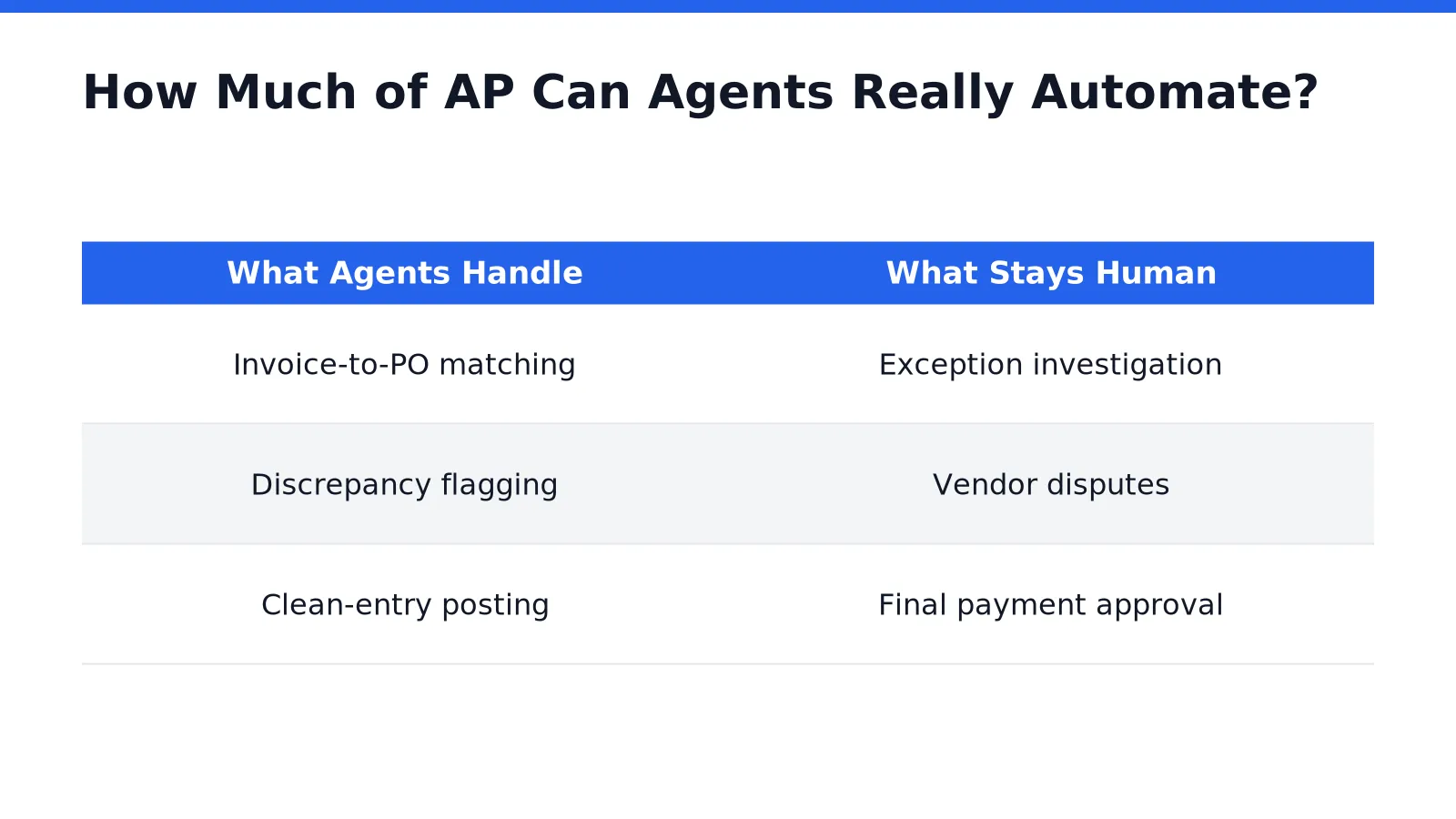
How Much of AP Can Agents Actually Automate?
Sixty to eighty percent of accounts payable. Reconciliation work falls within reach of autonomous agents, according to ILMTEC Engineering’s research on financial reconciliation agents. Agents combine document reading, reasoning, and tool use to match invoices, flag discrepancies, and post entries, all while audit trails and approval gates leave controllers in charge of money movement. That ceiling matters: the remaining 20 to 40 percent still demands judgment, vendor negotiation, and exception handling that no agent should touch unsupervised.
We build ai invoice processing engagements around that split from day one. Our integration and deployment work connects a reconciliation use case to the general ledger, rather than leaving it stuck as a diagram in a slide deck. We structure these engagements so finance leaders see measurable ROI in under 90 days, not an open-ended pilot that drags into a second budget cycle.
Which AP Tasks Should Stay Human?
Exception review, vendor disputes, and anything touching payment release authority stay with controllers. Our Responsible AI Principles treat governance, transparency, and safety as deployment requirements, not afterthoughts, which is why approval gates remain non-negotiable in every build.
Does Automating 60-80% of AP Mean Cutting Staff?
No. The goal of finance automation here is reclaiming hours lost to manual matching, not headcount reduction. Controllers redirect that time toward analysis, vendor strategy, and the judgment calls agents were never designed to make.

Are AI Agents Just Smarter RPA Bots?

No. Robotic process automation moves data along a fixed path. AI agents reason about the data before deciding what to do with it. Traditional finance automation scripts open emails, copy fields, and paste numbers into a template. They stop the moment something falls outside that scripted path. Pairing AI agents with RPA is actively rewriting how enterprises handle invoice workflows end to end, moving past rigid scripts toward systems that judge, match, and flag exceptions on their own.
That distinction matters for CFOs evaluating where to spend automation dollars. We see the difference play out in three capabilities:
- Fixed-path RPA: executes the same keystrokes regardless of invoice variation
- AI invoice processing: reads unstructured vendor formats and extracts meaning, not just fields
- Financial reconciliation agents: match invoices to purchase orders, flag true discrepancies, and route only real exceptions to a controller
Do We Need to Rip Out Existing RPA to Adopt Agents?
No. Most mid-market finance teams layer agents on top of existing RPA rather than replace it. The agent handles judgment calls; the RPA layer still handles the repetitive keystrokes it was built for.
Who Decides How the Agent Behaves on Our Ledger?
Finance leadership should, not an outside vendor writing scripts in isolation. We provide Fractional Chief AI Officer services specifically so controllers. VPs of Finance retain ownership of agent logic and escalation rules. Before any agent touches a ledger, we run readiness, audit, and strategy work to confirm the use case, the data quality, and the control points are sound. That sequence protects accuracy, not just speed.
How Should CFOs Govern This Rollout Safely?

Safe governance starts before an agent touches a single ledger entry. We build a 10-day structured roadmap that gives finance leaders a deployment-ready plan rather than months of open-ended discovery. That timeline matters: every week spent in unstructured exploration is a week of unmanaged risk sitting in the accounts payable queue.
We price that roadmap, our AI Opportunity Blueprint™, as a fixed $5,000 engagement. Cost certainty up front lets a CFO approve the first phase without an open-ended budget commitment to full finance automation. Controllers get a scoped deliverable, not a retainer that grows on its own.
Who oversees the agents once they’re live?
Oversight does not disappear after deployment. Our founder, Lee Pomerantz, a Certified Chief AI Officer, holds direct accountability for governance decisions on reconciliation rollouts. That single point of accountability keeps financial reconciliation agents answerable to a named executive, not a vendor support ticket.
How do AP teams learn to trust the agents?
Trust builds through structured exposure, not a memo. We run AI literacy sessions and workshops so AP staff understand how ai invoice processing agents flag exceptions and why.
Teams that skip this step tend to resist supervision duties or override agent outputs without review. Governance structures should include:
- A named executive accountable for agent decisions, not a shared inbox
- A fixed-scope roadmap completed before production deployment
- Literacy training for every AP employee who reviews agent output
- Clear escalation paths for exceptions the agent cannot resolve
Skip any one of these, and the rollout becomes a liability rather than an efficiency gain.
FAQ
How much time do AI agents save accounts payable teams?
AI agents automate 60–80% of accounts payable work, directly recovering the time finance teams currently lose to manual invoice reconciliation. The Institute of Finance and Management pegs at up to 30% monthly.
Why do traditional automation tools fail at invoice matching?
Rule-based tools break when vendor file formats shift by supplier or region, forcing staff back into manual review. AI agents built on reasoning instead of rigid rules handle these exceptions that legacy systems cannot.
What does eMediaAI offer to identify financial automation opportunities?
eMediaAI’s AI Opportunity Blueprint™ is priced at $5,000. Identifies financial automation opportunities, delivering ROI within 90 days, led by Certified Chief AI Officer Lee Pomerantz.
Conclusion

In closing, financial reconciliation and invoice processing represent the clearest path to operational freedom, where AI agents handle the repetitive work while your team focuses on strategy and relationships. The governance question isn’t whether to automate, but how to automate responsibly. That’s where the real competitive advantage lives: speed paired with control, efficiency paired with accountability. The technology exists. The framework exists. What remains is the decision to move.