

Zero-retention architecture governs data privacy for SMB AI agents: prompts, context, and outputs process in-memory only, never written to logs or training sets. We deploy Zero Data Retention patterns for SMB AI agents in regulated sectors, healthcare, finance, legal, where contractual ZDR matters, while flagging that non-regulated SMBs often overpay 30-50% for unnecessary protection.
Key Takeaways

- Zero Data Retention processes all AI agent prompts and outputs in-memory only, never storing to databases or logs.
- SMBs handling health data, NDAs, or GDPR information require contractual ZDR guarantees for compliance and security.
- eMediaAI’s Fractional Chief AI Officer services help implement ZDR patterns aligned with your specific regulatory requirements.
- Zero Data Retention architecture eliminates persistent storage risks while maintaining AI agent performance for enterprise-grade security.
Why Does AI Agent Data Privacy Matter Now?
AI agents process customer records, financial data, and proprietary workflows the moment they execute a task. That exposure creates legal consequences once prompts, context windows, or outputs persist past a single session. We see SMB and mid-market teams treat retention as an IT footnote rather than a board-level risk, and that mistake gets expensive fast.
Deploying autonomous agents without reviewing data retention introduces a gap most teams never test. Many organizations rushing agentic workflows into procurement, support, or operations overlook this security gap entirely, assuming the provider’s privacy policy covers them. It usually doesn’t.
We tell clients plainly: a provider’s promise not to train on your data is not the same as a promise not to store it. AI agent data privacy depends on architecture, not marketing language. “No training” and “no retention” are separate guarantees, and conflating them leaves regulated businesses exposed during audits, breach investigations, or client contract reviews.
Is a No-Training Policy the Same as Zero Retention?
No. A vendor can refuse to train models on your data while still logging every prompt and output indefinitely. Zero retention ai means data never touches persistent storage in the first place, closing both gaps at once.
Why Won’t Contracts Alone Satisfy Security Review?
Procurement and security teams no longer accept contractual language as sufficient proof. They increasingly evaluate agent vendors against an agentic zero trust standard: verify the retention architecture at the code level, assume nothing by default. If an agent vendor cannot demonstrate retention controls under that standard, the deal stalls or gets blocked outright.
For SMB operators, this is where smb data protection stops being optional:
- Legal exposure accumulates the moment data outlives the session that created it.
- “We don’t train on your data” leaves the retention question unanswered.
- Security review increasingly demands proof, not promises, before signing off.
What Is Zero-Retention AI, Exactly?
Zero-retention AI describes a technical and contractual guarantee: prompts, context windows, and model outputs get processed in memory only, never written to persistent storage. We treat this standard as the baseline for AI agent data privacy whenever we deploy agents for SMB. Mid-market clients handling regulated or sensitive workflows.
The distinction matters for anyone weighing deployment risk. A session ends, and the data disappears with it. That’s not a retention schedule promising deletion within 30 days. It’s an architectural constraint: a properly built agent is technically incapable of storing what it processes.
We draw a hard line between policy and architecture. Policies describe intentions. Architectures describe capabilities. Zero retention AI removes the question of intent entirely, because nothing remains to delete.
What Happens to Data During a Zero-Retention Session?
Nothing persists. Prompts, context, and outputs flow through the system and vanish the instant the session closes. There’s no storage, no copy, and no log file sitting in a database waiting for a breach or a subpoena.
Is Zero-Retention the Same Thing as a Privacy Policy?
No. A privacy policy is a promise about what a vendor will do with data. Zero-retention architecture removes the vendor’s ability to retain data in the first place. That’s a stronger guarantee for SMB data protection than any written commitment could offer.
For CTOs and CISOs evaluating vendors, the checklist stays short:
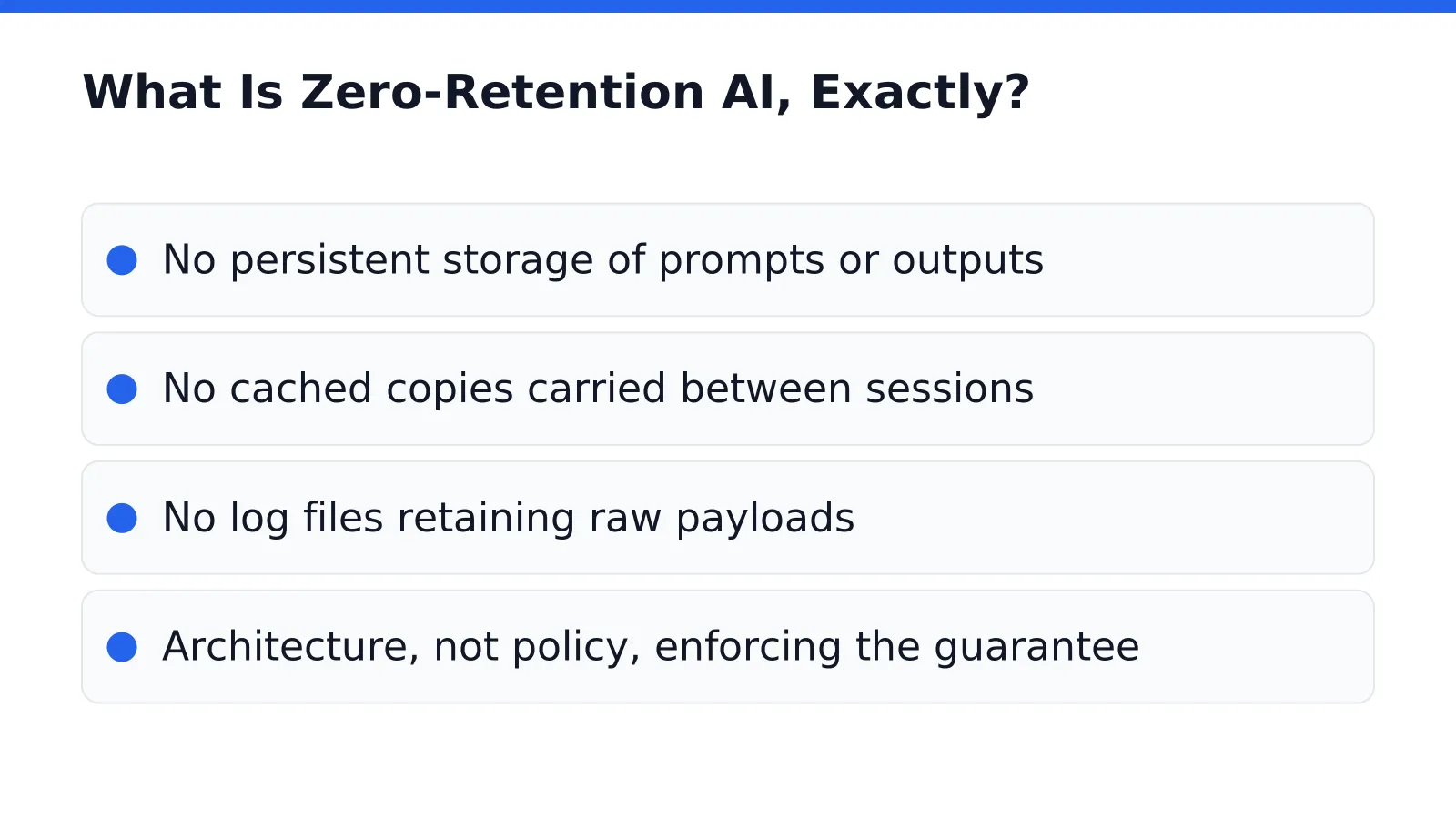
- No persistent storage of prompts or outputs
- No cached copies carried between sessions
- No log files retaining raw payloads
- Architecture, not policy, enforcing the guarantee
We build and deploy agents against that checklist, not against a vendor’s marketing language.

Does Every SMB Need Zero Data Retention?
Not every small or mid-sized business requires contractual zero-retention guarantees. The need depends on the category of data a company processes, not on headline anxiety about AI risk.
We advise clients to run a four-question test before committing budget to zero retention ai. A business crosses into mandatory-ZDR territory when it handles any of the following:
- Identifiable health data subject to compliance obligations
- Strict non-disclosure agreements signed with clients
- Operations inside a regulated industry such as banking, insurance, legal, defense, or pharmaceuticals
- GDPR-sensitive personal data covered under Article 9
Answer yes to even one of these. Contractual zero retention becomes a baseline requirement for sound ai agent data privacy, not a premium add-on.
Answer no to all four, and the calculus changes. Organizations outside those categories frequently pay 30 to 50 percent more for retention guarantees they never needed in the first place. That premium usually isn’t line-itemed as “zero retention,” it shows up as a higher-tier vendor plan, a dedicated compliance add-on, or a custom contract negotiated out of caution rather than requirement. It buys peace of mind, not risk reduction, when the underlying data never warranted the protection to begin with. We’ve walked clients back from that tier more than once simply by running the four-question test first and pricing the actual data exposure instead of the vendor’s default upsell.
Should smaller operations skip zero data retention entirely?
Skipping it outright is rarely the right move either. Smaller operations still need baseline smb data protection practices around access control, encryption, and vendor accountability, even without a full contractual zero-retention commitment.
What should guide the final decision?
The decision rests on the data itself, not on marketing fear designed to sell every business the top-tier package. We size the governance commitment to match actual data exposure, not the loudest vendor pitch in the room.

Regulated vs. Non-Regulated SMB Data Categories
How Zero-Retention Patterns Work Under The Hood

Integration middleware sits at the center of every zero-retention pattern. This software layer runs a pass-through AI agent pipeline: third-party API payloads process entirely through in-memory AI processing, never writing requests or responses to a database, log file, or cache. We treat ZDR architecture as a design constraint, not a configuration toggle: the system cannot store what it never persists.
Picture an agent that reads a CRM contact, updates an HR record, or writes an accounting entry. The raw payload passes through the integration layer exactly once, then disappears the instant a response goes back to the requester. Nothing lingers for a second pass or a retry queue.
What makes this different from a standard “we delete your data” policy?
A deletion policy relies on a provider’s word and a retention schedule. In-memory middleware removes the need for trust entirely, because there is no stored copy to delete in the first place. For SMB and mid-market teams handling client records, that distinction shapes ai agent data privacy outcomes far more than any written promise does.
Why does procurement care about this architecture?
Enterprise buyers and procurement teams now treat in-memory processing as the baseline, not a premium feature. The payoff shows up in three concrete ways:
- No duplicate copies of sensitive payloads sitting in auxiliary systems
- No retention windows that extend how long data exists outside the agent’s session
- No expanded compliance scope dragging additional systems into an audit
We build smb data protection into agent deployments at this architectural layer first. Governance bolted on after the fact never closes the gap a stored payload opens.
The Next Step For SMB Data Protection

A structured audit comes next, not another vendor demo. We built our Responsible AI Principles around people-first benefits, fairness, safety, privacy, transparency, governance, and empowerment, aligned with the NIST privacy framework for AI and the EU AI Act. We apply those principles before a single AI agent touches production data for SMB AI Agents clients.
Most SMB and mid-market teams skip the audit step. They deploy first and ask privacy questions later, after sensitive customer records have already moved through an unvetted pipeline. We reverse that order.
How Does eMediaAI Map Data Risk Before Deployment?
Our AI Opportunity Blueprint runs as a 10-day structured roadmap. We use that window to map where ai agent data privacy gaps exist. Any system goes live for an SMB AI Agents deployment.
The Blueprint identifies which workflows touch regulated or sensitive data and which don’t. That distinction determines whether zero retention ai architecture is warranted or whether a lighter-weight control set will do.
What Happens After The Audit?
Our integration and deployment services turn the roadmap into working systems. We build the APIs, funnels, and privacy-aligned architecture that put smb data protection into actual production environments serving SMB AI Agents, not just into a slide deck.
The sequence looks like this:
- Audit data flows and flag regulated or sensitive categories.
- Design governance controls matched to actual risk, not assumed risk.
- Deploy with human-in-the-loop oversight.
- Measure results.
We target measurable ROI within 90 days of a governed rollout. Speed without governance isn’t a shortcut; it’s a liability we won’t ship.
FAQ
Does a no-training policy guarantee zero retention?
No. Vendors can refuse to train on your data while still logging every prompt and output indefinitely. Zero retention closes both gaps by processing data in memory only.
Which SMBs actually need Zero Data Retention?
Businesses handling health data, NDAs, or GDPR information require contractual ZDR guarantees for compliance. Non-regulated SMBs often overpay 30-50% for unnecessary protection.
How does eMediaAI help implement ZDR patterns?
eMediaAI’s Fractional Chief AI Officer services, led by Certified Chief AI Officer Lee Pomerantz, align zero-retention architecture with your specific regulatory requirements.
Conclusion

In closing, zero-retention patterns and governed AI agents represent the operational standard for responsible SMBs, not a competitive luxury. The choice is straightforward: build systems that protect customer data while accelerating production, or accept the compliance risk and operational drag of legacy approaches. Privacy and velocity are no longer trade-offs, they’re prerequisites for sustainable growth.
Research & Sources
Research & Sources
The governance approach in this article draws on two frameworks we align our Responsible AI Principles to:
- NIST AI Risk Management Framework (AI RMF): organizes governance into four functions, Govern, Map, Measure, Manage, that SMBs can scale into lightweight, practical controls: a short risk register, mapped AI assets, defined KPIs, and assigned review cadences.
- EU AI Act: introduces risk-tiered categories for AI systems and requires documentation, transparency, and human-oversight measures for higher-risk use cases, standards we build into deployments for clients operating in or selling into regulated markets.
We treat these frameworks as the baseline for evaluating whether a given AI agent deployment needs full zero-retention architecture or a lighter-weight control set, not as a compliance checkbox to clear after the fact.