


Agentic AI resolves tier-1 and tier-2 support tickets by reasoning through multi-step workflows, not scripted replies. Gartner projects agentic AI may resolve 80% of common service issues by 2029, potentially cutting operational costs for some organizations. We deploy these agents with human-in-the-loop controls, protecting enterprise security and compliance while giving IT teams back their time.
Key Takeaways

- Gartner projects agentic AI may resolve up to 80% of common customer service issues by 2029, though outcomes will vary by organization.
- Tier-1 requests like password resets and access provisioning consume majority of help desk volume currently.
- Customers demand complete problem resolution without re-explaining issues or waiting for system integration delays.
- eMediaAI’s AI Opportunity Blueprint™ delivers measurable ROI within 90 days for enterprise implementations.
Why Is Tier-1 Ticket Volume Overwhelming IT Teams?
Password resets, access provisioning, and account unlocks eat up most of the enterprise help desk queue. Most IT teams still process these requests by hand, one ticket at a time. That math never works in a mid-market organization’s favor.
We see the same pressure from the top down. CIOs and IT leaders face a mandate to deliver more with fewer resources as technology cycles compress. Manual AI ticket resolution workflows cannot absorb that pressure; they just push the strain onto staff.
The cost shows up outside the queue, too. Every time a customer or employee has to re-explain an account number or restate a problem, the relationship takes a small hit. Multiply that across thousands of tickets a month and the damage compounds into churn and quiet resentment toward IT.
What Kinds of Requests Clog the Help Desk Most?
Password resets, access requests, and account unlocks dominate ticket volume in most enterprise environments. These are repetitive, low-complexity tasks that still require a human to touch every single one.
Can an Autonomous Helpdesk Actually Fix This?
Projections point to a significant shift. By 2029, agentic AI systems are projected by Gartner to resolve up to 80% of common service issues without a human stepping in, potentially cutting operational costs for some organizations. That is the gap we help mid-market organizations close: moving from a legacy chatbot that answers simple questions to an agentic customer support model and a true autonomous helpdesk that resolves the request, not just acknowledges it.
What Separates Agentic Support From Legacy Chatbots?
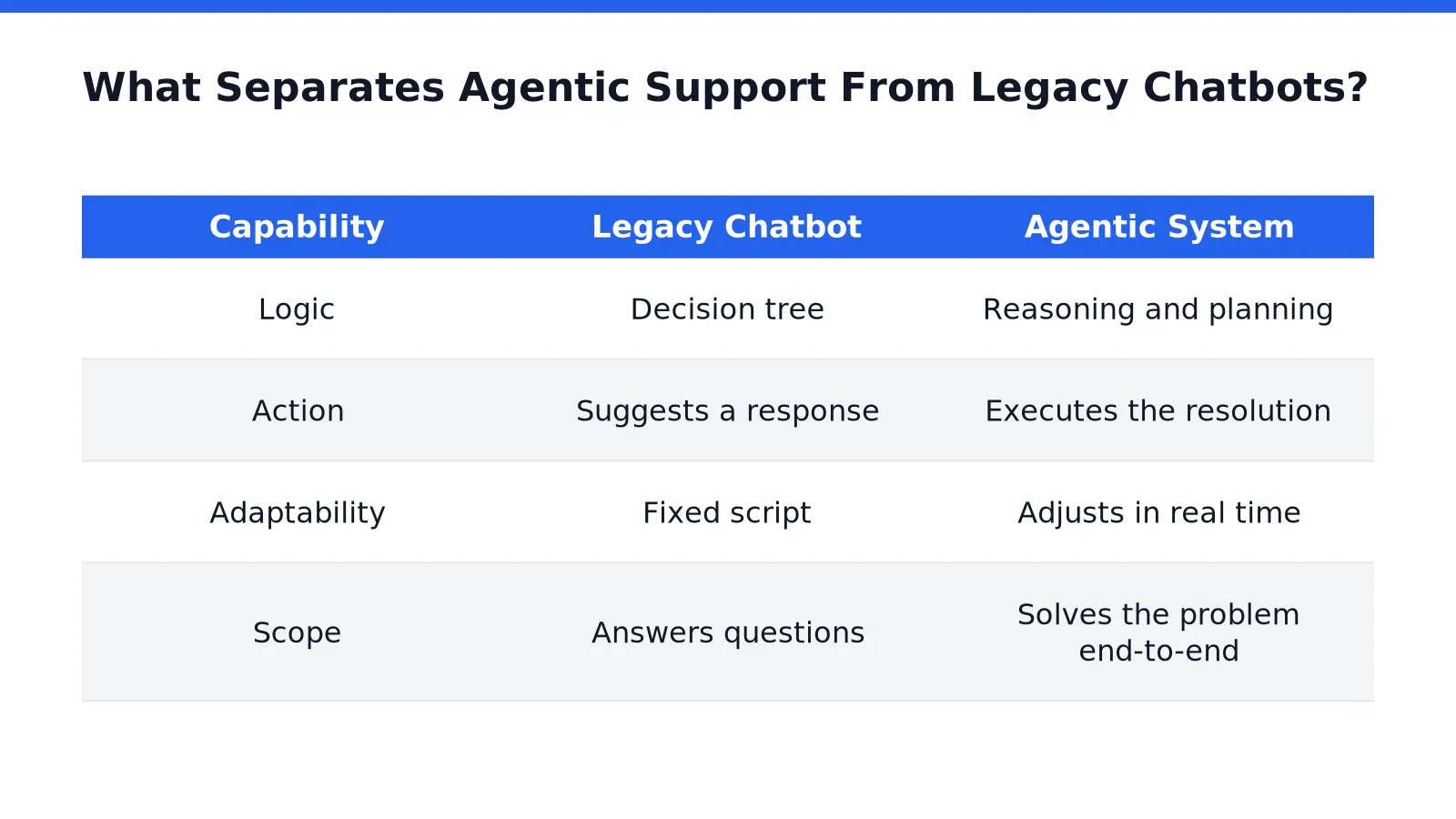
Decision trees define the old model. Reasoning defines the new one. Agentic customer support systems reason through a problem, plan a sequence of steps, take action, and adapt in real time, a sharp break from the scripted branches that trap legacy chatbots in dead ends.
We think of the distinction in terms of autonomy, not intelligence. The agents behind an autonomous helpdesk are software programs that reason, learn, and act on their own, rather than static scripts waiting for a matching keyword. That autonomy is what lets a system move from suggesting an answer to actually resolving a ticket.
Why can’t legacy chatbots resolve tickets on their own?
Legacy chatbots answer questions; they don’t solve problems. A true agentic system navigates systems, tools, and data without a human directing each step, which is what makes genuine ai ticket resolution possible instead of a glorified FAQ lookup.
Is agentic support just another layer of automation?
No, and this matters for IT leaders evaluating the build. Agentic support is engineered to address the root cause of broken service processes, not stack more automation on top of a flawed workflow.
That distinction shows up clearly when we compare the two models side by side:
For CIOs weighing a replacement cycle, that table is the whole decision in miniature. We don’t recommend swapping one chat widget for another; we recommend swapping the underlying reasoning model.

How Does Autonomous Ticket Resolution Actually Work?
Autonomous resolution works by automating the full lifecycle of a request, intake, diagnosis, action, and closure, without a human touching every step. Mean time to resolution drops from hours to minutes, and headcount does not need to grow to handle the volume. That is the core economic case for an autonomous helpdesk: speed without added staff.
We build the connective tissue that makes this work in practice. AI ticket resolution only functions when it can read from. Write to existing systems: identity management, ticketing platforms, knowledge bases. We handle the integration and deployment work required to wire an AI agent into those systems. It can actually close a ticket, not just suggest an answer.
What Kinds of Tickets Can an AI Agent Actually Resolve?
Password resets, access provisioning, and account unlocks make up the bulk of enterprise helpdesk volume. These are high-frequency, low-complexity requests, exactly the category where agentic customer support replaces manual, repetitive labor. Before any deployment, we run a 10-day AI Opportunity Blueprint to map which tier-1 and tier-2 workflows are ready for autonomous handling and which still need a human in the loop.
The decision about what gets automated matters more than the technology itself. Three questions guide that triage:
- Does the request follow a repeatable pattern across hundreds of past tickets?
- Can the resolution be executed through an existing API or system integration?
- Does failure carry low risk, or does it require escalation safeguards?
Gartner named agentic AI a top trend for 2025, projecting it will shape daily work decisions ahead. That shift is already reshaping how IT leaders plan staffing and system architecture.
What Keeps Autonomous Agents Safe And Compliant?

Six safeguards keep an autonomous agent inside its lane: people-first benefit, fairness, safety, privacy, transparency, and governance. eMediaAI’s Responsible AI Principles emphasize people-first benefits, fairness, safety, privacy, transparency, governance, and empowerment. Skip one, and we have not deployed agentic customer support. We have deployed a liability.
Executive appetite for this technology is real. Over half of tech executives now expect AI agents to become core to operations within the next two years. That timeline leaves mid-market IT leaders little room to treat governance as an afterthought bolted on after launch.
Does An Autonomous Agent Act Without Human Limits?
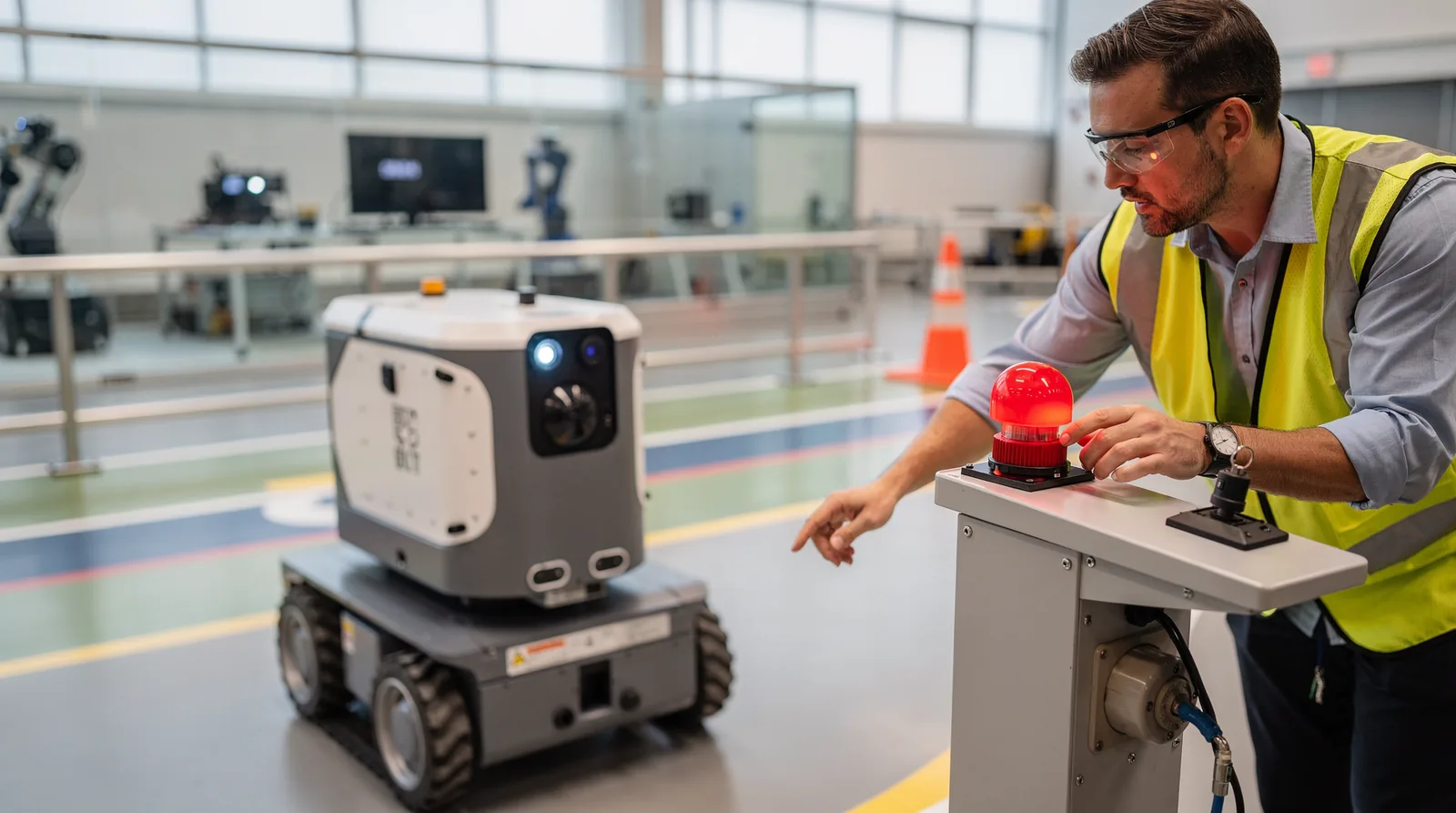
No. The mature platforms we deploy reason through multi-step requests and execute actions across enterprise systems, but always within guardrails IT leaders define in advance. That distinction separates a genuine autonomous helpdesk from an open-ended bot with system access and no supervision.
Who Keeps Governance Tight As Agents Scale?
Scaling introduces risk that a one-time audit cannot catch. Our Fractional Chief AI Officer model provides the standing oversight needed to keep AI ticket resolution agents. The governance wrapped around them, aligned as volume and system access grow.
In practice, the safeguards break down this way:
- Safety and privacy: agents operate inside defined data boundaries, not open internet reasoning.
- Transparency: every autonomous action leaves an auditable trail back to a human-approved rule.
- Fairness and people-first design: resolution logic gets reviewed for bias before it reaches a customer.
- Ongoing governance: a Fractional CAIO revisits the rules as the agent takes on new systems.
Compliance here is not a document. It is a standing practice, reviewed on a cadence, not a launch-day checkbox we file away.
How Should Mid-Market Leaders Start The Rollout?

Mid-market leaders start by scoping a fixed engagement, not an open-ended discovery contract. We built the AI Opportunity Blueprint™ around that principle: a fixed-scope assessment that maps where agentic customer support fits into existing ticket volume, staffing, and compliance requirements before anyone commits to a platform.
That structure matters because open-ended discovery is where most AI rollouts stall. Executives get strung along for months of workshops with no deployment date attached. We set a price and a scope up front, so the leadership team knows exactly what they’re buying and when they’ll have an answer.
How long until an autonomous helpdesk shows financial return?
Clients typically see measurable return on ai ticket resolution work in under 90 days. We treat that window as the real test of whether an autonomous helpdesk deployment is working, not vendor demos or adoption metrics alone.
Who actually leads the deployment?
Lee Pomerantz, our founder, holds Certified Chief AI Officer credentials and leads every rollout personally. That pairing matters for CIOs and operations leaders: governance expertise sits alongside hands-on deployment experience, not in a separate advisory silo.
A practical first step looks like this:
- Scope the Blueprint engagement against current ticket categories and escalation paths.
- Identify which issues qualify for autonomous resolution versus human-in-the-loop review.
- Set the 90-day ROI checkpoint before signing any long-term platform contract.
FAQ
What percentage of tickets does agentic AI resolve autonomously?
Gartner projects agentic AI may resolve 80% of common service issues by 2029, potentially cutting operational costs for some organizations that adopt it.
What requests dominate tier-1 help desk volume?
Password resets, access provisioning, and account unlocks dominate ticket volume in most enterprise environments, consuming the majority of IT teams’ manual workflow capacity.
How does agentic support differ from legacy chatbots?
Agentic systems reason through problems, plan steps, take action, and adapt in real time. Legacy chatbots rely on scripted decision trees that trap users in dead ends.
Conclusion

In closing, agentic customer support transforms support from a cost center into a competitive advantage, resolving routine inquiries at machine speed while freeing your team to handle the complex, high-value interactions that build loyalty. The shift from reactive troubleshooting to proactive, autonomous resolution doesn’t eliminate human judgment. It amplifies it, giving your people time to focus on what machines cannot: strategy, empathy, and growth. The question is no longer whether to deploy agentic systems. How quickly you can govern them responsibly and scale them across your operation.
Leaders ready to scope an assessment can reach us directly at [email protected].