
Integration bridges tie AI agents directly into HubSpot, GoHighLevel, or internal CRMs, giving every automation full access to existing customer data without rebuilding workflows. That’s Governed Velocity AI integration: speed without sacrificing control. eMediaAI’s Fractional Chief AI Officer services, led by Certified Chief AI Officer Lee Pomerantz, typically deliver measurable ROI in under 90 days.
AI agent integration into HubSpot, GoHighLevel, and internal CRMs demands zero-retention RAG patterns and human-in-the-loop controls before any system touches client data. Our AI Opportunity Blueprint maps API permissions and data flows in a 10-
Key Takeaways
- AI agents built on CRM data drive marketing, sales, and customer service results simultaneously.
- eMediaAI’s AI Opportunity Blueprint™ costs $5,000 and delivers measurable ROI within 90 days.
- Fractional Chief AI Officer services from eMediaAI integrate AI agents with your existing systems.
- Lee Pomerantz, Certified Chief AI Officer, leads eMediaAI’s Fort Wayne team of 10 experts.
Why Do CRM Agent Deployments Fail?
CRM agent deployments fail when organizations skip governance and treat automation as a plug-and-play feature instead of a controlled system. We see IT and operations leaders pushed to deliver more with fewer resources as agentic AI adoption accelerates, and that pressure often leads to shortcuts. Teams wire AI agents into HubSpot or connect GoHighLevel AI agents to client workflows without defining who approves what, who audits outcomes, or how errors get caught before they reach a customer.
The stakes keep rising. More than half of tech executives already believe these agents will become core to operations within two years. We think that timeline leaves little room for teams still treating governance as an afterthought.
What Causes Most Agent Failures in CRM Systems?
Most failures trace back to missing controls, not bad models. Agents granted write access to contact records, pipelines, or billing fields without human review introduce risk the moment they act on incomplete or outdated data.
How Do We Prevent Agent-Driven Data Incidents?
We apply Responsible AI Principles built around fairness, safety, privacy, transparency, and governance. In practice, that means:
- Scoped permissions limiting what each agent can read or write
- Human-in-the-loop checkpoints before customer-facing actions
- Audit trails for every agent decision touching CRM data
Deployments built this way protect revenue operations instead of exposing them.
How Do AI Agents Connect To HubSpot?
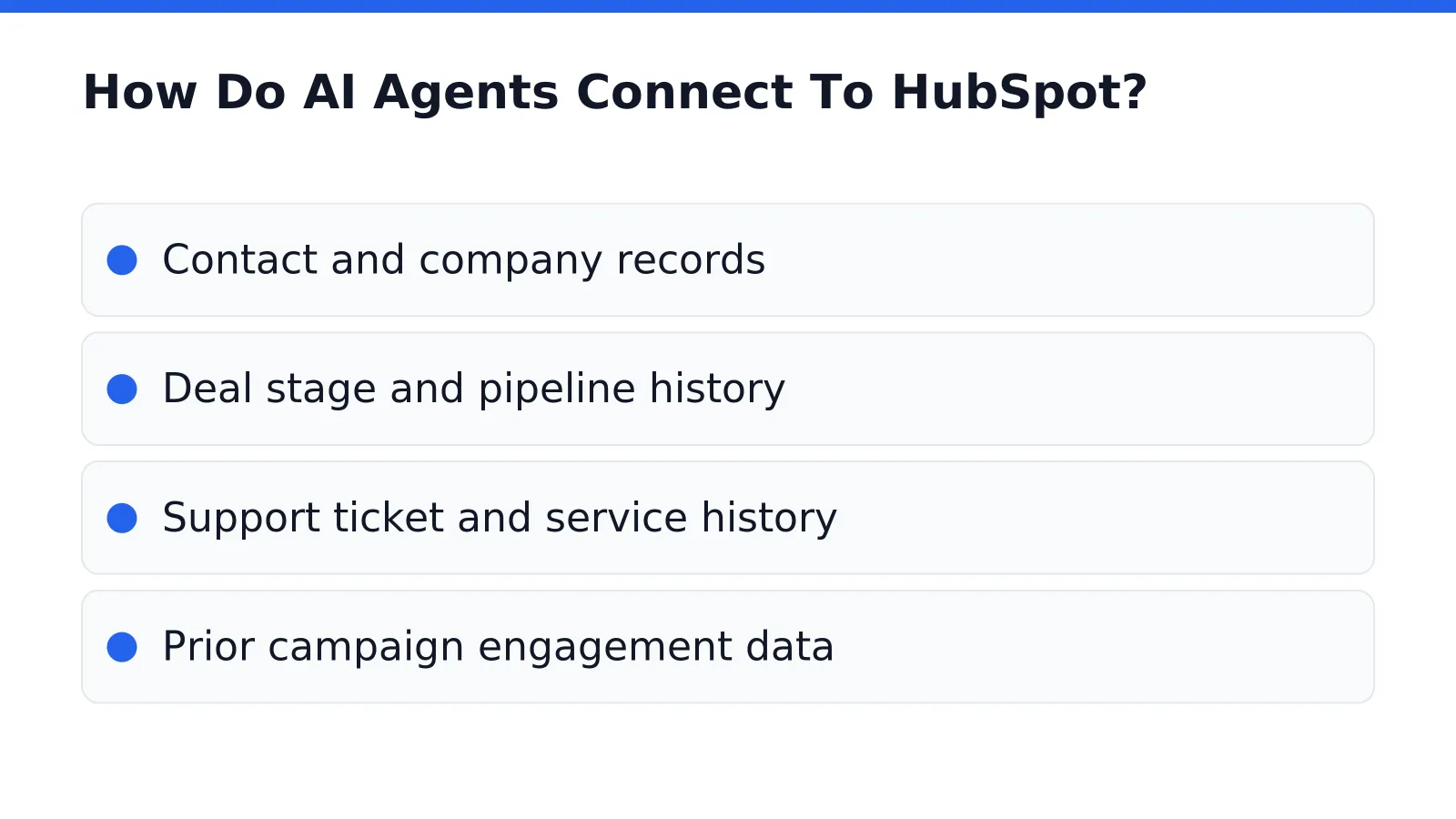
Connections between AI agents and HubSpot run through the CRM’s native data layer. Contact records, deal stages, and ticket histories feed directly into automated workflows, giving AI agents built on HubSpot data the context needed to act on real accounts rather than guesswork.
HubSpot’s pricing structure matters here. The platform offers an enterprise-grade CRM with a free entry tier. Costs climb to $3,600 per month as advanced AI features get layered on, according to a 2026 CRM comparison guide. For mid-market operations teams, that scaling cost shapes which agent capabilities are worth deploying first.
Context is what separates a useful agent from a noisy one. Agents built on top of CRM records gain the account history. Customer detail needed to work accurately, a point confirmed by HubSpot’s own Agent Hub documentation. Teams using content agents tied to that CRM data report measurable gains, averaging 14% more marketing reach, per the same Agent Hub source.
An autonomous sales agent data sync typically draws on:
- Contact and company records
- Deal stage and pipeline history
- Support ticket and service history
- Prior campaign engagement data
Does connecting AI agents to HubSpot risk corrupting existing records?
Risk exists wherever an agent writes back to live CRM fields without guardrails. We build the connective layer so agents read and act on HubSpot data without altering the underlying record structure, keeping existing pipelines, deal histories, and compliance fields intact.
How is this different from GoHighLevel integrations?
GoHighLevel AI agents typically operate inside a flatter, agency-oriented CRM structure, while HubSpot’s deeper data model demands more deliberate CRM agent integration work to avoid duplicate records or broken automation paths. Either platform needs that integration discipline before agents touch production data.

What Makes GoHighLevel AI Agents Different?
GoHighLevel suits agencies and service businesses that want marketing automation bundled with CRM in one apartment-rate plan. GoHighLevel AI agents run inside that bundle, firing off client campaigns and follow-up sequences from a single dashboard instead of stitching tools together. That bundling is the real split from AI agents for HubSpot, which assume a more modular, enterprise-style stack built for one company managing its own pipeline.
Price reinforces the split. GoHighLevel’s all-in-one marketing suite starts near $97 per month with unlimited contacts, which lowers the entry cost for an agency piloting agent workflows across dozens of client accounts at once.
Why Does GoHighLevel Cost Less Than HubSpot for Agent Pilots?
Apartment-rate pricing with no contact caps keeps the math predictable as an agency adds client accounts. HubSpot’s tiered model charges by contact volume and feature unlocks, so costs climb as usage scales. For Operations Officers testing agent deployment across several clients before full rollout, the apartment rate removes a budgeting variable.
The $97-per-month plan isn’t bare-bones. It includes:
- Built-in funnels agents can trigger without a separate landing-page tool
- SMS automation tied directly to agent-triggered campaign steps
- White-label options that let agencies brand the platform for their own clients
That combination gives agents a direct line to execution, not just recommendation. CRM agent integration inside GoHighLevel means the agent reads contact and campaign data and acts on it in the same system, which matters for compliance teams worried about data moving between platforms.
Strategy still has to meet deployment. We build the funnels, API integrations, and scripts that turn a GoHighLevel agent plan into a working system, closing the gap between a roadmap and a deployed, governed workflow.

How Do Internal CRMs Handle Agent Access?
Most internal CRMs grant agents only as much reach as the platform’s built-in features allow. That boundary matters more than most IT leads expect. CRM agent integration inside native systems stops at the edge of the vendor’s own database structure. An agent configured for one workflow often cannot touch another team’s custom fields or processes without extra infrastructure built around it.
This is where governance gaps start. A marketing agent reading customer records may sit on the same permissions layer as a finance workflow, with no clean separation enforced by the platform itself. We treat that as an architecture problem, not a vendor flaw to work around quietly.
Can agents query custom databases inside a CRM?
Generally, no, not without added work. Native CRM platforms restrict agents to the features shipped with the product, which means custom databases, full client portals, or team-specific workflow logic usually require outside tooling to connect properly. We build that connective layer so agents get the context they need without exposing data they shouldn’t touch.
What does safe internal access actually require?
Safe access starts with an audit, not a deployment date. Our AI readiness, audit, and strategy services map where an internal CRM is already exposed before a single agent gets connected. We align those deployments with NIST and EU AI Act frameworks, applying NIST AI framework CRM automation standards whether the agent reads native fields or runs through a custom CRM webhook AI agent integration, closing governance gaps that most teams discover only after an incident.
We run this process for mid-market organizations nationally from our Fort Wayne base, including teams whose AI agents for HubSpot or GoHighLevel AI agent builds sit far outside Indiana. Distance from our office changes nothing about how carefully we scope access before go-live.
What Should Operations Leaders Do Next?
Operations leaders need a fixed-cost, time-boxed plan before any CRM agent integration touches production data. We built the AI Opportunity Blueprint™ to answer that need directly: a 10-day structured roadmap instead of months of open-ended discovery calls. That compressed timeline matters when a CMO or RevOps manager is asked to show progress inside a single quarter.
The Blueprint runs as a $5,000 fixed-scope engagement. Finance teams get a known number before any integration work begins, which removes the budget guesswork that usually stalls agent projects at the approval stage.
How fast should we expect results from CRM agent deployment?
We position clients to see ROI in under 90 days. That window applies whether the agent work centers on ai agents hubspot workflows or gohighlevel ai agents campaigns. The governance and testing steps stay the same regardless of platform.
Who owns the agents after the roadmap is done?
Our Fractional Chief AI Officer service carries governance past the initial 10 days. Someone has to own prompt audits, data access reviews, and escalation paths once agents go live. That oversight does not end when the roadmap gets delivered.
Before signing off on any deployment, we recommend operations leaders confirm three things:
- A fixed-scope roadmap exists, with a defined end date and deliverable.
- Cost is known upfront, not estimated after discovery.
- Someone retains ongoing technical and governance responsibility after launch.
Skipping any of these three leaves the agent program exposed, both financially and operationally.
FAQ
Why do CRM agent deployments fail?
Deployments fail when organizations skip governance and treat automation as plug-and-play instead of a controlled system. Teams wire agents into HubSpot or GoHighLevel without defining approval processes, audits, or error-catching steps before customer impact.
How does eMediaAI prevent agent-driven data incidents?
eMediaAI applies Responsible AI Principles covering fairness, safety, privacy, transparency, and governance. This includes scoped permissions, human-in-the-loop checkpoints before customer-facing actions, and audit trails for every agent decision touching CRM data.
How do AI agents connect to HubSpot?
AI agents connect through HubSpot’s native data layer, pulling contact records, deal stages, and ticket histories directly into automated workflows. This context lets agents act on real account data instead of guesswork, as confirmed by HubSpot’s Agent Hub documentation.
Conclusion
In closing, connecting AI agents to your existing CRM infrastructure transforms strategy into operational reality. The integration work, whether through HubSpot, GoHighLevel, or proprietary systems, demands both technical precision and governance discipline. When executed with human oversight and clear accountability, these connections accelerate revenue cycles, reduce manual friction, and protect your data. The difference between AI that hypes and AI that delivers lies in execution. That’s where the real work begins.