

Autonomous SDRs scale outbound by automating research, first-draft personalization, and inbound reply classification, the judgment-free steps in the sequence. We keep humans deciding fit, tone, and send timing, because full automation of outbound hurts deliverability and brand trust. Pipeline grows through sharper prioritization and automation that multiplies existing reps, not through hiring three more SDRs.
Key Takeaways
- AI agents automate account research, message drafting, and reply classification without adding SDR headcount.
- Autonomous systems handle research and personalization stages while humans retain decision-making at send and close.
- eMediaAI’s AI Opportunity Blueprint™ delivers measurable ROI within 90 days for outbound sales teams.
- Fractional Chief AI Officer services optimize sales automation strategy without requiring full-time executive hiring.
Why Is Outbound Sales Breaking Under Headcount Math?
Headcount math breaks because buyer attention shrinks while payroll keeps growing. Inboxes sit oversaturated and prospects stay harder to reach than they were even two years ago, according to How to Scale Outbound Sales Without Hiring More SDRs. We watch sales leaders respond by hiring more reps, then watch that math fail anyway because human research and outreach capacity has a hard ceiling.
Executives feel this pressure from both directions. We see commercial leaders asked to deliver more pipeline with fewer resources, the same squeeze CTOs face during periods of rapid technological change. Adding bodies to a broken process just makes the process more expensive, not more effective.
Does hiring more SDRs actually fix the pipeline problem?
No. Scaling outbound pipeline does not require a bigger sales team at all. What fixes it is better intelligence, sharper prioritization, and automation that multiplies the output of reps already on staff.
That shift is already structural, not optional. Gartner projects that AI agents will handle daily work decisions by 2028. That shift signals judgment-adjacent work moving into automated systems across functions, not just sales.
This is where outbound sales automation earns its place. We think about it less as a headcount replacement and more as a capacity multiplier:
- Account research that used to eat an SDR’s morning now runs continuously in the background.
- Prioritization shifts from gut feel to data, so reps spend time on accounts worth the call.
- Existing reps carry a larger book without burning out or missing quota.
The math only improves when intelligence replaces headcount as the lever.

What Can Autonomous SDRs Actually Automate?
Autonomous SDRs automate the research and personalization stages of outbound, not the full sales motion. We define an autonomous SDR the way we define any AI sales agent: an autonomous software program built to reason, learn, and act on its own, inside a defined set of tasks. That distinction matters more than most vendors admit.
Outbound sales automation earns its keep on the steps that don’t require an established relationship or a judgment call. We see three tasks that consistently qualify:
- Account research. Pulling firmographic and signal data on a target company and summarizing it for a rep in seconds, work that used to take twenty minutes of manual digging.
- First-draft message writing. Producing an initial outreach draft the rep edits, not one the system ships without review.
- Inbound reply classification. Sorting responses by intent so reps spend time on the conversations that matter.
What these three tasks share is a lack of a human relationship stake. No one gets burned if research is slightly off or a draft needs rewriting. The risk changes entirely once a message leaves the building or a deal moves toward close.
Should AI agents send outbound messages without review?
No. The send and close stages carry a judgment component, tone, timing, fit, that the agent doesn’t own. We treat those decisions as a rep’s responsibility, full stop.
Why does this distinction matter for scaling a team?
Because conflating research automation with decision automation is where outbound programs lose deliverability and brand trust. A sales leader who wants volume without headcount growth has to automate the preparation, not the judgment. That’s the boundary that keeps scale from becoming a liability.

How Does Governance Keep Autonomous SDRs Safe?
Governance keeps an autonomous SDR safe by binding every automated action to a documented set of principles before deployment, not after. eMediaAI’s Responsible AI Principles emphasize people-first benefits, fairness, safety, privacy, transparency, governance, and empowerment. We apply that framework to outbound sales automation the same way we apply it to any other AI deployment.
That framing matters because sales agents touch prospects directly. A misfire doesn’t just waste a rep’s time. It damages a brand relationship with someone who never agreed to be a test case.
What Happens Before an Agent Goes Live?
We run AI readiness, audit, and strategy work before any outbound agent sends a single message. This step maps where human judgment stays required and where research and drafting are safe to automate. Skipping this diagnostic is how companies end up with AI sales agents making promises a rep can’t keep.
Who Connects the Agent to Existing Systems?
Deployment isn’t a plug-and-play exercise, so we handle integration work directly: connecting agents to the CRM, the sequencing tool, and the data sources reps already trust. That wiring determines whether an agent works from accurate account context or guesses at it.
We treat governance as an operating discipline, not a one-time checklist:
- Readiness and audit work precedes any live send.
- Integration ties agents to real CRM and sequencing data, not static spreadsheets.
- Oversight stays built into the workflow, with humans reviewing tone, timing, and fit decisions.
- Privacy and transparency principles govern what data an agent can access and how it gets used.
Industry data backs the urgency here. Our analysis in “AI Agents for the CTO” notes that over half of tech executives expect AI agents to become core to operations within two years. That timeline leaves little room for sales leaders to treat governance as optional. Build the guardrails now, or inherit the cleanup later.
How Fast Can You See ROI From AI SDRs?
Ten days sets the pace at eMediaAI. Our AI Opportunity Blueprint™ delivers a structured, deployment-ready roadmap for scaling outbound sales automation inside that window, built around a fixed $5,000 engagement. Most consulting relationships drag on for months before a sales leader sees a plan worth acting on. We compress that into two weeks at a set price, so the budget conversation happens once.
The Blueprint is not a strategy deck that sits in a drawer. It names which research, writing, and reply-sorting tasks an autonomous SDR should own. Which decisions stay with a human closer. That distinction matters for ROI math: automation that touches judgment calls tends to stall adoption. Automation scoped to research and drafting gets used from day one.
What’s the realistic timeline for seeing returns?
Clients working with eMediaAI typically see measurable ROI inside 90 days of deployment. That window covers the Blueprint sprint plus initial rollout of AI sales agents handling account research and first-draft outreach. Ninety days is enough time to compare pipeline volume. Rep capacity against the pre-automation baseline, without waiting a full fiscal quarter just to get a plan approved.
Does scaling outbound require a full-time AI hire?
No. A Fractional Chief AI Officer gives sales leaders ongoing strategic oversight without adding payroll. This person owns the governance decisions, vendor accountability, and performance review that most SMB and mid-market teams can’t justify staffing full-time.
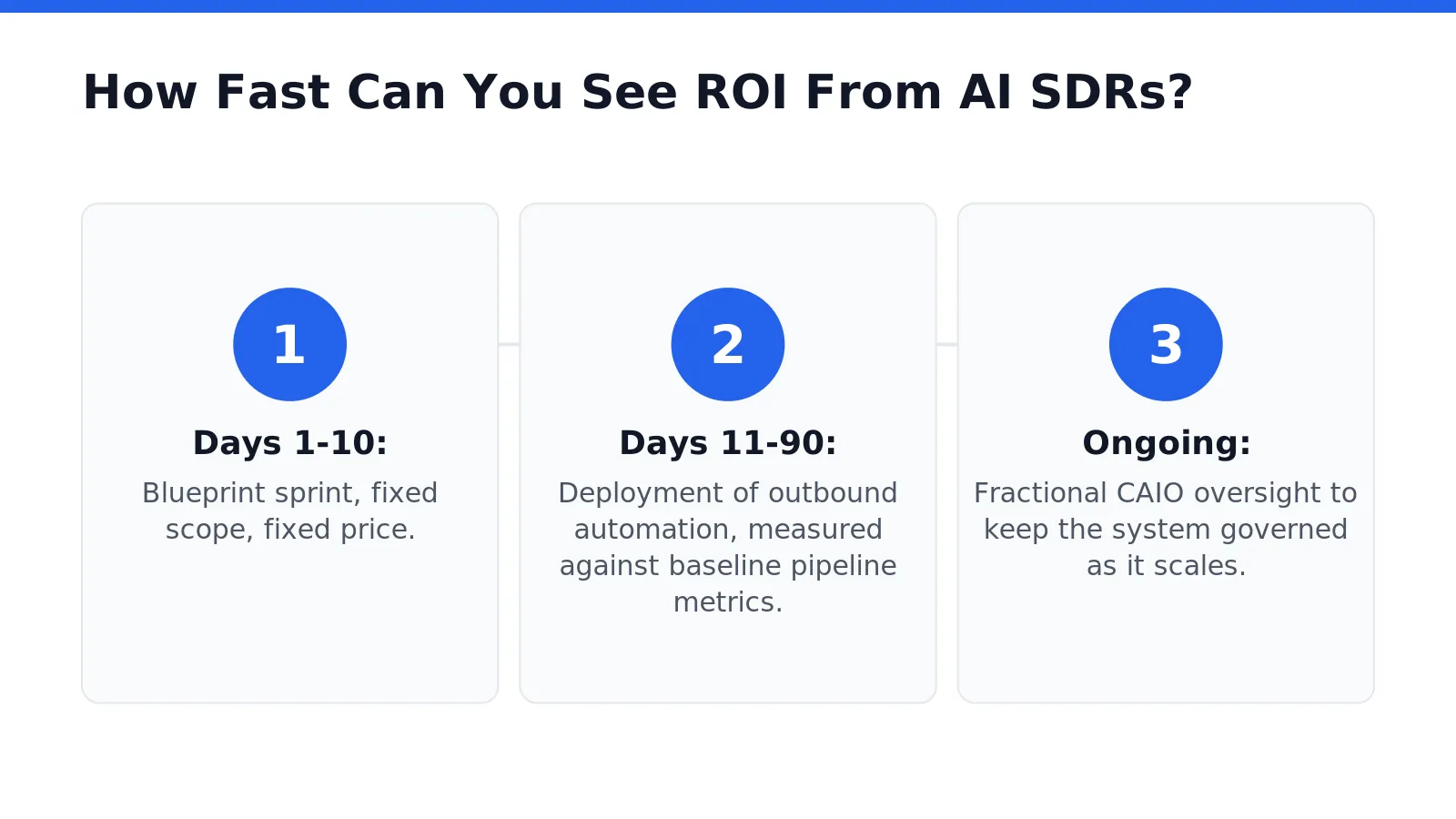
Put together, the sequence looks like this:
- Days 1-10: Blueprint sprint, fixed scope, fixed price.
- Days 11-90: Deployment of outbound automation, measured against baseline pipeline metrics.
- Ongoing: Fractional CAIO oversight to keep the system governed as it scales.
What’s The Right First Move For Sales Leaders?
Scaling outbound starts with a narrow pilot, not a company-wide rollout. We built our practice on this principle: our founder, Lee Pomerantz, holds the Certified Chief AI Officer credential overseeing every deployment we run. That credential matters less than the discipline behind it. We treat outbound sales automation as a precision tool, not a blanket replacement for reps.
Our mission is simple. We implement AI that saves time, reduces stress, and actually gets adopted by the team using it. A tool nobody trusts gets abandoned within a quarter, no matter how impressive the demo looked.
Where should sales leaders start the pilot?
Start with research and prioritization, not the full sequence. Scaling outbound well requires sharper prioritization. Automation that multiplies what existing reps already do, rather than automation that tries to replace their judgment entirely.
What does a 30-day pilot actually look like?
We recommend a structured first move:
- Pick one segment and deploy AI sales agents for account research only.
- Measure rep time saved weekly, not just pipeline volume.
- Expand the autonomous SDR scope only after reps report real relief, not just leadership enthusiasm.
We run this playbook from Fort Wayne, Indiana, serving sales teams across the United States. The geography matters less than the sequencing: research first, judgment last.
FAQ
Do autonomous SDRs replace the need for sales reps?
No. Autonomous SDRs automate research, message drafting, and reply classification. Reps retain control over fit, tone, and send timing to protect deliverability and brand trust.
How do autonomous SDRs help pipeline grow without new hires?
Pipeline grows through sharper prioritization and automation that multiplies existing reps’ output, replacing gut-feel targeting with data-driven research that runs continuously in the background.
What specific tasks do autonomous SDRs handle in outbound sales?
Autonomous SDRs handle account research, first-draft message writing, and inbound reply classification by intent, judgment-free steps that free reps to focus on calls worth making.
Conclusion
In closing, autonomous SDRs represent the operational inflection point where outbound sales scales without proportional headcount investment. The technology works only when paired with governance, human oversight, and a clear-eyed understanding of your sales motion. Organizations that treat autonomous outreach as a set-and-forget tactic fail. Those that architect it as a governed system, with feedback loops, compliance controls, and strategic human judgment, capture the efficiency gains that drive revenue growth and operational freedom.