

Autonomous content operations connect research, writing, SEO, and approval into one governed system instead of disconnected manual steps. Our AI Opportunity Blueprint™ maps these workflows in a 10-day sprint for $5,000, then we deploy human-in-the-loop agents engineered specifically for in-house marketing teams.
Key Takeaways

- In-house marketing teams eliminate manual content workflows by implementing autonomous AI agent orchestration systems today.
- eMediaAI’s AI Opportunity Blueprint™ identifies operational inefficiencies and delivers measurable ROI within 90 days for clients.
- Autonomous content operations reduce team bottlenecks by 10x through predictive lead scoring and zero-touch nurture workflows.
- Fractional Chief AI Officer services from eMediaAI guide marketing teams through scalable infrastructure implementation without full-time hires.
Why Are Traditional Content Workflows Falling Apart?
Legacy content processes break down because they were built for a slower, single-channel publishing cadence stacked with hand-offs nobody ever removed. Separate tools for drafting, keyword research, and SEO review force marketing teams into constant manual transfers that eat hours every week.
Most in-house marketing teams at SMB and mid-market organizations still run disconnected, multi-tab processes: one person drafts, another researches keywords in a separate tab, a third checks SEO scores after the fact, often too late to change anything. We see the same pattern across client after client: 2026 output expectations get stacked on top of workflows designed for an earlier era, and the backlog keeps growing anyway.
Adoption numbers tell a different story than the workflow reality on the ground. HubSpot’s 2026 State of Marketing Report found that marketers plan to use AI in content creation. Yet the tools rarely talk to each other. A single writer drafting faster with AI doesn’t fix a pipeline that still demands manual formatting, manual data transfer, and manual review across disconnected systems. That gap between individual AI use and connected autonomous content operations is exactly where staff hours disappear.
What Is the Real Cost of a Disconnected Content Workflow?
The cost shows up as lost hours: time managers spend managing handoffs instead of producing or improving content. Each manual transfer between a drafting tool, a research tab, and an SEO checker adds friction that compounds across a quarter’s content calendar.
- Drafting happens in one tool, research in another, SEO scoring in a third.
- Approvals wait on whoever checks their inbox last.
- Formatting and re-formatting consume time nobody budgeted for.
We built eMediaAI around a different mission: implement an ai content workflow that saves time and reduces stress, not stack another disconnected tool onto a strained team. That’s the difference between adding software and deploying lean marketing agents that actually remove steps.

What Does an Autonomous Content Operation Look Like?
An autonomous content operation replaces the single-prompt chatbot with a connected network of self-correcting agents. These agents research, plan, write, optimize, and report with little human hand-holding, passing work between stages the way a well-run production line passes a part from station to station. We build this structure for clients, not as a novelty, but as the backbone of a true ai content workflow.
The defining trait is reasoning, not just drafting. A single tool that generates a blog post on command is not an agent in this sense. A real agent thinks through a multi-step marketing strategy. Executes each stage without waiting for a fresh prompt at every turn. That distinction separates lean marketing agents from the chatbot add-ons most teams already have.
What stages does an autonomous content system actually run?
A typical agentic pipeline breaks into five connected functions:
- Research agents pull topic and competitive signals.
- Planning agents sequence the content calendar.
- Writing agents draft against that plan.
- Optimization agents check structure and quality before publication.
- Reporting agents close the loop with performance data.
We handle the integration and deployment work that connects these stages into one working system, rather than five disconnected tools.
Does automation mean losing control over quality and brand voice?
No, not when governance is built in from the start. Our Responsible AI Principles require fairness, safety, privacy, and transparency controls inside any automated content system we deploy. People-first design and clear governance keep marketing leaders in command of what ships, even as agents handle the execution load.

Why Do Lean Marketing Agents Beat Bloated Stacks?
Small, goal-seeking agent networks outperform sprawling tool stacks because fewer handoffs mean fewer failure points. Industry data from Gartner, cited in recent reporting on autonomous marketing teams, shows adoption is already underway. Enterprise marketing organizations have deployed autonomous agents into live production. That adoption curve rewards focus, not breadth.
Most marketing teams patch together disconnected point tools and spend hours fixing broken integrations instead of shipping work. The teams pulling ahead skip that maintenance cycle entirely. They deploy a small number of lean marketing agents that carry a campaign from brief to deployment without constant manual intervention.
We built our People-First, Then Process, Then Tech approach around that same principle. A handful of governed agents, each with a clear mandate, beats a dozen tools stitched together with workarounds. Our view: complexity is not capability. Complexity is risk, waiting to surface during a product launch or an earnings week, when no one has time to debug an API.
That’s also why we never treat autonomous content operations as an unsupervised experiment. We align every deployment with NIST and EU AI Act governance frameworks, not best-efforts oversight. Governance has to travel with the agent, not get added after the fact.
How many agents does a lean marketing team actually need?
Fewer than most teams assume. The pattern we see working: three to five agents, each owning one stage of the pipeline, connected end-to-end rather than bolted together.
Does fewer tools mean less capability?
No. A disciplined ai content workflow built on fewer, better-governed agents produces more finished work than a wide stack of disconnected point tools, because nothing stalls waiting on a human to move data between systems.
How Fast Can Governed AI Workflows Show ROI?

Governed AI content deployments return measurable ROI in under 90 days, not the open-ended quarters typical of bolted-on automation projects. We built our model around a simple conviction: strategy without a deadline turns into permanent discovery. Marketing leaders who wait six months for a roadmap lose that time twice, once in planning and again in the output their competitors shipped meanwhile.
Our AI Opportunity Blueprint compresses that planning phase into a ten-day sprint. Instead of months of workshops, we audit existing friction points inside the content function and hand back a deployment-ready roadmap built around the highest-impact use cases. The output is not a slide deck. It is a sequenced plan for where autonomous content operations replace manual handoffs first.
What Does a Governed AI Content Workflow Actually Produce?
A governed ai content workflow connects research, drafting, optimization, and reporting into one accountable system rather than isolated tools.
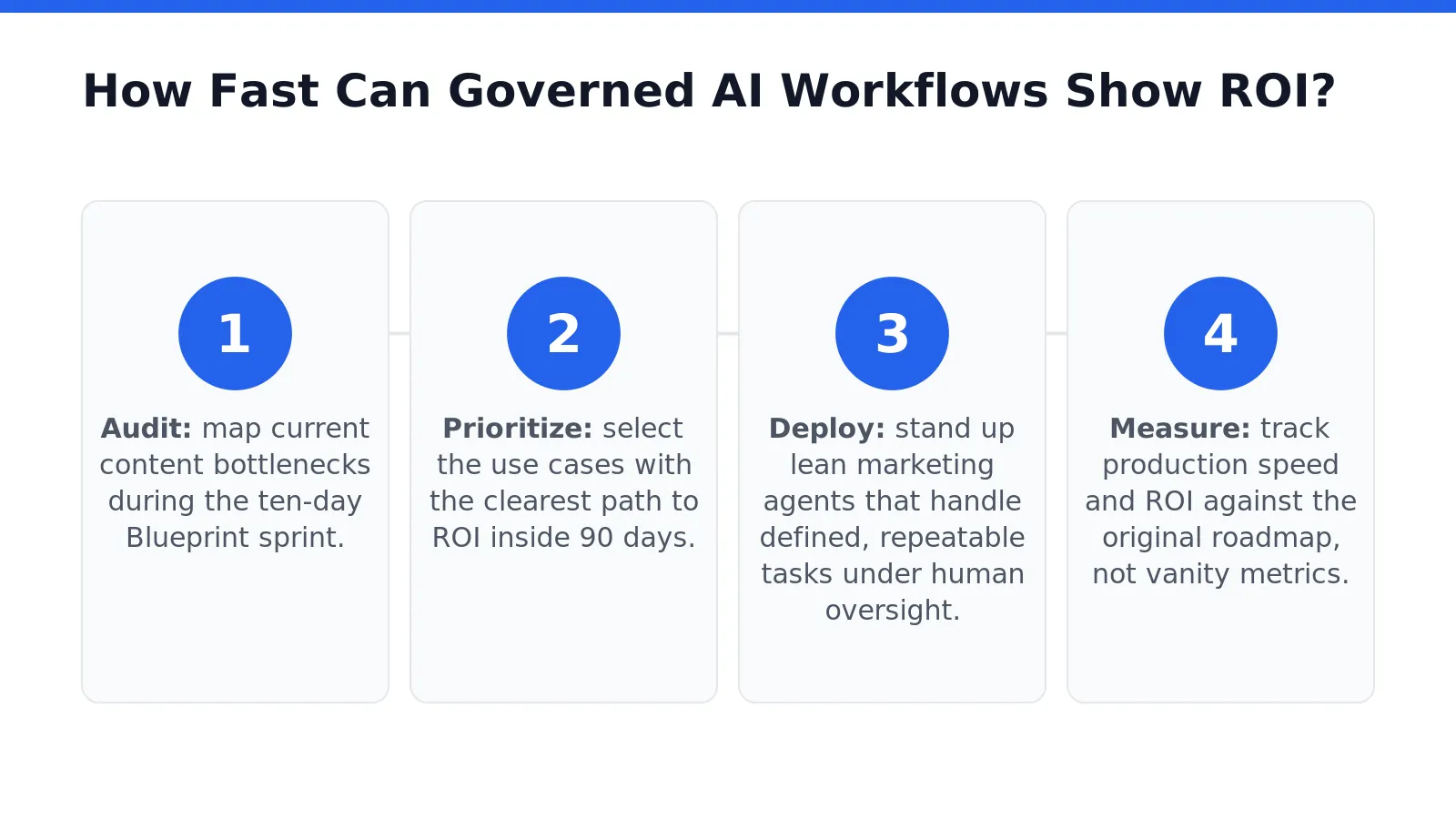
That speed comes from structure, not shortcuts. A properly sequenced rollout looks like this:
- Audit: map current content bottlenecks during the ten-day Blueprint sprint.
- Prioritize: select the use cases with the clearest path to ROI inside 90 days.
- Deploy: stand up lean marketing agents that handle defined, repeatable tasks under human oversight.
- Measure: track production speed and ROI against the original roadmap, not vanity metrics.
Clarity up front, not experimentation in public, is what makes the 90-day timeline realistic.
What Should Marketing Leaders Do First?

Marketing leaders should start with an audit of existing workflows, not a software purchase. Skipping that step wastes budget on tools that automate a process already broken. Sequence matters more than technology here: map the bottleneck first, then decide which parts of the content pipeline a machine can safely run.
We built our own engagement around that sequence. Our founder, Lee Pomerantz, a Certified Chief AI Officer, leads execution personally, pairing strategy with the technical deployment work most consultants hand off to a junior team. That combination matters once a marketing department moves from one-off experiments into full autonomous content operations. The gap between strategy slides and working code is where most AI projects stall.
Does a Fractional Chief AI Officer Replace a Marketing Team?
No. A fractional Chief AI Officer role adds ongoing strategic oversight after the initial roadmap ships, rather than handing over a document and disappearing. We offer this role specifically because an ai content workflow needs governance that evolves as agents take on more responsibility, not a one-time audit that goes stale by next quarter.
How Do Teams Avoid Burnout When Adopting AI Agents?
Literacy training built on human-in-the-loop controls keeps staff in charge of judgment calls while agents absorb repetitive work. That structure gives marketing teams back operational freedom instead of adding another system to manage.
Three things we tell every marketing leader before scaling:
- Audit the workflow before buying the tool.
- Keep a human reviewing every agent decision that touches brand voice.
- Treat governance as ongoing, never a one-time setup.
We operate out of Fort Wayne, Indiana, and support marketing leaders at companies nationwide as they adopt lean marketing agents without losing control of quality.
FAQ
What are autonomous content operations?
Autonomous content operations connect research, writing, SEO, and approval into one governed system instead of disconnected manual steps. A network of self-correcting AI agents researches, plans, writes, optimizes, and reports with little human hand-holding.
Why do traditional content workflows break down?
Legacy processes were built for a slower, single-channel publishing cadence stacked with hand-offs nobody removed. Separate tools for drafting, keyword research, and SEO review force teams into constant manual transfers that eat hours every week.
What does eMediaAI’s AI Opportunity Blueprint™ involve?
The AI Opportunity Blueprint™ maps a marketing team’s content workflows in a 10-day sprint for $5,000. Afterward, eMediaAI deploys human-in-the-loop agents engineered specifically for in-house marketing teams.
Conclusion

In closing, autonomous content operations succeed when strategy precedes technology and governance protects both speed and integrity. The teams that win are those that treat AI as a force multiplier for human creativity, not a replacement for it. Your in-house marketing function already understands your brand voice and customer intent better than any external vendor ever will. The work now is building the systems, training, and oversight that let your people move faster without sacrificing control or accountability.