


Streamline Your AI Journey: From Random Experiments to Measurable ROI
Artificial intelligence experiments that start with curiosity but lack purpose are what we call “Random Acts of Digital”—ad-hoc prompts, one-off automations, and pilots that never connect to measurable business goals. This article shows leaders of small and mid-sized businesses how to convert those scattered experiments into a focused program that delivers quantifiable value, with a practical promise: identify and launch high-impact pilots that can produce measurable ROI within 90 days. You will learn the risks of ad-hoc AI, a people-first approach to prioritizing use cases, the KPI framework to quantify gains, and a phased roadmap for readiness, pilot design, deployment, and governance. Along the way we illustrate how human-centric and ethical practices reduce adoption friction and improve outcomes, and we show how fractional executive leadership can provide affordable oversight. Expect actionable tables, short formulas for quick ROI estimates, and checklists you can use immediately to stop wasting spend and start realizing 5x outcomes from your AI investments.
What Are the Risks of Random Acts of Digital in AI Adoption?

Random Acts of Digital are uncoordinated AI experiments that fail to align with business processes and objectives, causing wasted time and budget. Because these efforts are disconnected from measurable KPIs and governance, they commonly produce fragmented outputs that teams cannot operationalize, leading to low adoption and hidden ongoing costs. The most critical consequence is opportunity cost: time spent on low-impact automations delays investment in high-return use cases that could drive revenue uplift or operational savings. Recognizing these risks is the first step toward a strategy that prioritizes impact over novelty, and the next section explains how lack of strategy specifically translates into wasted spend and poor ROI.
The typical risks include financial waste, stalled adoption, compliance exposure, and broken workflows that cascade into customer-facing issues. To crystallize these risks for decision-makers, consider the following succinct list of the most common failure modes and their business effects.
- Wasted Spend: Unscoped pilots consume budget but fail to produce measurable change.
- Low Adoption: Teams abandon tools that do not integrate with workflows or improve day-to-day tasks.
- Compliance & Bias Risk: Ungoverned models can introduce legal, ethical, or reputation exposures.
These failure modes are preventable when organizations adopt a strategic, people-first process that prioritizes low-drag, high-impact pilots and establishes governance before scaling.
How Does Lack of AI Strategy Lead to Wasted Spend and Low ROI?
A missing AI strategy means experiments are chosen for novelty or curiosity rather than for alignment with measurable business objectives; this causes prioritization errors where low-impact projects receive disproportionate resources. Without clear criteria, teams often pick technical feasibility over business value, leading to pilots that look successful in isolation but deliver negligible financial impact when measured. Hidden costs compound the problem: model maintenance, retraining, tooling subscriptions, and integration work inflate total cost of ownership beyond initial estimates. The remedy is a simple prioritization mechanism—score use cases by impact versus effort so executive sponsors and teams can agree on what to fund and why.
A strategic approach also requires early definition of success metrics to prevent ambiguous outcomes and ensure pilots produce decision-grade data. Clear ROI baselines and measurement windows (for SMBs, a 30–90 day projection) make it possible to stop projects that fail to meet thresholds and redeploy resources to higher-return opportunities, improving overall portfolio performance and reducing waste.
Research highlights that AI can significantly benefit SMEs by providing actionable insights and recommendations, thereby improving decision-making and fostering competitive dynamism, though careful management of data quality, bias, and privacy is crucial.
AI-Powered Innovation for SMEs: Driving Growth and Mitigating Risks
Findings reveal that AI-driven assessments based on data analysis, pattern recognition, and predictive modeling significantly benefit SMEs by offering actionable insights and recommendations, enabling efficient decision-making, and promoting competitive dynamism. However, limitations such as data quality, algorithmic bias, and privacy concerns must be carefully managed to avoid potential risks associated with AI implementation. The study discusses the impact of AI on reducing the “innovation divide” by democratizing access to advanced innovation management tools, thus supporting SMEs in achieving strategic growth and market adaptability. This research concludes that AI-driven tools represent a valuable asset for SMEs, bridging gaps in consultancy access, and fostering economic inclusivity.
Why Do Overwhelmed Teams Resist AI Adoption Without a Clear Roadmap?
Teams resist AI when it adds perceived work, introduces uncertainty, or lacks tangible benefits to daily tasks; this resistance is intensified when leadership fails to communicate a roadmap that ties AI to role-level improvements. Overload and change fatigue are common in SMBs where staff wear multiple hats, making even well-intentioned pilots feel like extra work. The social mechanism of adoption depends on rapid wins that demonstrably reduce effort or improve outcomes; absent those wins, enthusiasm evaporates and tools sit unused.
Reducing resistance requires involving frontline employees in use-case selection, offering targeted training tied to workflows, and appointing clear governance for model behavior and escalation. By designing pilots that augment repetitive tasks and track employee well-being metrics, organizations increase the chance that pilots stick and scale into sustained ROI—an outcome we explore next when discussing the structured Blueprint approach.
How Does eMediaAI’s People-First AI Opportunity Blueprint™ Drive 5x ROI for SMBs?
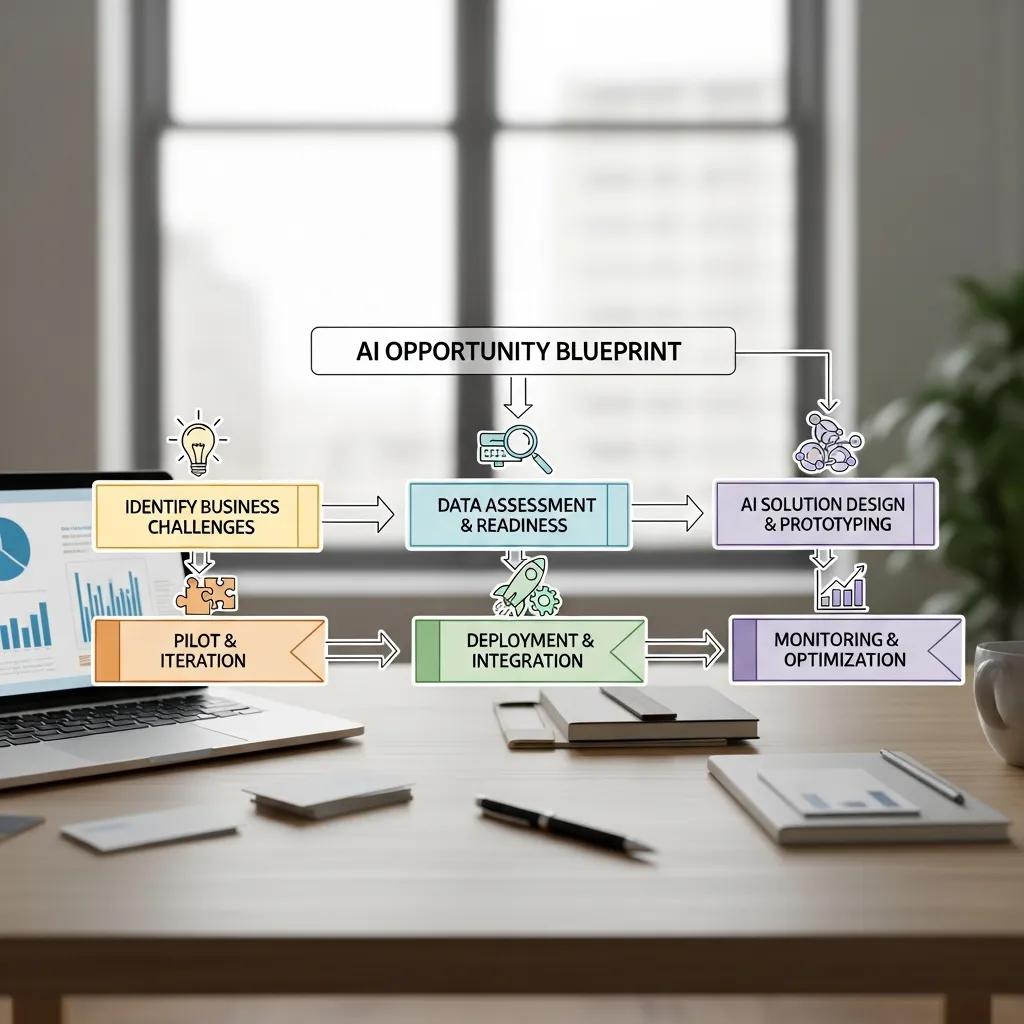
The AI Opportunity Blueprint™ is a focused, 10-day structured discovery that identifies low-drag, high-impact AI pilots and produces measurable ROI projections and a scoped pilot plan. The Blueprint applies a people-first methodology: it combines stakeholder interviews, workflow mapping, and use-case scoring to surface opportunities that improve employee productivity and customer outcomes. Deliverables include a prioritized use-case list, a pilot scope with success metrics, a 90-day ROI projection, and recommended governance controls to manage bias and compliance. This process reduces exploratory waste and accelerates pilot-to-production timelines by creating clear decision criteria.
The Blueprint is offered as a priced, fixed-duration engagement designed to de-risk discovery: it is a 10-day structured roadmap that culminates in actionable pilots and ROI estimates for those pilots. For SMBs seeking leadership support without hiring full-time, fractional executive options complement this work by providing ongoing governance and vendor oversight. Organizations that complete the Blueprint leave with a prioritized pipeline and precise next steps that shorten time-to-value and improve conversion from experiment to measurable benefit.
What Is the AI Opportunity Blueprint™ and How Does It Identify High-Impact Use Cases?
The Blueprint’s methodology combines rapid discovery interviews, process mapping, and a quantitative scoring model that weighs impact versus effort to rank use cases. During the 10-day engagement, cross-functional stakeholders are interviewed to surface pain points that map to tangible KPIs—time saved, error reduction, cost avoided, or revenue uplift. Use-case scoring applies a simple matrix to estimate probable 90-day value and required integration effort, producing a ranked list that fuels pilot selection. The approach emphasizes pilotability: prefer use cases with accessible data, minimal integration friction, and clear measurement windows so teams can demonstrate impact quickly.
This prioritization leads directly into pilot scoping where success metrics, data inputs, and governance checkpoints are defined, ensuring pilots are measurable and that the organization can decide whether to scale, iterate, or halt a project after the evaluation window.
How Does Fractional CAIO Leadership Support SMBs Without Full-Time Costs?
Fractional Chief AI Officer (fCAIO) engagement provides executive AI leadership, governance, and vendor oversight on a part-time basis so SMBs can access strategic direction without the expense of a full-time hire. The fCAIO defines AI governance policies, sets measurement frameworks, coordinates vendor and cloud tool choices (including generative models and managed platforms), and mentors internal teams to adopt new workflows. This model reduces risk by providing continuous oversight and by ensuring pilots align to business objectives and compliance standards.
Compared with hiring full-time, fractional leadership accelerates decision-making and avoids costly mis-hires while retaining strategic accountability. For SMBs, the combination of a time-boxed Blueprint followed by fractional leadership offers a practical path from discovery to accountable execution without ballooning overhead.
How Can Small Businesses Quantify AI Value and Measure ROI Effectively?
Measuring AI ROI begins with defining the right KPIs, establishing a baseline, and selecting a short, measurable window—90 days is a practical period for SMBs to observe meaningful change. The measurement framework focuses on operational KPIs (time saved, throughput), financial KPIs (cost savings, revenue uplift), and adoption KPIs (user engagement, manual steps eliminated). A simple ROI formula for pilots is: (Annualized benefit – annualized cost) / annualized cost; for 90-day pilots convert the observed benefit to a 12-month estimate or report the realized 90-day value directly for decision-making.
To make this pragmatic, use the following example use-case projections for common SMB pilots—these are sample estimates to adapt to your business context and inputs.
Intro to ROI table: The table below provides sample SMB use cases, the primary KPI to track, and an expected 90-day value range to help prioritize pilots.
| Use Case | Metric (KPI) | Expected 90-day Value (quantified) |
|---|---|---|
| Content automation (marketing copy, product descriptions) | Time saved per piece / cost avoided | 200–600 hours saved → $10k–$30k labor value |
| Video ad production automation | Production time / cost per ad | 60–80% faster → $8k–$25k production savings |
| Finance automation (invoicing, reconciliations) | Days to close / error rate | 30–50% faster processing → $5k–$20k error/cost reduction |
| Customer support triage (assistants) | Response time / resolution rate | 40–60% faster response → improved retention value |
What Are the Key AI ROI Metrics and KPIs for Small and Mid-Sized Businesses?
Define KPIs that are measurable, attributable to the AI pilot, and tied to business value. Operational KPIs include time saved per task, throughput increases, and error reduction percentages; financial KPIs capture direct cost savings, incremental revenue uplift, and payback period; adoption KPIs track user engagement, percent of workflows automated, and reduction in manual steps. Data sources are critical: use system logs, time-tracking data, financial records, and before/after sampling to generate credible baselines and post-implementation measurements.
A simple KPI checklist helps teams maintain measurement discipline:
- Establish Baseline: Measure current performance over a representative period.
- Define Measurement Window: Use 30–90 days for pilots depending on frequency of events.
- Attribute Outcomes: Use A/B testing or controlled rollouts when possible to isolate AI impact.
AI adoption can significantly boost SMEs’ dynamic capabilities, enabling them to adapt to new demands, pivot operations, and enhance efficiency, thereby reducing business risks and improving competitive advantage.
AI for SMEs: Boosting Capabilities, Competitive Advantage, and Reducing Business Risks
The study indicates that AI enables SMEs to boost their dynamic capabilities by leveraging technology to meet new types of demand, move at speed to pivot business operations, boost efficiency and thus, reduce their business risks.
SMEs have transformed to succeed in the emerging digital world (Chan, Morgan, et al.,2018; Chan, Teoh, et al.,2018; Ulas,2019). Indeed, digital technologies aided by Artificial Intelligence (AI) have transformed the nature and scope of entrepreneurial activity in SMEs (Hansen & Bøgh,2021; Ulas,2019). It has been shown that SMEs that adopt digital technology aided by AI enhance their competitive advantage and productivity (Chan et al.,2018; Chan, Morgan, et al.,2018; Kumar & Kalse,2021). SMEs invest in AI technologies to track users’ habits and provide recommendations, improve customer’s purchasing decisions, search results, media communication, trade raise sales, improve organisational performance, and lower costs (Basri,2021; Chan et al.,2018a,b; Hansen & Bøgh,2021; Jablonska & Polkowski,2017; Ulas,2019; Ulrich et al.,2021).
Which Case Studies Demonstrate Realizing AI ROI in Under 90 Days?
Real-world SMB pilots commonly show value in content workflows, video production, and finance operations because these areas have repeatable tasks and measurable outputs. For example, automating ad creative iteration and templated video edits can reduce production time dramatically, enabling more campaign tests and higher conversion rates. Content automation for product descriptions or email drafts often delivers rapid time savings and improved SEO throughput. Finance and reconciliation pilots that automate rule-based matching reduce manual review and correct error-prone steps, yielding quick cost avoidance.
When measuring these case studies, prioritize transparent before/after baselines, document the intervention (model, tool, integration steps), and report both absolute gains and payback periods to support scaling decisions. eMediaAI’s measurement approach emphasizes tight 90-day projections and post-pilot validation to decide on scaling or iterating.
What Is Human-Centric and Ethical AI Implementation for SMBs?
Human-centric AI centers people in design, ensuring systems augment human work, preserve employee well-being, and operate transparently and fairly. Ethical AI implementation for SMBs translates these principles into concrete practices: define Responsible AI Principles, run bias and impact evaluations, and monitor employee outcomes as part of success metrics. This approach aligns adoption incentives—when employees see AI reducing drudgery rather than replacing roles, adoption accelerates and retention benefits follow. The next subsection explains how Responsible AI Principles are operationalized in practice.
Human-centric practices also improve customer trust since transparent models and clear governance reduce the risk of biased outputs and reputational harm. By treating ethics as a driver of adoption and not merely a compliance checkbox, SMBs can create sustainable value that compounds as pilots scale.
The successful adoption of AI in digital transformation hinges on a human-centric approach, where Human Resource Management plays a vital role in aligning AI’s technological capabilities with organizational goals and human values.
Human-Centric AI Adoption: HRM’s Role in Digital Transformation Success
The rapid advancement of Artificial Intelligence (AI) in the business sector has led to a new era of digital transformation. AI is transforming processes, functions, and practices throughout organizations creating system and process efficiencies, performing advanced data analysis, and contributing to the value creation process of the organization. However, the implementation and adoption of AI systems in the organization is not without challenges, ranging from technical issues to human-related barriers, leading to failed AI transformation efforts or lower than expected gains. We argue that while engineers and data scientists excel in handling AI and data-related tasks, they often lack insights into the nuanced human aspects critical for organizational AI success. Thus, Human Resource Management (HRM) emerges as a crucial facilitator, ensuring AI implementation and adoption are aligned with human values and organizational goals. This paper explores the critical role of HRM in harmonizing AI’s technological capabilities with human-centric needs within organizations while achieving business objectives.
How Do eMediaAI’s Responsible AI Principles Ensure Ethical AI Adoption?
eMediaAI emphasizes a people-first responsible AI approach grounded in transparency, bias mitigation, and employee impact monitoring. In practice this means documenting model inputs and decision logic, running targeted bias tests on representative data sets, and establishing audit trails for model decisions. Governance controls include approval gates for production deployments, sampling-based quality checks, and clear owner accountability for model behavior. These practices reduce legal and brand risk while increasing internal trust in AI outputs by making behavior explainable and testable.
Operationalizing responsible principles requires mapping controls to the pilot lifecycle—discovery, scoring, pilot, and production—so that ethics checks are not an afterthought but embedded in decision milestones.
Why Is Employee Well-Being Critical in Human-Centric AI Adoption?
Employee well-being is directly tied to adoption: when AI reduces repetitive tasks and contributes to role enrichment, workers are more likely to embrace tools and advocate for scaling. Conversely, if AI is perceived as a surveillance or replacement technology, adoption stalls and morale suffers, eroding potential ROI. Trackable employee metrics—task time, satisfaction surveys, and voluntary turnover—should be part of pilot KPIs to ensure interventions improve both productivity and workplace experience.
Tactics that preserve well-being include role redesign to remove monotonous work, targeted retraining for higher-value tasks, and feedback loops that allow employees to flag model errors and suggest improvements, thereby converting frontline insights into iterative gains.
What Is the Step-by-Step AI Implementation Roadmap for Achieving Operational Excellence?
A practical implementation roadmap moves from readiness assessment to prioritized pilots, staged deployment, training, and governance to sustain gains. Here are five concise phases to capture the roadmap in operational terms and provide a how-to sequence for SMBs seeking measurable outcomes.
- Assess Readiness: Inventory data, people, and processes to score readiness.
- Discover & Prioritize: Use structured workshops to generate and rank use cases.
- Scope Pilot: Define metrics, data needs, integration, and success criteria.
- Deploy & Train: Implement a staged rollout with role-based training.
- Measure & Govern: Evaluate against KPIs and establish ongoing oversight.
These numbered steps create a clear path for teams to stop ad-hoc experimentation and move toward accountable execution; the roadmap table below maps phases to activities and deliverables, including the 10-day Blueprint as an initial discovery phase.
| Roadmap Phase | Activities | Deliverables / Measures |
|---|---|---|
| Assess Readiness | Data audit, skills inventory, process mapping | Readiness scorecard, prioritized gaps |
| Discover & Prioritize (10-day Blueprint) | Stakeholder interviews, use-case scoring | Ranked use-case list, 90-day ROI estimates |
| Scope Pilot | Technical design, integration plan, governance checklist | Pilot spec, success metrics, test plan |
| Deploy & Train | Staged rollout, role-based training, feedback loops | Pilot results, adoption metrics, training completion |
| Measure & Govern | Post-pilot evaluation, governance handoff | ROI report, governance playbook, scale recommendation |
How to Conduct an AI Readiness Assessment for Your Business?
A readiness assessment scores four dimensions: data, people, process, and strategy. For data, evaluate availability, cleanliness, and access; for people, inventory skills and executive sponsorship; for process, identify repeatable workflows amenable to automation; for strategy, confirm alignment with top business goals. Use a simple scoring model—red, amber, green—or a numeric 1–5 scale to prioritize remediation work and recommend next steps based on the score range.
If readiness is low, remediation might focus on data capture and minimal viable datasets; if readiness is medium, prioritize pilots with accessible data; if readiness is high, accelerate pilot deployment with governance and fractional leadership support to sustain progress.
What Are the Best Practices for Deployment, Training, and Ongoing AI Support?
Best practice is to run staged deployments starting with a controlled pilot group, tie training to real workflows, and embed monitoring so teams can see early wins and flag issues quickly. Training should be contextual—task-based sessions that demonstrate how AI augments specific activities—and include feedback channels so users can report model issues or suggest improvements. For ongoing support, define monitoring KPIs, schedule sampling audits, and maintain a governance role (e.g., a fractional CAIO) to manage vendor relationships and compliance.
Combining staged rollout with continuous measurement ensures that adoption scales only when pilots prove positive ROI and when governance ensures stable, explainable behavior.
How Can SMBs Overcome Common AI Adoption Challenges to Maximize ROI?
Common adoption challenges include limited AI expertise, constrained budgets, data quality issues, and vendor selection friction; each challenge has practical, low-cost mitigations that SMBs can deploy quickly. Focusing on quick wins with minimal integration, using fractional leadership, and applying minimal viable datasets for pilots can dramatically reduce time-to-value. The following table maps common challenges to practical fixes and the resource or role that typically addresses them.
Intro to challenge/fix matrix: Use this matrix as a troubleshooting guide to link each common barrier to concrete fixes and who should own the work.
| Challenge | Practical Fix | Resource / Role |
|---|---|---|
| Expertise gap | Engage fractional CAIO or contract specialists | Fractional CAIO / Consultants |
| Cost constraints | Time-box pilots, focus on low-drag use cases | Product owner / Finance lead |
| Data quality issues | Create minimal viable datasets and improve capture | Data steward / IT |
| Vendor overload | Standardize evaluation criteria and pilot purchases | Procurement / fCAIO |
How to Address AI Expertise Gaps and Manage Costs Effectively?
SMBs mitigate expertise gaps by combining internal upskilling with fractional or contract expertise to lead strategy and vendor management. Fractional CAIOs provide governance and strategy without full-time cost, while contractors fill technical execution gaps for specific pilots. Budget management best practices include time-boxed pilots, predefined success gates, and caps on ongoing tool subscriptions to prevent runaway costs.
Comparative examples show fractional leadership often yields faster, lower-risk returns than ad-hoc hiring for early-stage AI programs, enabling SMBs to preserve capital while proving value before scaling investments.
What Data Strategies Support Successful AI Adoption in Small Businesses?
Successful data strategies focus on improving hygiene, creating minimal viable datasets, and ensuring secure access and labeling practices. Start by cataloging existing data sources, prioritize datasets that feed high-value use cases, and apply lightweight governance: clear access controls, basic lineage documentation, and sampling checks for label quality. Quick wins include automating data capture for key workflows and using small, validated datasets to run pilots that demonstrate value without full-scale data engineering.
- Prioritize high-impact datasets that map to chosen KPIs.
- Use skeletal governance and access controls to protect sensitive data.
- Iterate on labeling quality with small human-in-the-loop checks.
These pragmatic steps convert data from a blocker into an accelerator, enabling pilots to deliver measurable ROI that supports broader investment decisions.
Frequently Asked Questions
What are the first steps for small businesses to implement AI effectively?
The initial steps for effective AI implementation include conducting a readiness assessment, which evaluates data availability, team skills, and alignment with business goals. Following this, businesses should prioritize use cases that can deliver quick wins and measurable ROI. Engaging stakeholders in the discovery process ensures that the selected pilots address real pain points. A structured approach, such as the AI Opportunity Blueprint™, can help streamline this process and set clear expectations for outcomes.
How can small businesses ensure their AI pilots are ethical and responsible?
To ensure ethical and responsible AI pilots, small businesses should establish clear Responsible AI Principles that guide their implementation. This includes conducting bias evaluations, maintaining transparency in model decisions, and monitoring the impact on employees and customers. Regular audits and governance checks should be integrated into the pilot lifecycle to ensure compliance with ethical standards. By prioritizing human-centric design, businesses can foster trust and improve adoption rates among employees and customers alike.
What role does employee training play in successful AI adoption?
Employee training is crucial for successful AI adoption as it helps staff understand how AI tools can enhance their workflows. Training should be contextual and tied to specific tasks, ensuring that employees see the practical benefits of AI in their daily activities. Providing ongoing support and feedback channels allows employees to voice concerns and suggest improvements, which can lead to better tool adoption and overall satisfaction. A well-trained workforce is more likely to embrace AI, leading to higher ROI.
How can small businesses measure the success of their AI initiatives?
Measuring the success of AI initiatives involves defining clear KPIs that align with business objectives. These can include operational metrics like time saved, financial metrics such as cost reductions, and adoption metrics that track user engagement. Establishing a baseline before implementation and using a defined measurement window (typically 30-90 days) allows businesses to assess the impact of AI accurately. Regular evaluations against these metrics help in making informed decisions about scaling or iterating on AI projects.
What common challenges do small businesses face when adopting AI, and how can they overcome them?
Common challenges in AI adoption for small businesses include limited expertise, budget constraints, and data quality issues. To overcome these, businesses can engage fractional leadership for strategic guidance, focus on low-drag use cases that require minimal integration, and create minimal viable datasets for pilots. By prioritizing quick wins and leveraging existing resources effectively, SMBs can navigate these challenges and maximize their AI investments.
How can small businesses maintain ongoing support for their AI initiatives?
Ongoing support for AI initiatives can be maintained through structured governance, regular performance evaluations, and continuous training. Establishing a governance role, such as a fractional Chief AI Officer, can help oversee AI projects and ensure alignment with business goals. Additionally, implementing feedback loops allows teams to address issues promptly and adapt to changing needs. Regularly scheduled audits and updates to training materials will keep the workforce engaged and informed about the latest AI developments.
Conclusion
Transforming random acts of digital into strategic AI initiatives can significantly enhance ROI for small businesses. By prioritizing high-impact pilots and establishing clear governance, organizations can avoid wasted resources and achieve measurable outcomes. Embracing a structured approach, such as the AI Opportunity Blueprint™, empowers teams to align AI efforts with business goals effectively. Start your journey towards maximizing AI value by exploring our tailored solutions today.