
Budgets break under consumption-based AI pricing: one 2026 report found usage-based models exceed planned spend by 40% as token and API costs spike unpredictably. Flat-rate engagements, like eMediaAI’s $5,000 AI Opportunity Blueprint™, give finance teams a fixed number to govern against instead of an unpredictable usage meter. We weigh vendor pricing against verifiable outcomes, not projected savings, before recommending any contract to clients.
Key Takeaways

- Consumption-based pricing models exceed budget plans by 40%, creating unpredictable costs for enterprises.
- Defining measurable outcomes for AI agents remains difficult; interpretation conflicts plague implementation efforts.
- Flat-rate pricing eliminates usage chaos and provides budget certainty compared to token-based models.
- eMediaAI’s AI Opportunity Blueprint™ identifies sustainable pricing strategies aligned with your business outcomes.
Why Is AI Agent Pricing So Confusing Now?
Vendors are rewriting the rules of software pricing faster than finance teams can model them. AI agent pricing models now mix per-seat licenses, usage tiers, and outcome fees inside a single contract. That blend creates real budgeting risk for buyers who still expect a flat-rate invoice. The shift traces back to a basic change in what software does. Agents now perform the work a team used to assemble by hand, which makes a per-seat license a weak proxy for value delivered.
That single change explains most of the confusion. Once an agent, not a human, produces the output, the old math breaks down. Executives end up comparing contracts that look similar on paper but allocate cost in entirely different ways:
- Flat-rate licenses, priced per seat regardless of agent activity
- Usage-based plans, where consumption vs flat rate ai structures tie cost to tokens processed or tasks completed
- Hybrid models blending a base fee with variable charges
Why Does Token-Based Pricing Feel Unpredictable?
Token-based pricing feels unpredictable because the unit of work varies wildly from task to task. A short summary and a multi-step reasoning job can carry the same label but wildly different costs. The token based pricing vs flat rate decision often comes down to this volatility: a flat rate gives you one number to plan around, while token billing gives you a meter that moves with every request. token costs budgeting becomes a guessing exercise without real usage data.
How Should Executives Respond to This Shift?
We built eMediaAI’s mission around implementing AI that saves time, reduces stress, and actually gets adopted, not around chasing the lowest headline rate. Confusing pricing creates the exact operational anxiety that mission exists to remove. Our founder, a Certified Chief AI Officer, gives leadership teams a credentialed reference point when vendor claims start to contradict each other.

What Is Consumption-Based AI Pricing, Exactly?
Consumption-based AI pricing ties the bill directly to measured usage, not to a headcount of licensed seats. Cost scales with tokens processed, API calls made, and compute cycles consumed. We walk clients through this distinction constantly, because most vendor contracts bury it in fine print until the invoice arrives.
The practical effect is simple: a lightweight task costs pennies, and a complex multi-agent reasoning run costs far more. That variability is the core of what separates consumption vs flat rate AI billing from traditional software economics. Flat-rate software made budgeting predictable. AI usage billing does not, at least not without discipline.
How Does Usage-Based Billing Differ From a Flat-Rate License?
A flat-rate license charges one fee regardless of how hard the software works. Usage-based billing charges for the actual work performed, measured in tokens, calls, or compute time. Executives comparing vendors need to ask which model governs the contract before signing, not after the first invoice.
Before committing to either model, we recommend separating evaluation cost from deployment cost. Our AI Opportunity Blueprint™ reflects that separation directly:
- Fixed, flat-rate structure: priced as a flat fee, independent of any token volume or API traffic generated during the engagement.
- 10-day delivery window: producing a structured roadmap on a known timeline, not an open-ended usage meter.
- Predictable evaluation cost: a known number before any consumption-based agent deployment begins.
Token costs budgeting starts with this separation. Know what the diagnosis costs before pricing out the ongoing meter. We built the Blueprint specifically so leadership teams get clarity without absorbing usage risk on day one.

Why Do Consumption Costs Blow Past Budgets?
Vendors bill AI agents by variable units, not flat-rate seats, and none of those units show up on a forecast until the invoice arrives. Finance teams build budgets around headcount and subscriptions, a habit that breaks down the moment usage replaces seats as the real cost driver. Common usage-based cost drivers include:
- Tokens processed per request
- API calls made per agent action
- Compute cycles consumed during multi-step reasoning tasks
Consumption-based pricing already pushed actual AI spend 40% past budgeted plans in 2026, according to a Vertice industry report. That gap is not a rounding error; it reflects what happens when billing shifts from fixed seats to variable, unpredictable units.
Can Outcome-Based Pricing Solve the Problem?

Partially, but not cleanly. Outcome-based pricing promises that organizations pay only when an AI agent delivers a result, and we understand the appeal. No result, no invoice. That pitch sounds like the cleanest answer to the volatility baked into most ai agent pricing models. The catch sits in the definition of the outcome itself.
What counts as a “resolved” outcome?
A resolved support ticket or a qualified sales lead rarely has one agreed-upon meaning. The criteria often favor whoever wrote the contract, usually the vendor, and verifying the outcome after the fact proves difficult. We’ve watched clients discover this gap only after disputing an invoice line by line.
Does outcome-based pricing replace consumption or flat-rate billing?
Not yet, and we don’t expect it to soon. The debate over consumption vs flat rate ai billing still runs alongside outcome pricing rather than being replaced by it. Until the priced outcome matches the actual value delivered, in a way both sides can verify without argument, outcome-based contracts will keep coexisting with usage-based and flat-fee structures.
That ambiguity is exactly why we push executives to define success before signing anything. Our firm’s readiness and audit work exists to pin down what “resolved,” “qualified,” or “completed” means in a contract. A vendor’s definition becomes the only one on the table. We also help finance teams build the token costs budgeting discipline needed to compare an outcome-based proposal against a usage-based one on equal footing.
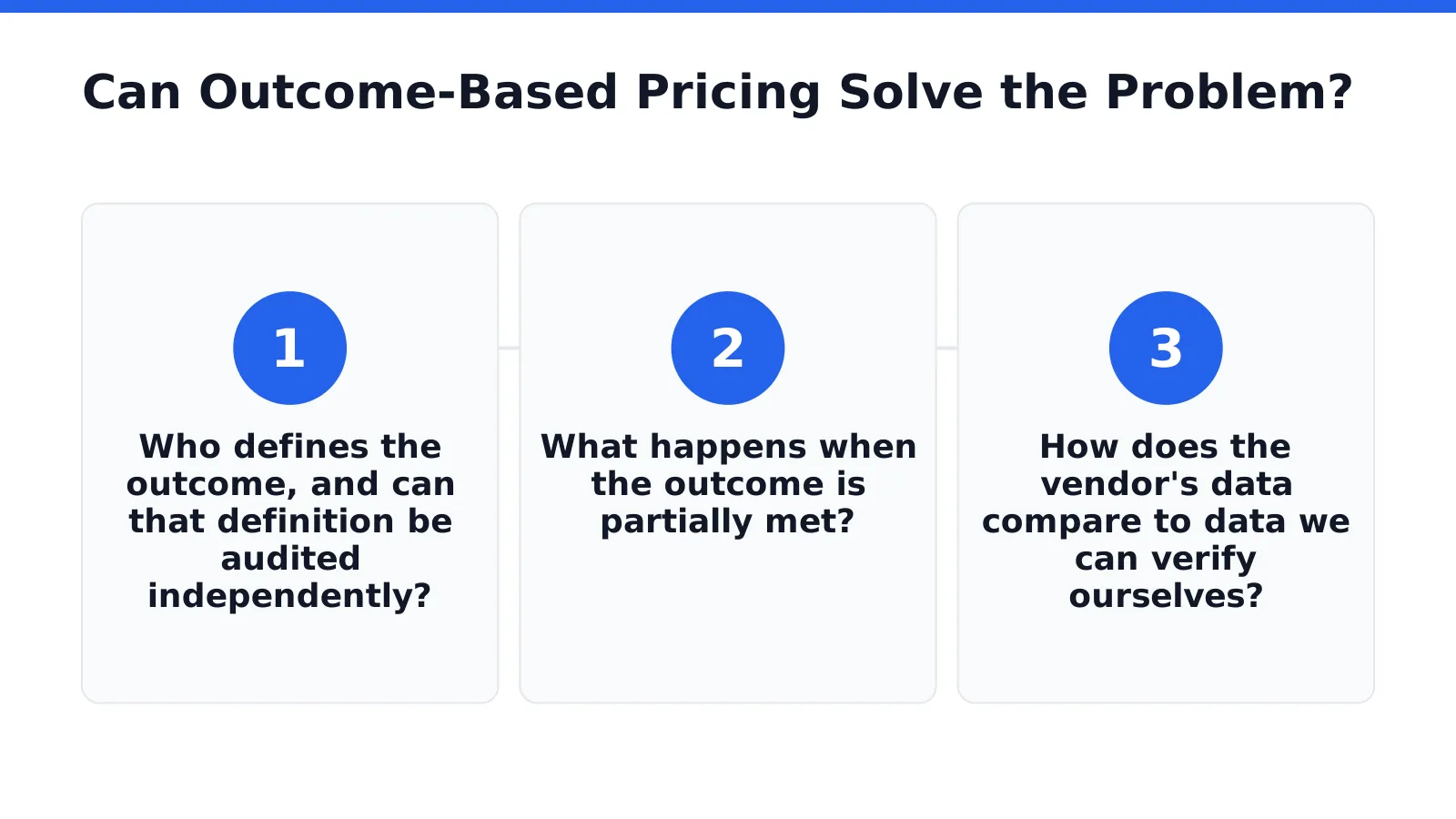
Three questions belong in every outcome-pricing negotiation:
- Who defines the outcome, and can that definition be audited independently?
- What happens when the outcome is partially met?
- How does the vendor’s data compare to data we can verify ourselves?
Skipping these questions is how organizations end up paying for outcomes they never actually received.
How Should Executives Evaluate Vendor Pricing?

Executives should hold every vendor proposal against one question: what result does this deliver, and by when? We built our own engagements around that discipline, helping clients see measurable ROI in under 90 days. That benchmark gives operations leaders a concrete yardstick against any AI agent pricing model a vendor pitches, whether it bills by seat, by usage, or by some hybrid of the two.
Price structure matters less than the governance behind it. We evaluate every deployment, ours and any vendor’s, against principles that put people first: fairness, safety, privacy, transparency, and clear accountability for how the system makes decisions. A vendor billing on consumption vs flat rate AI without disclosing how usage gets measured, and without being governed, is asking for trust it has not earned.
What questions should executives ask before signing an AI agent contract?
Ask how the vendor defines a billable unit, and ask for it in writing. Request a sample invoice before signing anything. This is the core of ai agent cost governance: treating pricing terms as something to audit before signing, not something to discover after the first invoice.
- Does the contract specify what counts as one unit of work, or does that definition shift after signing?
- Can the finance team audit usage logs independently of the vendor’s dashboard?
- What happens to cost if usage spikes unexpectedly mid-quarter?
- Does the vendor publish its data-handling and transparency standards, or only its feature list?
Does geography affect who can evaluate these contracts well?
Headquarters location matters less than cross-industry pattern recognition. Operating out of Fort Wayne, Indiana, and serving clients across the country, we have reviewed pricing structures across industries with very different usage patterns and budget cycles.
That range matters for token costs budgeting, since a retail client’s usage curve looks nothing like a manufacturer’s. Executives without that comparative view risk accepting a contract built for someone else’s volume, not their own.
FAQ
What makes consumption-based AI pricing risky for budgets?
Consumption-based pricing ties costs to tokens, API calls, and compute cycles. A 2026 Vertice report found these usage-based models exceed planned spend by 40% as costs spike unpredictably.
How does flat-rate pricing solve the budgeting problem?
Flat-rate engagements, like eMediaAI’s $5,000 AI Opportunity Blueprint™, give finance teams a fixed number to govern against, eliminating the usage chaos that token-based models create.
Who can help executives evaluate these vendor pricing models?
eMediaAI’s founder, Lee Pomerantz, a Certified Chief AI Officer, gives leadership teams a credentialed reference point for weighing vendor pricing against verifiable outcomes before signing any contract.
Conclusion

In closing, the consumption versus flat-rate decision hinges on your operational maturity and risk tolerance. Consumption models reward efficiency and scale; flat-rate structures provide predictability and governance clarity. The right choice depends on whether your team prioritizes cost control or operational velocity. Either way, the vendor relationship succeeds only when pricing aligns with your actual deployment needs and your capacity to manage the human side of AI adoption.