
In change management AI work, resistance drops when leadership provides structure: eMediaAI’s Fractional Chief AI Officer service guides clients through a clear roadmap, turning skeptical employees into confident adopters through measurable ROI milestones rather than vague promises.
Employee hesitancy stalls AI rollouts because leaders skip the people-first step. McKinsey’s 2025 research found over 60% of businesses haven’t scaled AI company-wide. We close that gap with “Human-in-the-Loop” controls, hands-on literacy training, and governance aligned to NIST and the EU AI Act, giving staff time back instead of more burnout.
Key Takeaways

- Over 60% of businesses haven’t scaled AI company-wide, revealing widespread adoption challenges across industries.
- Employee resistance stems from lack of engagement and change management, not technology limitations alone.
- Leadership must address cultural barriers and provide clear communication to drive meaningful team adoption.
- eMediaAI’s AI Opportunity Blueprint™ identifies adoption roadblocks and delivers measurable ROI within 90 days.
Why Do Employees Resist New AI Tools?
Fear of job loss drives most resistance to new AI systems. That fear is one of the biggest risk factors in whether a rollout succeeds at all. Staff don’t reject automation because they dislike software. They reject it because nobody told them what happens to their role once the software works. We see this pattern across nearly every organization we advise: leadership announces a tool, skips the conversation about job security, and wonders why adoption stalls.
The pressure behind these rushed launches is real. Executives face demands to deliver more output with fewer resources during a period of rapid technological change. That pressure pushes many teams to deploy tools before staff are ready. Speed without readiness backfires. Change management AI work exists because technical deployment and human acceptance are separate problems; both must be addressed.
Is Employee Resistance a Top AI Project Risk?
Yes. Up to 70% of organizational change programs fail, largely because of employee pushback or weak management support, and AI rollouts follow the same pattern. The technology rarely breaks. The trust does.
Three conditions consistently precede failed employee AI adoption:
- No clear explanation of how the tool changes daily responsibilities
- No visible plan to retrain or redeploy affected staff
- No feedback channel for employees to raise concerns before launch
Our own approach starts from the opposite assumption: AI should save time, reduce stress, and earn adoption, not force it. Helping staff overcome AI fear means addressing the job question directly, not hoping it fades after launch.
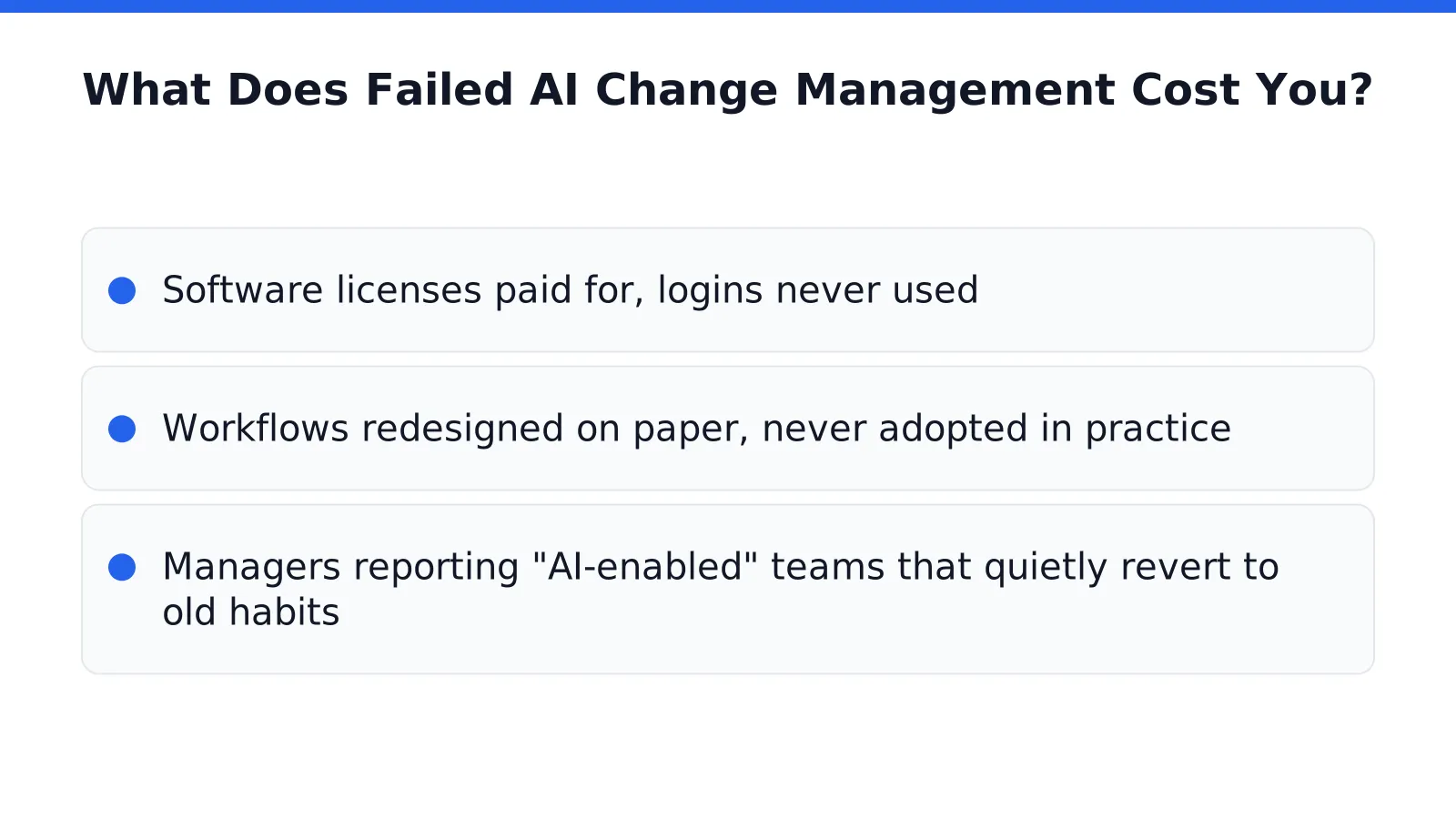
What Does Failed AI Change Management Cost You?
Failed change management AI rollouts cost budget, momentum, and staff trust, often before a single workflow improves. McKinsey’s 2025 research on the state of AI found that more than 60% of businesses have not. Begun scaling AI company-wide, according to the How to Increase AI Adoption in the Workplace report. Most organizations stall at the pilot phase, never reaching the deployment that justifies the spend.
We see the same pattern inside clients before we start: a pilot run, then silence. That silence has a price.
Why does uneven AI adoption hurt company culture?
Uneven rollouts split teams into two groups. One group works faster using AI tools; the other falls behind because they never adopted them. That gap breeds resentment and quietly punishes the employees who were never given proper training or a reason to trust the system.
What happens when leaders ignore employee resistance to AI?
Ignoring resistance does not make it disappear. It produces unused systems, wasted investment, and projects that stall mid-build, according to a CSA report on employee resistance.
The costs compound:
- Software licenses paid for, logins never used
- Workflows redesigned on paper, never adopted in practice
- Managers reporting “AI-enabled” teams that quietly revert to old habits
We built our Responsible AI Principles around this exact failure mode. People-first benefits, fairness, safety, and transparency come before automation metrics. A system employees won’t touch delivers zero return regardless of its capability. Employee AI adoption fails for human reasons first, technical reasons second. Any executive trying to overcome AI fear across a workforce has to treat that order correctly.
How Do You Build Trust To Overcome AI Fear?
Trust gets built by proving, with evidence employees can see in their own workflow, that new tools add capacity rather than cut headcount. Overcoming AI fear starts there: staff need to watch the technology augment their work, not replace it, according to a 2026 article on workplace AI adoption. Skip that proof step, and no rollout survives contact with a skeptical team.
We treat this as the first job of change management AI work, not an afterthought bolted on after deployment. A technically flawless system still stalls if employees feel anxious, distrustful, or unprepared. The Cloud Security Alliance notes in its research on employee resistance to AI adoption. Confidence has to be built deliberately, before launch day, not patched in afterward.
What Does eMediaAI Do Differently Here?
We run AI literacy sessions and workshops built specifically to raise employee confidence before any tool goes live. Our founder, Lee Pomerantz, holds a Certified Chief AI Officer credential and personally oversees the people-first decisions behind every deployment. That oversight keeps employee AI adoption grounded in operations reality, not theory.
How Do We Make Trust Measurable?
We pair readiness training with structured AI audit. Strategy work, giving trust-building an actual starting line instead of a vague promise. The combination looks like this:
- Audit first: map current workflows and friction points before introducing tools
- Train second: run literacy workshops so staff understand what the technology will and won’t do
- Deploy third: roll out with leadership accountable for adoption, not just installation
Skip any step, and resistance fills the gap.

What Role Should HR Play In AI Adoption?

HR owns the training and enablement function for AI adoption. That role extends naturally from the onboarding and upskilling work HR departments already handle daily. Operations and IT build the technical infrastructure; HR builds the human infrastructure that determines whether anyone actually uses it. Skip that second piece, and the most polished tool rollout stalls at the login screen.
We treat AI change management as an HR-led function, not an IT afterthought. HR teams already know how to sequence training, measure comprehension, and flag resistance before it becomes attrition. Applying that same discipline to AI tools turns a software rollout into a staffed, measured program with clear ownership.
What does HR need to drive successful AI adoption?
HR needs executive-level guidance that doesn’t require a full-time hire. Our Fractional Chief AI Officer service gives HR and operations leaders ongoing strategic oversight. Policy decisions on employee AI adoption get made by someone accountable, not left to whoever read the vendor pitch last.
How does HR help employees overcome AI fear?
Employees overcome AI fear when training connects directly to the systems they use, not a generic slide deck. Our integration and deployment work links policy decisions to the actual tools on an employee’s desktop. HR’s training plan matches the real workflow rather than a theoretical one.
The stakes keep rising. Over half of tech executives already expect AI agents to become core to daily operations within two years. Waiting for a “calmer” rollout window costs HR teams the lead time they need to build trust before adoption becomes mandatory. HR that moves now sets the pace; HR that waits inherits someone else’s rushed timeline.
How Do You Govern AI Adoption For Lasting Results?

Governance works when a fixed plan replaces open-ended exploration. We built our AI Opportunity Blueprint™ as a 10-day structured roadmap precisely for this reason: teams need a sequence they can follow, not a committee that meets indefinitely. That structure is what we think of as governed AI velocity, speed paired with accountability instead of speed at the expense of it, and it’s where real change management AI begins, because ambiguity is what kills momentum inside most organizations. Run this way, the Blueprint works as a repeatable enterprise AI adoption framework teams can apply to the next tool, not a one-off fire drill.
Cost clarity matters just as much as timeline clarity. We offer the Blueprint as a fixed $5,000 engagement. Executives know the investment before a single staff hour goes toward it. No scope creep, no surprise invoices three months in.
What Does Good AI Governance Actually Look Like Day To Day?
Governance is not a policy binder. It is a cadence of decisions tied to outcomes, reviewed on a schedule leadership actually keeps. We structure our engagements so clients see measurable ROI in under 90 days, which keeps governance anchored to results instead of activity for its own sake.
Who Should Own AI Decisions Inside The Company?
Someone needs to hold the strategy, and that role has a name: Chief AI Officer. A CAIO leads the organization’s AI strategy, oversees individual initiatives, and ensures the technology gets used ethically and effectively across departments. Without that ownership, employee AI adoption stalls because no one is accountable for outcomes.
Three elements separate durable governance from a stalled pilot program:
- A fixed roadmap with a defined endpoint, not open-ended discovery
- A known cost structure, agreed upon before work begins
- A named owner accountable for ROI, not just deployment
Done this way, organizations overcome AI fear by replacing uncertainty with a visible plan, a visible price, and a visible person in charge.
FAQ
Why do employees resist new AI tools?
Employees resist because leaders skip explaining how roles change, fail to plan retraining, and don’t give staff a channel to raise concerns before launch. The fear centers on job security, not dislike of the technology itself.
What does failed AI change management cost a company?
It costs budget, momentum, and staff trust, often stalling at the pilot phase before any workflow improvement justifies the spend. Most organizations purchase a license, run a pilot, then go silent.
How does uneven AI adoption affect company culture?
Uneven rollouts split teams into those who adopt AI and work faster and those who fall behind without proper training. This gap breeds resentment and punishes employees who were never given a reason to trust the system.
Conclusion

In closing, employee adoption succeeds when leadership treats AI as a tool that returns time to people, not a threat to their roles. The shift from hesitancy to confidence happens through transparent governance, hands-on training, and visible wins, not mandates. Organizations that prioritize human readiness alongside technical deployment build teams that accelerate, not resist. The path forward belongs to those willing to lead with clarity and put people first.