

Empowering SMBs to Ethically Adopt AI: The Blueprint Revealed
Small businesses that want to adopt AI responsibly need a clear, practical route from principle to practice; the AI Opportunity Blueprint does precisely that by translating ethical AI principles into actionable steps that deliver measurable value. This article explains how ethical AI differs from generic AI adoption, outlines a human-centric framework tailored for small and mid-sized businesses, and maps the Blueprint’s phases to concrete deliverables and safeguards. Readers will learn how to assess AI readiness, design governance artifacts, mitigate bias and privacy risks, and measure ROI while keeping people-first outcomes central to decision-making. The piece also shows how fractional leadership and targeted workshops can reduce resource strain and accelerate adoption. Finally, you’ll find checklists, EAV-style comparisons of typical SMB use cases and outcomes, and practical next steps to start an ethical AI program. With recent research emphasizing fairness, transparency, and governance, this guide offers a compact roadmap for SMBs to adopt AI safely, ethically, and profitably while preserving trust.
This comprehensive approach aligns with recent academic research emphasizing the need for structured ethical AI roadmaps for small and medium enterprises.
Ethical AI Adoption Roadmap for SMEs: Bias, Privacy & Accountability
This paper examines the ethical considerations and societal implications of AI adoption by small and medium enterprises (SMEs) in emerging markets. Drawing on Stakeholder Theory, Diffusion of Innovation, and the Technology-Organization-Environment framework, it proposes a comprehensive conceptual model that places ethical principles, fairness, accountability, and inclusivity at its core. The discussion highlights the complex interplay of technological, organizational and societal dimensions, illustrating how AI can enhance competitiveness while potentially exacerbating inequalities and raising privacy, bias and transparency concerns. This framework can serve as a roadmap for responsible AI adoption, informing capacity-building initiatives, regulatory guidance and future empirical studies.
Ethical Considerations and Societal Impacts of AI Adoption In SMEs Within Emerging Markets, D Boikanyo, 2025
What Is Ethical AI and Why Is It Essential for Small Businesses?
Ethical AI means designing, deploying, and governing AI systems so they are fair, transparent, privacy-preserving, and subject to human oversight, which reduces harm and builds trust. The mechanism that makes ethical AI valuable is governance: processes and artifacts that align technical behavior with organizational values and legal obligations, producing usable and trustworthy outcomes for customers and employees. For small businesses, ethical AI is essential because limited scale amplifies reputational and regulatory risks, and early missteps can erode customer trust faster than large organizations experience. Adopting ethical AI also improves decision quality and employee morale by removing opaque automation and enabling human-in-the-loop controls. Understanding these points leads naturally to the concrete business benefits and human-centric principles that follow.
Indeed, the broader academic discourse consistently highlights the critical ethical and legal implications of AI, particularly concerning privacy, bias, and accountability in business operations.
AI’s Ethical & Legal Impact: Privacy, Bias, Accountability in Business
addresses the ethical and legal implications of Artificial Intelligence (AI) in business and employment, with a specific focus on privacy, bias, and accountability.
Ethical and Legal Implications of AI on Business and Employment: Privacy, Bias, and
Accountability, KS Reddy, 2024
Ethical AI benefits SMBs in several measurable ways:
- Stronger Customer Trust: Transparent decision logic reduces churn and complaint rates.
- Lower Operational Risk: Privacy-by-design and access controls reduce incident likelihood.
- Higher Employee Engagement: Human oversight and reduced drudgery improve retention.
- Faster Adoption: Clear governance accelerates rollout with fewer reversals.
These benefits illustrate why small businesses should treat ethical AI as a strategic priority, which prepares the context for practical human-centric principles next.
How Does Ethical AI Benefit Small and Mid-sized Businesses?
Ethical AI delivers specific advantages that map to business outcomes: improved accuracy reduces costly errors, transparency lowers customer friction, and privacy safeguards reduce compliance exposures. For example, automating routine tasks with oversight can free frontline staff for higher-value work, improving productivity and customer service metrics. Ethical AI also supports marketing and retention by making recommendation logic explainable, which increases conversion and reduces disputes. These impacts are often measurable within months when governance artifacts and monitoring are in place, which makes the return predictable for SMBs.
| AI Use Case | Benefit Type | Estimated Impact |
|---|---|---|
| Customer support triage | Time saved per ticket | 30–50% faster resolution |
| Lead scoring | Conversion lift | 10–25% higher qualified leads |
| Invoice processing | Error reduction | 60–80% fewer manual errors |
These examples demonstrate how ethical safeguards amplify tangible outcomes; the next subsection will unpack the human-centric principles that make these results reliable.
What Are the Core Principles of Human-Centric AI for SMBs?

Human-centric AI centers on fairness, transparency, privacy, accountability, and human oversight as core design principles that protect people and deliver reliable value. Fairness requires bias-aware datasets and evaluation metrics; transparency uses explainability and documentation to make system behavior understandable to stakeholders. Privacy is implemented through minimization, access controls, and anonymization so customer data is handled safely, while accountability establishes roles, decision logs, and audit trails to assign responsibility. Human oversight integrates review gates and escalation paths so humans can intervene when automation risks arise, ensuring that technology augments rather than replaces judgment.
- Fairness: Audit datasets for representativeness to prevent disparate impacts.
- Transparency: Maintain model cards and explanation tools to clarify outputs.
- Privacy: Limit data collection and enforce role-based access controls.
These principles form the foundation for operationalizing ethical AI, which the AI Opportunity Blueprint translates into phased activities and deliverables.
How Does the AI Opportunity Blueprint Facilitate Responsible AI Adoption?
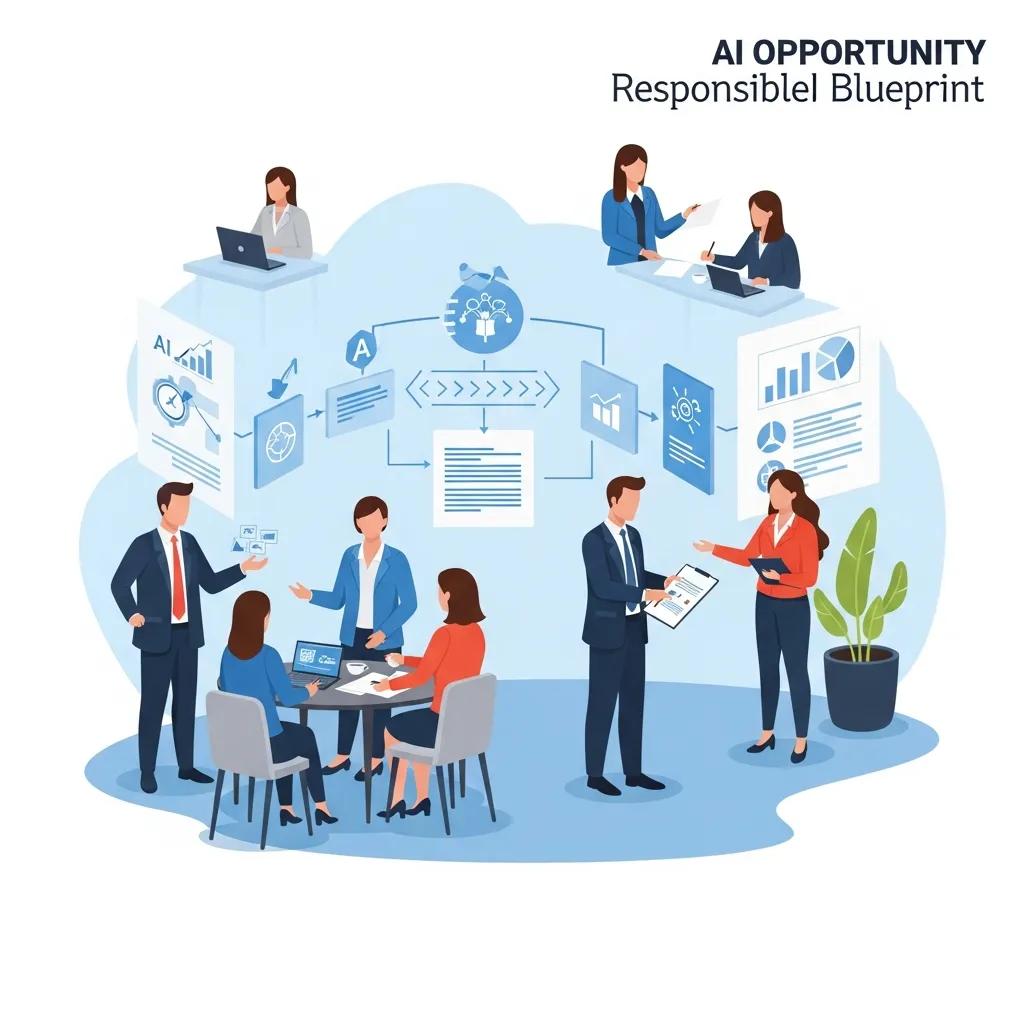
The AI Opportunity Blueprint operationalizes ethical AI by providing a concise, phase-based roadmap that embeds bias checks, privacy controls, and governance artifacts into each step of adoption. In practice, the Blueprint compresses discovery, strategy, and early deployment activities into a focused engagement that surfaces high-ROI use cases while protecting people and data. This structured approach ensures that each technical decision maps to an ethical safeguard and that measurable outcomes are identified early. Below is a compact phase mapping that links phases to ethical deliverables.
| Blueprint Phase | Deliverable | Ethical Outcome |
|---|---|---|
| Discovery & Readiness | Readiness scorecard, data inventory | Identifies bias and privacy risks early |
| Strategy & Framework | Ethical policy, governance model | Establishes accountability and approval workflows |
| Deployment & Oversight | Pilot rollout, monitoring plan | Ensures human oversight and continuous auditing |
This table shows how each phase creates artifacts that protect people and data while moving toward value. The next subsection details the phases and timelines for ethical implementation.
What Are the Key Phases of the AI Opportunity Blueprint for Ethical Implementation?
The Blueprint runs through three core phases: Discovery/Readiness, Strategy/Framework Design, and Deployment/Training/Oversight, each with embedded ethical checkpoints that reduce risk and speed adoption. Phase 1, Discovery/Readiness, focuses on stakeholder interviews, data inventories, and risk mapping to produce a readiness scorecard that highlights constraints and opportunities. Phase 2, Strategy/Framework Design, develops policies, governance roles, and evaluation metrics that operationalize fairness and transparency. Phase 3, Deployment/Training/Oversight, executes a pilot with monitoring, training, and feedback loops to sustain human oversight and iterative improvement.
- Discovery/Readiness — assess data, workflows, and ethical alignment.
- Strategy/Framework — design policies, metrics, and approval flows.
- Deployment/Oversight — pilot, train staff, and implement monitoring.
With these phases defined, the Blueprint also includes technical methods to mitigate bias and protect privacy, which the next subsection explains.
How Does the Blueprint Address Bias Mitigation and Data Privacy?
Bias mitigation under the Blueprint combines dataset audits, representative sampling, fairness metrics, and validation against real-world outcomes to detect and correct disparate impacts before deployment. Practical steps include bias audits that compare model outputs across demographic slices, synthetic resampling to balance datasets, and ongoing monitoring to capture drift. For privacy, the Blueprint prescribes data minimization, role-based access, anonymization techniques, and retention policies that limit exposure and align with legal expectations. Together, these methods form a privacy-by-design and fairness-by-design posture that prevents common harms and supports transparent accountability.
- Bias Checks: Audit → Remediate → Validate across segments.
- Privacy Controls: Minimize data, enforce access controls, anonymize outputs.
- Monitoring: Continuous performance checks and a drift alert system.
These techniques ensure a defensible and ethical deployment, and they naturally lead into the step-by-step strategy development described in the next major section.
What Steps Does the AI Opportunity Blueprint Include for Ethical AI Strategy Development?
The AI Opportunity Blueprint structures ethical strategy development into clear, actionable steps that produce governance artifacts, prioritized use cases, and measurable KPIs for SMEs to implement. The approach ensures that ethical alignment is assessed early, that policies and approval workflows are codified, and that deployment plans include training and monitoring. Each step generates deliverables such as a readiness report, ethics policy draft, risk register, and pilot metrics, making adoption auditable and repeatable. Below is a numbered list of the primary steps, optimized for quick reference and featured-snippet style clarity.
- Conduct AI readiness assessment and data inventory to identify constraints and risks.
- Prioritize use cases by impact and ethical feasibility, creating a risk-adjusted roadmap.
- Design an ethical framework including governance roles, approval workflows, and audit plans.
- Run pilot deployments with training, monitoring, and iteration plans tied to KPIs.
- Scale with ongoing governance, literacy programs, and fractional oversight as needed.
These steps convert ethical principles into operational artifacts and procedures, and the following subsections unpack Phase 1 assessments and Phase 2 frameworks in more detail.
How Is AI Readiness and Ethical Alignment Assessed in Phase 1?
Phase 1 uses stakeholder interviews, a data inventory, workflow analysis, and a risk map to produce a readiness scorecard that highlights ethical and technical gaps. The assessment examines data sources, label quality, coverage, access controls, and existing manual processes that AI would touch. Outputs typically include a ranked list of risks, a candid readiness score, and recommended quick wins that minimize ethical exposure while maximizing value. This process delivers clarity about where governance, data improvements, or training will be required before moving forward.
- Assessment Artifacts: Readiness scorecard, data inventory, risk register.
- Typical Findings: Missing data documentation, role misalignment, privacy exposures.
- Next Steps: Prioritize fixes and select pilot use cases with low ethical risk.
By surfacing precise constraints and opportunities in Phase 1, organizations can design a strategy that balances speed and safety, which leads into the framework design covered next.
What Ethical Frameworks Are Designed During Phase 2 Strategy Development?
Phase 2 produces the governance artifacts that make ethical AI operational: an ethics policy, a governance model with roles and approval gates, audit plans, and monitoring metrics aligned to KPIs. The ethics policy defines acceptable use, data handling rules, and escalation procedures; the governance model assigns responsibility (decision owner, reviewer, auditor) to ensure accountability. Audit plans include test procedures and reporting cadence to validate fairness, privacy, and performance objectives. Together these frameworks create the organizational scaffolding needed to maintain ethical controls as AI scales.
| Framework Artifact | Purpose | Example Outcome |
|---|---|---|
| Ethics policy | Define acceptable AI uses | Clear do/ don’t for automation |
| Governance model | Assign roles and approvals | Who signs off on new models |
| Audit plan | Define tests and cadence | Regular bias and privacy checks |
Creating these artifacts ensures that technical deployments are bounded by organizational commitments, which prepares teams for deployment, training, and oversight in Phase 3.
How Does eMediaAI Support Ongoing Ethical AI Governance for SMBs?
eMediaAI offers consulting services that help SMBs operationalize and sustain ethical AI through advisory engagements, fractional leadership, readiness assessments, and workshops focused on AI literacy. These support options are designed to fit small business budgets and timelines while embedding people-first values like fairness, transparency, privacy, and governance. For teams that need hands-on help, fractional Chief AI Officer (fCAIO) arrangements provide part-time governance and vendor oversight without the cost of a full-time executive. The combination of strategy and practical training ensures SMBs can maintain ethical controls while scaling AI initiatives responsibly.
eMediaAI’s offerings complement the Blueprint by converting strategy into staffed execution and capacity building, which connects directly to the specific governance roles and workshops described below.
What Role Does the Fractional Chief AI Officer Play in AI Governance?
A Fractional Chief AI Officer from eMediaAI provides strategic oversight, enforces policy adherence, coordinates vendor selection, and maintains the governance lifecycle for SMBs that lack full-time AI leadership. The fCAIO sets priorities, reviews model risk, and ensures that approval workflows and audits are executed on schedule, acting as the accountable owner without requiring a permanent hire. This role accelerates decision-making, reduces vendor risk, and helps institutionalize ethical practices across teams. For SMBs, a fractional leader balances cost and expertise while maintaining continuous governance and alignment with business objectives.
The presence of a fractional leader also supports on-the-ground change management and training, which feeds directly into the AI literacy efforts described next.
How Do AI Literacy Workshops Build an Ethical AI Culture?
AI literacy workshops teach staff how AI systems work, what ethical risks to watch for, and how to apply governance tools like model cards and incident reporting in daily workflows. Workshops typically include modules on bias awareness, privacy hygiene, safe use policies, and human-in-the-loop practices, equipping teams to spot issues early and respond appropriately. Measured outcomes include higher adoption rates, fewer misuse incidents, and better cross-functional collaboration between technical and business teams. Training reinforces governance artifacts and empowers employees to be stewards of ethical AI, creating a culture where technology supports people rather than undermines them.
These capacity-building activities are essential to sustain ethical AI over time and to ensure the measurable benefits described in the next section.
What Are the Measurable Benefits of Ethical AI Adoption Using the AI Opportunity Blueprint?
Adopting ethical AI through the Blueprint produces measurable gains in productivity, accuracy, employee well-being, and ROI because the program prioritizes high-impact, low-risk use cases and embeds safeguards that prevent costly reversals. Measurable benefits often include percent reductions in manual hours, improvements in lead conversion, and decreases in customer complaints tied to clearer, explainable decision logic. The Blueprint’s emphasis on monitoring and auditing ensures that gains are sustained and that any drift or bias is detected early. The following table compares typical SMB use cases, their primary benefits, and representative impact ranges when implemented with ethical controls.
| AI Use Case | Benefit Type | Estimated ROI or Impact |
|---|---|---|
| Customer support automation | Time saved, customer satisfaction | 30–50% faster handling, +10% NPS |
| Sales lead scoring | Revenue uplift | 10–25% increase in qualified pipeline |
| Accounts payable automation | Cost reduction, error decrease | 40–70% fewer exceptions |
These figures show that ethical controls do not slow ROI; they make returns more predictable and defensible, which feeds into employee well-being and financial outcomes discussed next.
How Does Ethical AI Improve Employee Well-being and Productivity?
Ethical AI improves well-being by automating repetitive, low-skilled tasks while keeping humans in advisory or exception roles, which reduces burnout and raises job satisfaction. For example, automating invoice matching with human review for exceptions reduces tedious work and allows staff to focus on analysis and exception handling, increasing skill utilization and engagement. Measured outcomes include fewer overtime hours, higher task satisfaction scores, and lower attrition in pilot teams. By coupling automation with training and transparent decision logs, employees feel empowered rather than replaced, improving adoption and sustaining productivity gains.
These human-centered outcomes create the conditions for measurable financial returns, which the next subsection quantifies.
What ROI Can Small Businesses Expect from Ethical AI Implementation?
Small businesses can often expect ROI within months for targeted AI use cases, with pilot-stage returns driven by time savings and error reduction and scaling returns driven by revenue lift and improved customer retention. ROI drivers include use case selection quality, adoption rates among staff, and the robustness of governance and monitoring. Typical timelines to measurable benefit range from 30 to 90 days for automation pilots, with compounded gains as monitoring and iteration reduce error rates and improve models. Key KPIs to track include time saved per task, error/exceptions rate, conversion lift, and employee satisfaction metrics.
- Time saved per task — baseline vs. post-automation.
- Error rate — reductions tied to governance and audits.
- Revenue uplift — attributable to higher-quality leads or personalization.
Tracking these KPIs ensures that ROI is visible and that ethical safeguards contribute directly to sustainable value.
How Can Small Businesses Overcome Challenges in Ethical AI Adoption?
Small businesses face common barriers—limited budgets, scarce expertise, data quality issues, and fear of regulatory exposure—but the Blueprint and targeted services reduce these constraints through fixed-scope planning, prioritized use cases, and fractional governance. By focusing on high-ROI, low-risk pilots and by building governance artifacts early, SMBs can avoid over-investment and limit trial-and-error costs. Practical checklists and compact governance playbooks help teams implement safeguards without large teams or budgets, enabling steady, controlled adoption. The following problem/solution pairs succinctly map common challenges to direct Blueprint responses.
- Limited expertise → Fractional CAIO and targeted workshops for governance and upskilling.
- Budget constraints → Fixed-scope 10-day engagements to prioritize value (cost-effective planning).
- Poor data quality → Data inventory and remediation plans focused on high-impact fields.
What Common Ethical AI Challenges Do SMBs Face?
SMBs commonly encounter several ethical and operational obstacles: dataset bias due to small or skewed samples, unclear accountability without governance, privacy exposures from uncontrolled data access, limited AI literacy among staff, and scarce budget or time for sustained monitoring. Each challenge increases the risk that automation will cause harm or failure and reduces stakeholder trust. Recognizing these obstacles early allows teams to apply targeted mitigations such as sampling strategies, role-based approvals, anonymization, and lightweight monitoring. Identifying these common issues sets the stage for how the Blueprint’s structure addresses them directly.
How Does the AI Opportunity Blueprint Address Resource and Expertise Limitations?
The Blueprint addresses resource and expertise constraints through a fixed-scope, 10-day engagement model that prioritizes use cases, creates governance artifacts, and delivers an actionable roadmap without requiring large upfront investment. Prioritized pilots reduce time-to-value by focusing on high-impact tasks, and fractional leadership options supply expertise on an as-needed basis, avoiding costly full-time hires. Training workshops and clear playbooks transfer knowledge to internal teams so they can sustain governance and monitoring. The following table maps typical constraints to concrete Blueprint activities and eMediaAI services.
| Challenge | Constraint Type | Blueprint Response / Service |
|---|---|---|
| Limited budget | Financial | 10-day fixed-scope engagement for prioritized roadmap; focused pilots |
| Limited expertise | Human capital | Fractional Chief AI Officer and targeted AI literacy workshops |
| Data limitations | Technical | Data inventory, remediation plan, and sampling strategies |
This mapping demonstrates how constrained resources can be mitigated without sacrificing ethical safeguards. A final practical checklist follows to help SMBs take immediate next steps.
- Start with a short readiness assessment to surface risks and quick wins.
- Prioritize 1–2 high-impact, low-risk pilots to demonstrate value.
- Engage fractional leadership or workshops to build governance and staff capability.
- Implement monitoring and audit plans to detect bias or drift early.
These actionable steps help small businesses begin ethical AI adoption with controlled cost and strong safeguards. For teams ready to move from planning to execution, eMediaAI’s AI Opportunity Blueprint and related services provide a structured path and hands-on support to translate ethical principles into measurable outcomes while keeping people at the center of every decision.
Frequently Asked Questions
What are the key ethical considerations for small businesses when adopting AI?
Small businesses must consider several ethical aspects when adopting AI, including fairness, transparency, accountability, and privacy. Fairness involves ensuring that AI systems do not perpetuate biases present in training data. Transparency requires that businesses can explain how AI decisions are made, fostering trust among users. Accountability means establishing clear roles and responsibilities for AI outcomes, while privacy focuses on protecting user data through stringent controls. Addressing these considerations helps mitigate risks and enhances the ethical deployment of AI technologies.
How can small businesses measure the success of their ethical AI initiatives?
Measuring the success of ethical AI initiatives involves tracking specific key performance indicators (KPIs) such as customer satisfaction, error rates, and employee engagement. Businesses can assess improvements in customer trust through feedback and reduced complaint rates. Additionally, monitoring operational metrics like time saved and error reduction can provide insights into efficiency gains. Regular audits and assessments of AI systems against ethical standards also help ensure that the initiatives align with organizational values and legal requirements, providing a comprehensive view of success.
What role does employee training play in ethical AI adoption?
Employee training is crucial for the successful adoption of ethical AI as it equips staff with the knowledge and skills to recognize and address ethical risks. Training programs can cover topics such as bias awareness, data privacy, and the importance of human oversight in AI processes. By fostering a culture of ethical awareness, businesses empower employees to act as stewards of responsible AI use. This not only enhances compliance with ethical standards but also improves overall engagement and trust in AI systems among staff and customers alike.
How can small businesses ensure ongoing compliance with ethical AI standards?
To ensure ongoing compliance with ethical AI standards, small businesses should implement regular monitoring and auditing processes. This includes establishing governance frameworks that define roles, responsibilities, and approval workflows for AI projects. Continuous training and education for employees on ethical practices are also essential. Additionally, businesses can utilize feedback mechanisms to identify and address any ethical concerns that arise during AI deployment. By embedding these practices into their operations, small businesses can maintain compliance and adapt to evolving ethical standards in AI technology.
What are some common pitfalls small businesses face in ethical AI adoption?
Common pitfalls in ethical AI adoption for small businesses include inadequate data quality, lack of governance structures, and insufficient employee training. Poor data quality can lead to biased outcomes, while the absence of clear governance can result in accountability issues. Additionally, failing to educate staff on ethical AI practices may lead to misuse or misunderstanding of AI systems. To avoid these pitfalls, businesses should prioritize data management, establish robust governance frameworks, and invest in comprehensive training programs that promote ethical awareness and responsibility.
How can small businesses balance innovation with ethical AI practices?
Small businesses can balance innovation with ethical AI practices by adopting a phased approach to AI implementation that prioritizes ethical considerations alongside technological advancements. This involves conducting thorough assessments of potential AI use cases to identify ethical risks and benefits. By integrating ethical frameworks into the innovation process, businesses can ensure that new technologies align with their values and stakeholder expectations. Engaging in continuous dialogue with employees and customers about ethical implications also fosters a culture of responsibility, enabling innovation that is both effective and ethically sound.
Conclusion
Adopting the AI Opportunity Blueprint empowers small businesses to implement ethical AI practices that enhance customer trust, reduce operational risks, and improve employee engagement. By following a structured roadmap, organizations can achieve measurable outcomes while ensuring fairness, transparency, and accountability in their AI systems. This guide serves as a valuable resource for businesses ready to navigate the complexities of ethical AI adoption. Start your journey towards responsible AI implementation today by exploring our tailored services and resources.