

Mid-market agentic AI rollout succeeds through sequenced ownership, governance, and scale, not isolated pilots. Our 10-day AI Opportunity Blueprint™ fixes scope and priorities first. Weeks two through twelve build integrations, establish human-in-the-loop controls, and align IT with business units around one scalable use case. We target measurable ROI inside 90 days, not slide decks.
Key Takeaways

- eMediaAI’s AI Opportunity Blueprint™ delivers measurable ROI within 90 days for mid-market operators.
- Lee Pomerantz, Certified Chief AI Officer, leads structured agentic AI rollout execution plans.
- Fractional Chief AI Officer services close the gap between AI ambition and production deployment.
- eMediaAI helps founder-led and PE-backed companies move from isolated pilots to unified adoption.
What Must Be Ready Before Day One?
Readiness starts with ownership, not software. Mid-market operators often recognize that AI matters, yet most lack a clear, executable plan to turn that recognition into measurable value quickly. We treat the days before launch as the real work of any 90 day AI rollout plan. The organizations that stall usually skip this stage entirely.
Why do most AI rollouts stall before they start?
Most organizations know they need an AI strategy but have no clear execution path connecting that strategy to daily operations. The gap shows up not in the technology. In governance: the difference between pilots that succeed and rollouts that fail is governance infrastructure, not technical sophistication. We build that infrastructure first.
Before we sequence a single workflow, three conditions need to be in place:
- Named ownership. One executive owns outcomes; no committee decides by consensus.
- Defined use cases. Projects are prioritized by near-term impact, not novelty.
- Change management, not just a technical build. Companies that scale an agentic AI implementation roadmap successfully treat it as an organizational shift involving staff, workflows, and incentives.
What does a readiness assessment actually produce?
A readiness assessment produces a prioritized, dated project list, not a slide deck. We use a structured 10-day process to translate scattered AI opportunities into ranked projects with near-term impact, giving operators a concrete starting point for phased AI deployment instead of an open-ended pilot. That list, not enthusiasm, is what Day One requires.

Days 1-10: How Do You Build The Roadmap?
Ten days is the deadline we hold ourselves to, not a vague estimate. We built a fixed-scope AI Opportunity Blueprint™ priced at $5,000 specifically to remove cost ambiguity from the planning phase. Executives deserve a number upfront, not a change order three weeks into discovery.
Open-ended workshops stretch into months and still leave COOs without a document they can act on. We compress that process into a structured 10-day roadmap instead. Speed matters as much as rigor when competitors are already testing agents. Ten days forces discipline: no wandering workshops, no circular stakeholder interviews that never resolve into a decision.
What Does The Blueprint Actually Produce?
By day 10, we deliver four concrete outputs: a readiness checklist, governance steps, fractional leadership options for ongoing oversight, and measurement templates targeting ROI inside 90 days. Each piece exists to answer a specific executive question, not to pad a slide deck.
Who Signs Off On The Roadmap?
Lee Pomerantz, our founder and a Certified Chief AI Officer, leads roadmap oversight directly. That credential matters because technical plans without executive-level accountability tend to stall once budget scrutiny begins.
We build each agentic ai implementation roadmap using semantic methods, specifically use-case mapping, EAV tables, and KPI formulas. These tools convert aspiration into a document engineers can build from and CFOs can approve. The result is a phased ai deployment plan grounded in specifics, not slogans, ready to move from paper to production without another round of discovery fatigue.
Days 11-30: How Do You Launch The Pilot?

Launch begins with governance, not code. We sequence every phased ai deployment the same way: lock versioned standards and approval rules first, then layer in routing and secrets controls. Skipping that order invites exactly the sprawl we get hired to clean up.
What belongs in the first pilot team?
Pick one team and one workflow. We treat this as the test case for our broader agentic ai implementation roadmap, proving the controls hold before anyone scales them. The workflow should involve real decisions, not a demo.
AI agents fit this stage well. They reason, learn, and act on their own, which makes them suited to decision workflows that would otherwise sit on a human’s desk. We don’t deploy an agent until the approval rules governing it are written down and version-controlled.
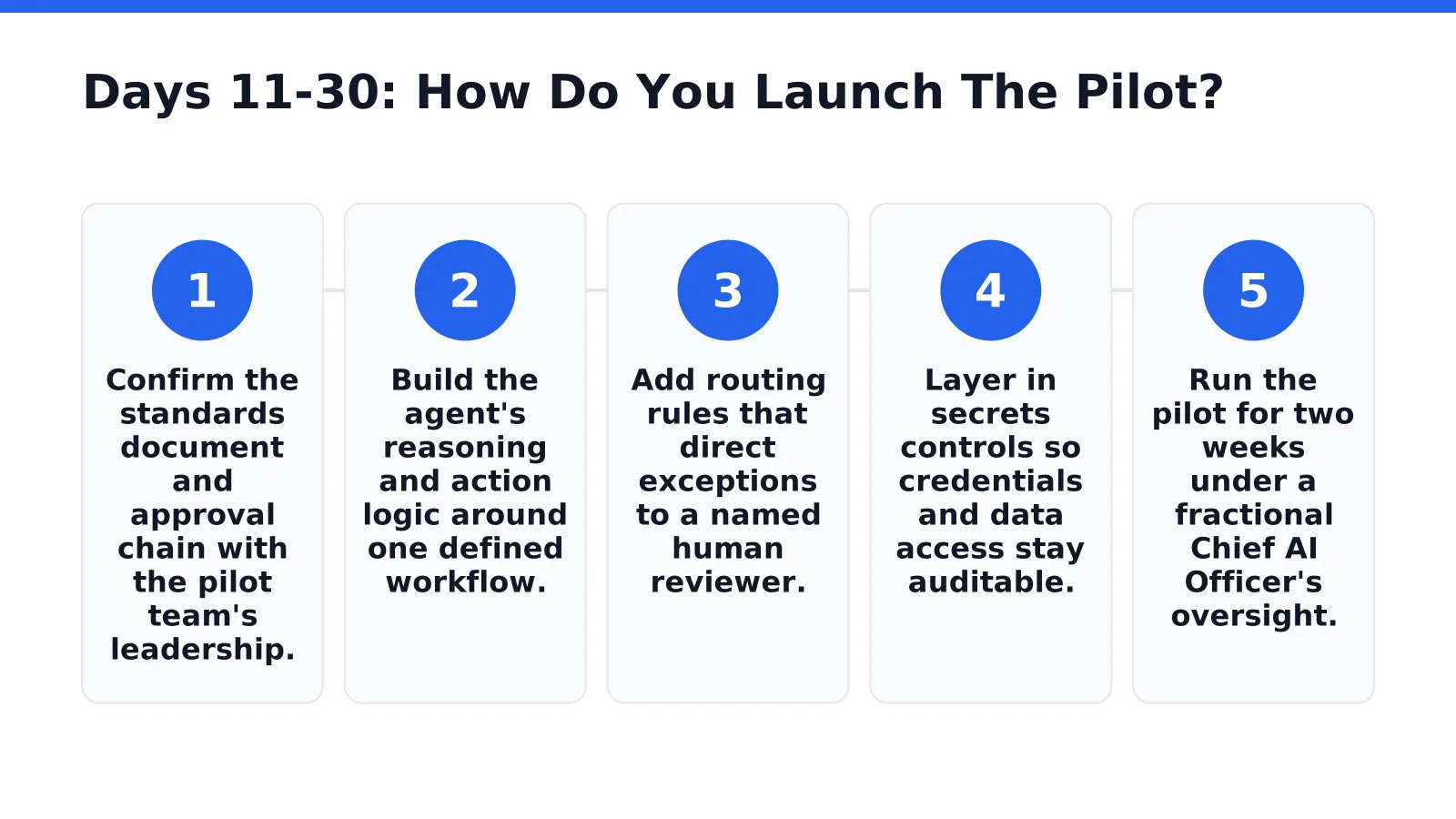
Our 20-day build runs through five steps:
- Confirm the standards document and approval chain with the pilot team’s leadership.
- Build the agent’s reasoning and action logic around one defined workflow.
- Add routing rules that direct exceptions to a named human reviewer.
- Layer in secrets controls so credentials and data access stay auditable.
- Run the pilot for two weeks under a fractional Chief AI Officer’s oversight.
Does the pilot stop at strategy?
No. We handle integration and deployment work ourselves, not just a roadmap document. Our teams write the connectors, configure the permissions, and stand up the monitoring. A plan nobody can deploy isn’t a 90 day ai rollout plan, it’s a slide deck.
Once the first team runs clean for two consecutive weeks, we add a second team on a different workflow. That second rollout tells us whether the controls travel or whether we built something too specific to the first use case. Fractional oversight continues through both, so no pilot runs unsupervised.
Ready to Move Past the Pilot Stage?
If your pilot is proving out, the next step is scaling it with the same governance discipline that got it there, not winging it. Our AI Opportunity Blueprint™ lays out exactly how to sequence that expansion for your organization. Get in touch and we’ll walk through what the next 60 days should look like.
Days 31-90: How Do You Scale And Govern?

Scaling means expanding a proven pilot across departments while locking in the governance rules that keep it safe. Governing means refusing to let speed outrun accountability. We build both into the same phased AI deployment, because treating them as separate workstreams is where most programs stall.
We design every 90 day ai rollout plan to show return on investment inside that window, not a quarter or two later. That timeline matches what the market is already seeing. Research on AI ROI backs that urgency up: organizations that measure the right function from day one see real returns fast, averaging $3.50 back for every dollar invested. A client who waits past day 90 for proof of value has lost the argument with their own finance team.
What Does Scaling Actually Require?
Scaling is not a bigger version of the pilot. It requires staff literacy, not just wider technology rollout. Adoption stalls when employees do not trust or understand the tools. We run literacy sessions and workshops alongside deployment, so teams expand the system instead of resisting it.
What Governs The Expansion?
Expansion needs rules, not momentum. Our agentic ai implementation roadmap runs on Responsible AI Principles covering fairness, safety, privacy, transparency, governance, and employee empowerment. These principles apply the same way at 10 users as at 1,000.
Days 31 through 90 follow a fixed sequence:
- Confirm the pilot’s ROI data before expanding to a second team or department.
- Apply the same governance checks, fairness, safety, privacy, transparency, to every new use case.
- Run literacy workshops for each new group of users before go-live.
- Measure outcomes against the original 90-day target, not a revised one.
We never let enthusiasm for scale outpace our governance checklist.
What Mistakes Derail A 90-Day Rollout?

Most 90-day AI rollout plans collapse for one reason: teams scale agents before building a control surface they can actually inspect. We see executives push a proof-of-concept straight into company-wide use, skipping the permissions and results tracking that make a deployment safe at scale. That gap, not weak technology, is what stalls a phased AI deployment.
The cost of skipping governance keeps rising. Waiting on governance means losing ground, not buying safety.
Why do agentic AI pilots fail after the proof-of-concept stage?
Pilots fail when nobody can see what the agent is doing or why. An agentic AI implementation roadmap needs inspectable permissions, logged exceptions, and traceable results before expansion, not after.
Three mistakes repeat across failed rollouts:
- Scaling headcount access before control surfaces exist
- Treating adoption metrics as optional instead of core to the plan
- Ignoring staff stress and workload in favor of speed
Our own standard stays fixed: AI should save time, reduce stress, and earn real adoption, not just run in production.
FAQ
What must be in place before Day One of the rollout?
Readiness requires named ownership by one executive, defined use cases prioritized by near-term impact, and change management covering staff, workflows, and incentives, not just a technical build.
What does the AI Opportunity Blueprint™ deliver by day 10?
The Blueprint produces a readiness checklist, governance steps, fractional leadership options for ongoing oversight, and measurement templates targeting ROI inside 90 days, priced at $5,000.
Why do most agentic AI rollouts stall before launch?
Rollouts stall because organizations lack governance infrastructure, not technical sophistication, and have no clear execution path connecting AI strategy to daily operations.
Conclusion

In closing, a 90-day agentic AI rollout succeeds when strategy, governance, and people readiness move in lockstep. The operators who win are those who treat AI deployment as a business transformation, not a technology project, one that returns time to their teams, protects their data, and drives measurable revenue within the quarter. The path forward demands clarity, discipline, and a partner who understands both the technical depth and the human stakes. That’s where execution separates intention from results.
Ready to Build Your 90-Day Rollout?
If you’re ready to replace the slide decks with a dated, executable plan, reach out to eMediaAI. Call us at +1 260.673.0312 x300 or email [email protected] to talk through what a 10-day AI Opportunity Blueprint would look like for your team.