

Harness AI to Slash Support Ticket Times by 40% and Boost Efficiency
The Inbox Shield is a human-centric AI architecture that automates ticket triage, delivers instant first responses, and augments agents with contextual suggestions to reduce ticket resolution time by up to 40%. It combines natural language processing, priority scoring, knowledge-base retrieval, and workflow automation to classify and route inquiries immediately, which shortens queues and raises first-contact resolution. Readers will learn the technical components of the Inbox Shield, the specific mechanisms that drive faster resolution, how those improvements lift CSAT and reduce agent burnout, and practical steps for SMBs to adopt the approach responsibly. This article maps the solution across six core sections: a definition and component overview, the mechanisms behind the 40% reduction, impacts on customer satisfaction and employee well-being, real-world ROI and timelines, how SMBs can implement the Inbox Shield with expert consulting, and concise answers to common adoption questions. Throughout the piece we integrate semantic terms like ticket triage, AI-powered help desk, intelligent ticket routing, and ethical AI in customer service to make it actionable for support leaders and technical stakeholders. The guidance focuses on SMB readiness, measurable outcomes, and a people-first deployment path that minimizes disruption while maximizing value.
What Is The Inbox Shield and How Does It Use AI for Customer Support Automation?
The Inbox Shield is an AI-driven support layer that classifies incoming messages, retrieves relevant knowledge, and automates routine responses so agents focus on high-value work. It works by combining NLP-based ticket triage with retrieval-augmented generation for answer drafts and rule-based workflow automation to trigger status updates or escalations, delivering faster routing and fewer manual handoffs. The result is a system that not only accelerates resolution but also preserves agent agency and transparency through human-in-the-loop checks. Understanding the core features clarifies how each component maps to operational benefits and prepares teams for phased adoption.
This section outlines the principal features of the Inbox Shield and explains how a people-first architecture enables faster, ethical automation.
What Are the Key Features of The Inbox Shield AI Solution?
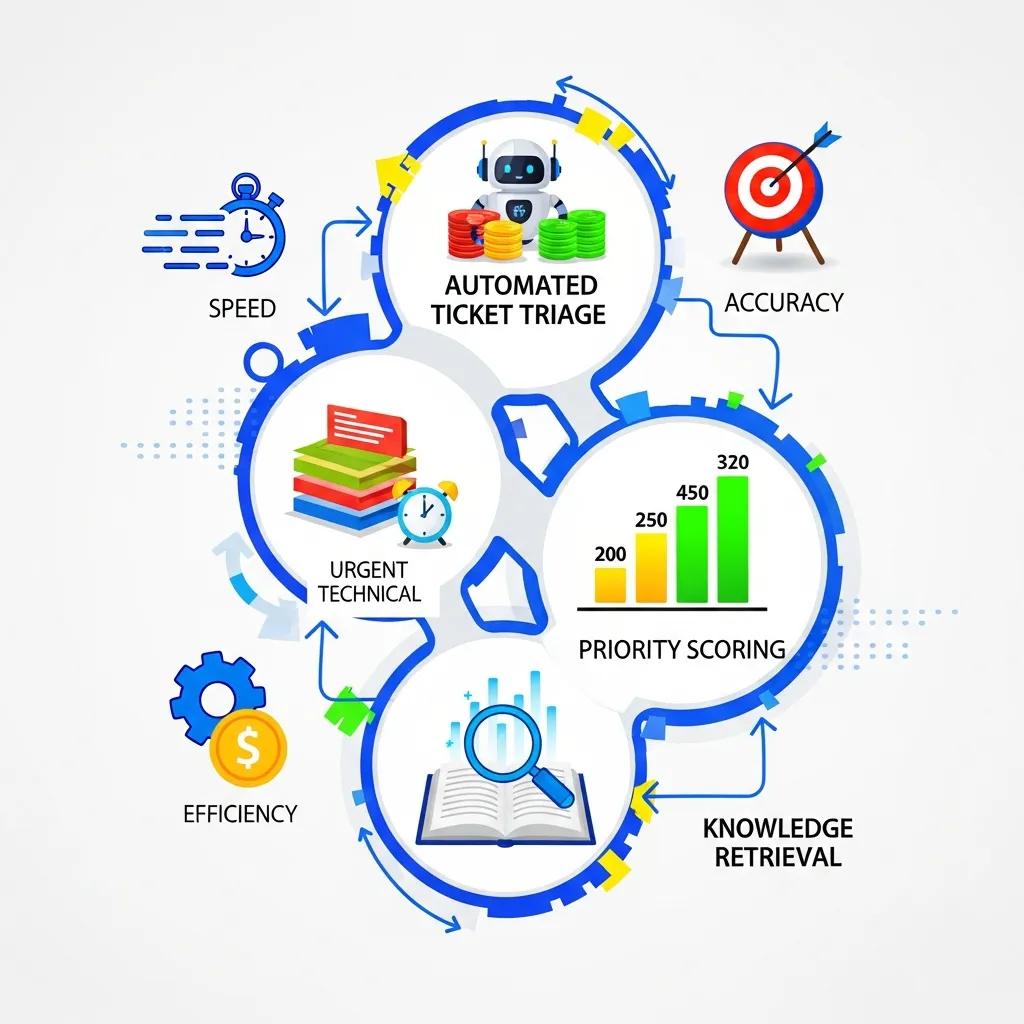
The Inbox Shield includes automated ticket triage, priority scoring, knowledge-base integration, AI-powered first responses, analytics, and agent-assist tools that fit into existing helpdesk stacks. Automated triage uses NLP classification models to tag intent and urgency, which speeds routing and reduces manual sorting. Priority scoring assigns a numerical urgency value so high-impact tickets reach skilled agents sooner, improving first-contact resolution rates. Knowledge-base integration and retrieval-augmented responses provide context-aware suggested replies that agents can review, edit, and send, which shortens average handle time while preserving accuracy.
The feature set is designed so teams can adopt incrementally, starting with classification then adding agent assist and self-service elements.
Key feature list and immediate benefits:
- Automated Ticket Triage: Speeds initial sorting and matching to skillsets.
- Priority Scoring: Ensures urgent issues are escalated quickly.
- Knowledge Retrieval: Delivers context-rich suggestions to agents.
These features combine to produce measurable time savings and a more consistent support experience, which leads into the human-centered adoption practices that follow.
How Does eMediaAI’s Human-Centric Approach Enhance AI Adoption?
A human-centric deployment prioritizes agent involvement, transparent decisioning, and iterative feedback loops to build trust and maintain service quality. This approach begins with collaborative requirement workshops, followed by supervised model tuning and staged rollouts that give agents control over automated suggestions and routing overrides. Ethical oversight and governance ensure fairness in priority scoring and maintain audit trails so teams understand why the AI made a recommendation. Training and change management programs focus on workflow redesign and skills that elevate agent judgment rather than replace it, reducing resistance and improving long-term adoption.
These human-centered practices create a reliable foundation for scaling automation across channels, which connects directly to the specific mechanisms that produce the 40% reduction in resolution time.
How Does The Inbox Shield Reduce Support Ticket Resolution Time by 40%?
The Inbox Shield reduces resolution time by automating early-stage work—classification, first-response drafting, and routine workflows—allowing agents to focus on complex tasks that require judgment. Intelligent triage reduces manual sorting and misrouting, AI-generated first-responses cut initial wait time, and agent-assist tools compress research and reply composition into seconds instead of minutes. Workflow automation handles status updates, SLA checks, and routine escalations to eliminate repetitive clicks and context-switching, which together drive a 30–40% decline in end-to-end resolution time for many SMB deployments.
Below we break down the main mechanisms and quantify their contributions to faster resolution.
Primary mechanisms that shorten ticket lifecycles:
- Triage & Routing: Automated classification reduces queue time and misassignment.
- First-Response Automation: Instant replies or suggested messages shrink response lag.
- Agent Assist & Automation: Contextual snippets and auto-tasks reduce handling time.
These mechanisms integrate into existing helpdesk tools through APIs and webhooks, enabling rapid pilots that preserve current operations and measure uplift.
Intro to table: The following table compares core Inbox Shield components, the methods they use, and expected operational impact on routing and handling time.
| Component | Method | Expected impact on routing/handling |
|---|---|---|
| Ticket Triage | NLP classification + priority scoring | Reduces initial routing time by 20–35% |
| First-Response Automation | Retrieval-augmented templates + generative drafts | Cuts first-response latency by 40–60% |
| Agent Assist | Contextual snippets and recommended actions | Lowers average handle time by 15–30% |
This comparison shows how combining triage, first response, and agent assist concentrates time savings early in the ticket lifecycle, which compounds into the headline 40% resolution improvement.
Concise business example (integration point): In practice, a small support team engaged an AI partner to map intents, tune priority scores, and deploy knowledge retrieval rules; that partner then ran a short pilot to validate results and recommend rollout steps. For SMBs evaluating readiness, a structured 10-day diagnostic that produces an implementation roadmap can clarify integration effort and ROI quickly.
This integration model makes it straightforward to move from pilot to scale while preserving agent control and minimizing disruption.
What Role Does Intelligent Ticket Triage Play in Faster Resolution?
Intelligent ticket triage uses supervised and semi-supervised NLP models to categorize incoming messages by intent and urgency, which speeds routing and matches tickets to the most appropriate queues. By replacing manual sorting with automated classification and priority scoring, triage reduces handoffs and the time tickets spend in generic queues awaiting assignment. Accurate triage also increases the chance of first-contact resolution by directing issues to agents with the right knowledge, which reduces reassignments and cycle time. Continuous retraining with agent feedback improves model accuracy and ensures triage evolves with product changes and seasonal trends.
Effective triage therefore sets the stage for downstream automations like first-response drafts and agent assist, directly lowering the average time tickets spend before action begins.
Research indicates that AI-driven troubleshooting models can significantly reduce mean time to resolution.
AI and Machine Learning for IT Support: Enhancing Efficiency and Automation
The rapid evolution of Artificial Intelligence (AI) and Machine Learning (ML) has brought significant advancements in IT support systems, transforming the efficiency, automation, and responsiveness of technical service management (TSM). Traditional IT support methods, which rely heavily on manual troubleshooting, rule-based ticketing systems, and reactive maintenance approaches, often suffer from delayed issue resolution, increased operational costs, and inefficiencies in service management. This systematic review, analyzing 563 peer-reviewed studies published before 2023, investigates the application of AI-driven solutions in automated troubleshooting, predictive maintenance, intelligent ticketing systems, and AI-powered virtual assistants. The findings indicate that AI-driven troubleshooting models reduce mean time to resolution (MTTR) by 50-60%, improving system uptime and minimizing service disruptions. Predictive maintenance models leveraging ML algorithms achieve u
… REVIEW OF AI AND MACHINE LEARNING-DRIVEN IT SUPPORT SYSTEMS: ENHANCING EFFICIENCY AND AUTOMATION IN TECHNICAL SERVICE …, S Ahmed, 2023
How Do AI-Powered First Response and Self-Service Options Accelerate Support?
AI-powered first responses and self-service link knowledge-base retrieval to templated messages and contextual generative suggestions so customers receive immediate, relevant answers. Instant first-touch messages reduce perceived wait time and often resolve simple queries without agent intervention, causing measurable ticket deflection. Self-service portals enhanced by AI search and suggested articles reduce incoming load for common issues and funnel complex problems to skilled agents. Human review gates and confidence thresholds maintain quality, ensuring that generative responses are surfaced as suggestions or auto-sent only when accuracy is high.
These controls preserve customer trust while delivering rapid answers that materially lower response latency and overall resolution time.
How Does Agent Assist and Workflow Automation Empower Support Teams?
Agent-assist tools provide concise, context-aware snippets, suggested reply templates, and relevant knowledge links that compress research and composition into seconds. Workflow automation handles repetitive tasks—status updates, tagging, SLA reminders, and common follow-ups—removing cognitive overhead and reducing multitasking errors. Together, assistive suggestions and automated tasks increase agent throughput, reduce average handle time, and improve consistency across responses. Because agents retain final control, these tools enhance productivity without eroding quality or accountability.
Agent empowerment through assistive AI also supports morale and retention, which ties directly to the Inbox Shield’s human-centric philosophy and downstream CSAT benefits.
How Does The Inbox Shield Improve Customer Satisfaction and Employee Well-Being?

The Inbox Shield links operational efficiency to customer experience by shortening response times and increasing answer accuracy, which drives higher CSAT scores. Faster, accurate responses improve first-contact resolution and reduce repeat interactions, both strong drivers of customer satisfaction. For employees, eliminating repetitive triage and search tasks reduces cognitive load and burnout, allowing agents to focus on nuanced, rewarding problem-solving. Ethical safeguards—transparency about AI suggestions and human-in-the-loop approval—sustain trust for both customers and staff while ensuring fairness in priority handling.
The next subsections map Inbox Shield components to measurable customer and employee KPIs and explain governance practices that reduce burnout and protect worker dignity.
Intro to KPI mapping table: The table below maps Inbox Shield components to measurable KPIs to clarify which metrics move when a component is active.
| Component | Attribute | Measurable KPI |
|---|---|---|
| First Response | AI drafts + auto-send thresholds | First response time (reduction %) |
| Self-Service | Knowledge retrieval + AI search | Ticket deflection rate (%) |
| Agent Assist | Contextual snippets | Average handle time (AHT) decrease (%) |
This KPI mapping highlights that improvements to initial contact processes and agent tooling translate directly into CSAT gains and lower handling costs.
When teams track these KPIs consistently, they can validate improvements and iterate on content quality, routing rules, and assistant suggestions to sustain gains.
What Are the Measurable Benefits of AI on CSAT Scores?
AI-driven improvements in response speed and answer relevance commonly yield CSAT uplifts in measurable ranges depending on baseline performance and implementation depth. Faster first responses and higher first-contact resolution raise perceived reliability and reduce frustration, which directly influence CSAT. The Inbox Shield’s combined effect—lower latency, better routing, and fewer follow-ups—produces consistent positive shifts in satisfaction metrics when paired with quality assurance and feedback loops. Measuring CSAT before and after staged rollouts, with confidence thresholds for auto-responses, helps teams attribute gains to specific components and refine them.
Benchmarking and iterative tuning ensure CSAT improvements are durable as products and customer needs evolve.
Specific applications of AI in the telecommunications sector have demonstrated a 40% decrease in ticket resolution time, alongside significant improvements in customer satisfaction.
AI’s Impact on Telecom Customer Support: Reduced Resolution Time and Improved Satisfaction
The AI-driven diagnostic engine reduced ticket resolution time decreased by 40%, and customer satisfaction scores improved significantly. The AI-driven diagnostic engine reduced
Revolutionizing Telecom Customer Support: The Impact of AI on Troubleshooting and Service Efficiency, P Singh, 2022
How Does Ethical AI Reduce Agent Burnout and Enhance Work Satisfaction?
Ethical AI reduces burnout by eliminating repetitive, low-value work while preserving agent autonomy through transparent suggestions and override controls. Policies that mandate human review for ambiguous responses, maintain traceability of AI decisions, and incorporate agent feedback into retraining cycles prevent deskilling and build trust. By shifting agents toward complex problem-solving and relationship-focused tasks, AI enhances job satisfaction and provides opportunities for upskilling. Governance frameworks that include fairness checks and open communication about automation’s role help teams adapt without fear of displacement.
These safeguards create an employee-centered automation pathway that balances productivity gains with psychological safety and long-term retention.
Companies like Pegasystems are actively developing AI solutions aimed at alleviating burnout among customer service agents.
Pega’s AI for Reducing Customer Service Agent Burnout
Pegasystems (Pega), a leader in AI-driven customer service. By leveraging artificial intelligence (AI), Pega’s platforms can help reduce the workload on human agents, allowing them to focus on more complex and high-priority issues. This can lead to a decrease in stress and burnout among customer service representatives.
The Impact of Pega’s AI on Reducing Customer Service Burnout Among Human Agents, 2022
What Are the Real-World Results and ROI of Implementing The Inbox Shield?
Real-world implementations of the Inbox Shield show measurable gains in resolution time, CSAT, and cost-to-serve, with many SMB pilots reporting meaningful ROI within condensed timelines. When properly scoped and measured, the combination of triage, first-response automation, and agent assist compresses cycle time and reduces repeat work, generating labor cost savings and improved customer outcomes. SMBs often see initial wins during a pilot phase and measurable ROI in under 90 days when data is clean and integrations are straightforward. An ROI framework helps estimate savings from reduced AHT, lowered ticket volume via deflection, and improved agent productivity.
The following anonymized ROI table presents expected timelines and typical outcome ranges for SMBs using the Inbox Shield.
| Outcome Area | Investment/Time | ROI Metric |
|---|---|---|
| Pilot & Tuning | 10–30 days | Initial AHT reduction 10–20% |
| Early Production | 30–90 days | Resolution time reduction up to 40% |
| Scale & Governance | 90+ days | CSAT uplift and lower cost-to-serve |
This ROI framework shows how short diagnostic phases lead to staged measurable results, with compounded benefits as governance and content maturity improve.
Which Case Studies Show a 40% Reduction in Ticket Resolution Time?
Anonymized summaries of SMB pilots indicate that when teams apply precise triage, a reliable knowledge base, and agent-assist workflows, resolution times can fall by roughly 40% for specific ticket types. Key contributors to such outcomes include well-structured knowledge articles, clear routing rules, and agent acceptance of suggested replies during a monitored pilot. Variability depends on ticket mix, legacy tools, and data cleanliness, so the 40% is a realistic upper-bound for well-prepared environments. Teams should view the figure as achievable with disciplined rollout and continuous measurement rather than an immediate guarantee.
Prospective adopters should therefore prioritize data hygiene and staged pilots to reproduce similar results while being mindful of contextual factors that influence magnitude.
How Quickly Can SMBs Expect ROI from AI-Driven Support Automation?
SMBs typically follow a pilot → refine → scale sequence with measurable improvements emerging in phases: pilot (0–30 days) yields diagnostic insights and small wins, early production (30–90 days) shows measurable KPI improvements, and scaling (90+ days) realizes sustained ROI and governance maturity. Factors that accelerate ROI include well-maintained knowledge bases, clear routing rules, and executive sponsorship. Conversely, fragmented data or complex legacy systems can slow deployment and extend timelines. Setting realistic milestones and measurement cadence—weekly during pilot, monthly post-launch—ensures teams can identify lift and course-correct quickly.
This staged approach helps SMBs forecast outcomes and manage internal expectations while preserving service continuity.
How Can SMBs Implement The Inbox Shield with eMediaAI’s AI Consulting Services?
SMBs can implement the Inbox Shield by following a structured path: assess opportunity, run a targeted blueprint, pilot core automations, and scale with governance and fractional leadership. eMediaAI offers services designed to accelerate that path while maintaining a human-centered ethos. The AI Opportunity Blueprint™ is a 10-day fixed-scope engagement that identifies high-impact automation opportunities, produces a practical roadmap, and quantifies potential ROI. For ongoing leadership and governance, eMediaAI provides Fractional Chief AI Officer (fCAIO) support to oversee strategy, adoption, and ethical governance on a cost-effective basis. These offerings help SMBs de-risk adoption while aiming for measurable ROI in under 90 days.
Below is a simple stepwise implementation list SMBs can follow to adopt the Inbox Shield.
- Assess & Prioritize: Map ticket types and identify high-volume, high-impact use cases.
- Blueprint: Run a focused diagnostic (10 days) to produce an integration roadmap and ROI estimate.
- Pilot: Deploy triage and agent-assist on a subset of channels and measure AHT and CSAT.
- Scale & Govern: Expand automations, add governance, and consider Fractional CAIO oversight.
These steps balance speed and control, enabling SMBs to move from assessment to measurable outcomes while preserving agent trust.
What Is the AI Opportunity Blueprint™ and How Does It Facilitate AI Integration?
The AI Opportunity Blueprint™ is a 10-day fixed-scope engagement that delivers a prioritized roadmap, quick-win pilots, and a measurable ROI estimate to guide Inbox Shield adoption. During the blueprint, teams map ticket flows, identify data gaps, and define success metrics so pilots can be designed to demonstrate value rapidly. The fixed-scope nature reduces uncertainty and provides a clear next-step plan, making it easier for SMBs to make investment decisions. Pricing for this offering is set at approximately $5,000, which covers the diagnostic, deliverables, and recommendations to move toward piloting and production.
This blueprint reduces implementation risk by focusing effort on the highest-value areas and preparing teams for a controlled pilot phase.
How Does Fractional CAIO Leadership Support Successful AI Deployment?
Fractional CAIO engagements provide part-time executive-level oversight for strategy, governance, and change management without the cost of a full-time hire. A fractional CAIO helps define ethical guardrails, align AI efforts to business outcomes, manage vendor selection, and coordinate cross-functional adoption activities. This role is particularly valuable for SMBs that lack internal AI leadership and need consistent oversight during scaling phases. Fractional CAIO support ensures responsible deployment, sustained measurement, and alignment with longer-term automation goals while keeping costs proportionate to SMB budgets.
Having dedicated, experienced oversight reduces governance risks and accelerates value realization as automations expand.
What Are Common Questions About Using AI to Cut Support Ticket Resolution Time?
Organizations commonly ask whether AI actually shortens resolution times, whether agents will be replaced, and what costs and timelines to expect; clear, direct answers help set realistic expectations. AI shortens resolution time primarily by automating low-value tasks and improving routing, but measurable outcomes depend on data readiness and process alignment. Adoption is best approached as augmentation, with staged pilots and governance that emphasize human oversight and ethical safeguards. Below are concise answers to the most frequent operational questions.
How Does AI Specifically Cut Support Ticket Resolution Time?
AI reduces resolution time through three primary mechanisms: automated ticket triage, AI-powered first responses/self-service, and agent assist with workflow automation. Triage rapidly categorizes and prioritizes tickets so they reach the right queue, reducing routing delays. First-response automation and self-service provide instant answers for routine queries, deflecting volume and shrinking mean time to first response. Agent-assist tools compress research and reply composition, lowering average handle time and enabling agents to process more tickets per shift.
These mechanisms work together to remove delays at the start of the ticket lifecycle, producing the compound effect that leads to large reductions in end-to-end resolution time.
Will AI Replace Customer Service Agents or Support Teams?
AI is designed to augment—not replace—customer service agents by automating repetitive tasks and enabling agents to focus on complex, human-centered interactions. Automation takes over low-skill activities like triage and routine replies, while agents retain responsibility for judgment, escalation, and relationship management. With proper change management, retraining programs, and transparent governance, teams can re-skill staff into higher-value roles that improve job satisfaction. This augmentation model aligns with ethical, employee-first automations that preserve work quality and career pathways.
Focusing on augmentation reduces fear and encourages adoption, which improves results and retention.
What Is the Cost and Timeline for Implementing The Inbox Shield?
Costs and timelines vary based on data quality, integrations, and ticket complexity, but a common SMB path begins with a 10-day AI Opportunity Blueprint™ (approximately $5,000) to scope work and estimate ROI. Pilots typically run 30–90 days to demonstrate AHT reductions and CSAT improvements, with measurable ROI often appearing in under 90 days for well-prepared environments. Primary cost drivers include integration effort, knowledge-base curation, and governance resources. Starting with a fixed-scope blueprint and a targeted pilot helps control cost while providing tangible metrics to inform scale decisions.
SMBs that prepare data, prioritize high-volume use cases, and adopt staged rollouts will see the fastest path from investment to measurable returns.
- Next steps summary: Begin with an opportunity assessment, run a focused blueprint, pilot core automations, and scale with governance and fractional leadership as needed.
- Key reminders: Prioritize data readiness, maintain human oversight, and measure CSAT and AHT consistently to validate improvements.
These practical actions and governance steps help SMBs adopt the Inbox Shield responsibly and efficiently, unlocking the operational and customer-experience benefits described throughout this article.
Frequently Asked Questions
What types of businesses can benefit from implementing The Inbox Shield?
The Inbox Shield is particularly beneficial for small to medium-sized businesses (SMBs) that handle a high volume of customer inquiries. Industries such as telecommunications, e-commerce, and tech support can leverage its capabilities to streamline operations. By automating ticket triage and enhancing agent productivity, businesses can improve customer satisfaction and reduce operational costs. The solution is designed to integrate seamlessly with existing helpdesk systems, making it accessible for various sectors looking to enhance their customer support efficiency.
How does The Inbox Shield ensure data privacy and security?
The Inbox Shield incorporates robust data privacy and security measures to protect customer information. It adheres to industry standards and regulations, such as GDPR and CCPA, ensuring that personal data is handled responsibly. The system employs encryption for data in transit and at rest, along with access controls to limit data exposure. Regular audits and compliance checks are conducted to maintain high security standards, providing peace of mind for businesses and their customers regarding data protection.
Can The Inbox Shield be customized to fit specific business needs?
Yes, The Inbox Shield is designed to be customizable to meet the unique needs of different businesses. Organizations can tailor the AI’s ticket triage rules, priority scoring, and knowledge base integration to align with their specific workflows and customer service goals. This flexibility allows businesses to optimize the system for their operational requirements, ensuring that the AI solution effectively addresses their challenges while enhancing overall support efficiency.
What training is required for staff to use The Inbox Shield effectively?
Training for staff using The Inbox Shield typically involves a combination of initial onboarding sessions and ongoing support. Employees are educated on how to interact with the AI system, including how to review and edit AI-generated responses. Workshops focus on understanding the AI’s capabilities, ethical considerations, and best practices for leveraging the technology to enhance customer interactions. Continuous feedback loops and refresher courses help ensure that staff remain proficient and comfortable with the evolving system.
How does The Inbox Shield impact customer experience?
The Inbox Shield significantly enhances customer experience by reducing response times and increasing the accuracy of answers provided. With automated ticket triage and AI-generated first responses, customers receive timely and relevant information, which leads to higher satisfaction rates. The system’s ability to resolve issues on the first contact further minimizes frustration and fosters a positive relationship between customers and support teams. Overall, the Inbox Shield contributes to a more efficient and responsive customer service environment.
What metrics should businesses track to measure the success of The Inbox Shield?
To measure the success of The Inbox Shield, businesses should track key performance indicators (KPIs) such as average handle time (AHT), first-contact resolution rate, customer satisfaction (CSAT) scores, and ticket deflection rates. Monitoring these metrics provides insights into the effectiveness of the AI solution in improving operational efficiency and customer experience. Regular analysis of these KPIs allows organizations to identify areas for improvement and optimize their use of the Inbox Shield over time.
Conclusion
Implementing the Inbox Shield can significantly enhance customer support efficiency by automating ticket triage and reducing resolution times by up to 40%. This innovative AI solution not only improves response accuracy but also boosts employee well-being by minimizing repetitive tasks. By adopting this technology, businesses can achieve measurable improvements in customer satisfaction and operational costs. Discover how the Inbox Shield can transform your support operations by exploring our consulting services today.