

Ensure Responsible AI Implementation: The Blueprint for Ethical Business Practices in Business
Responsible AI means designing, deploying, and governing artificial intelligence systems so they are fair, transparent, safe, privacy-preserving, and accountable throughout their lifecycle. This article explains why responsible AI matters for small and mid-sized businesses (SMBs), how ethical principles translate into operational controls, and how a practical 10-day roadmap can produce measurable outcomes. Readers will learn core ethical principles, governance best practices, concrete risk-mitigation techniques for bias and privacy, human-centric adoption strategies, and how to measure ethical ROI. The guide maps foundational concepts to implementation steps, including a structured approach to rapid readiness and actionable metrics for stakeholders. Throughout, the discussion integrates proven frameworks—such as NIST AI RMF and emerging regulatory signals like the EU AI Act—and highlights practical service options for businesses that need hands-on support to move from policy to production.
What Are the Core Principles of Ethical AI Implementation for Businesses?
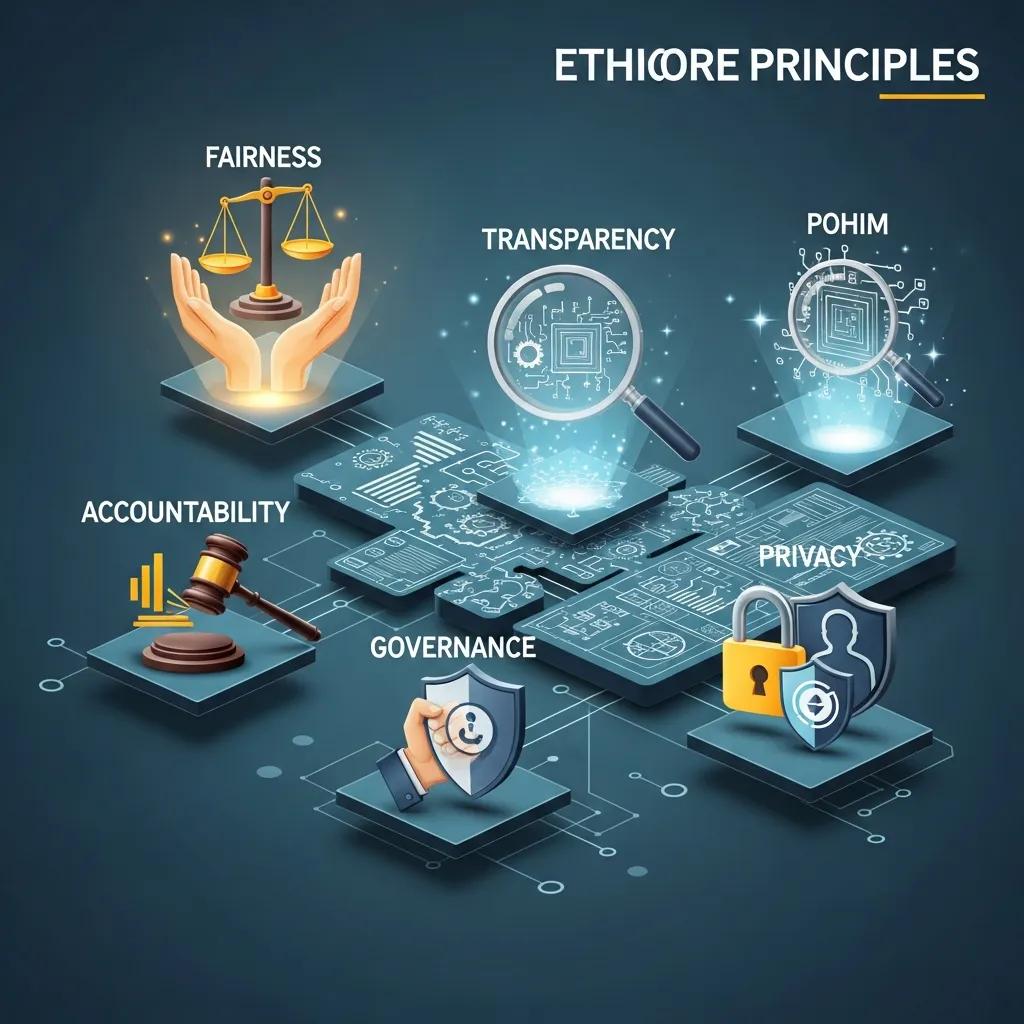
Responsible AI is a set of principles and practices that align AI systems with human values, legal obligations, and business goals, reducing harm while unlocking value. It works by embedding controls across data, models, and processes—ensuring systems are trained on representative data, logged for auditability, and governed by clear roles—so outcomes remain reliable and defensible. For SMBs, these principles protect customers and employees, reduce legal and reputational risk, and improve adoption by building trust. Implementing ethical AI also accelerates business value because stakeholders accept systems that are demonstrably fair and explainable. The next sections break down each core principle and show operational examples that SMBs can apply immediately.
Ethical AI rests on five interlocking pillars that guide practical implementation:
- Fairness
: Ensure systems do not systematically disadvantage groups and monitor outcomes for disparate impact. - Transparency
: Document data, models, and decision flows so stakeholders can understand how outputs arise. - Accountability
: Assign ownership, logging, and escalation paths so decisions and failures are traceable. - Privacy & Safety
: Minimize data collection, apply access controls and encryption, and test systems for safety risks. - Governance & Empowerment
: Create policies and training that empower humans to oversee and correct AI systems.
These pillars form a roadmap from principle to practice, and the following subsection explains how fairness, transparency, and accountability interact in real systems.
How Do Fairness, Transparency, and Accountability Shape Responsible AI?
Fairness, transparency, and accountability form a trio that converts ethical intent into measurable controls, safeguarding decisions and enabling remediation when systems err. Fairness focuses on data and model parity—using representative datasets, running bias metrics, and adjusting models or thresholds when disparate outcomes appear—while transparency documents feature provenance, model versions, and decision rationales so that developers and auditors can trace behavior. Accountability assigns clear roles and logging requirements so that when a model produces an unexpected outcome, teams can investigate root causes and apply corrective actions. Together, these elements reduce legal exposure and improve user trust; for example, a hiring-assist system that logs inputs, applies fairness testing, and surfaces explainable reasons for candidate scores makes human reviewers more confident to use the tool. Operationalizing these controls requires both technical checks and governance procedures, which we explore next.
Why Is Data Privacy and Safety Essential in AI Adoption?
Data privacy and safety are essential because AI systems depend on personal and sensitive data, and poor controls create regulatory, ethical, and operational risks that can quickly erode trust. Privacy-by-design reduces exposure by minimizing data collection, anonymizing or pseudonymizing records, and applying role-based access controls and encryption so only authorized processes can access raw inputs. Safety testing complements privacy by stress-testing models for adversarial inputs, hallucinations, and dangerous failure modes and by instituting monitoring and rollback mechanisms for production models. SMBs benefit from lightweight safeguards—data retention policies, consent mechanisms, and encryption at rest and in transit—that are practical to implement and scale. Maintaining these protections also simplifies compliance mapping to frameworks such as NIST AI RMF and the EU AI Act, which prioritize both data governance and demonstrable safeguards.
How Does the AI Opportunity Blueprint™ Facilitate Ethical AI Adoption?
The AI Opportunity Blueprint™ is a structured, fixed-scope roadmap purpose-built to move businesses from ethical principles to an actionable, risk-aware implementation plan within ten days. It works by combining an accelerated assessment of opportunities and risks with concrete technical and governance recommendations, producing prioritized deliverables that align AI investments with ethical controls and business value. The Blueprint integrates risk assessment, technical stack recommendations, and an implementation plan so teams receive both strategic direction and operational artifacts ready for execution. For organizations that prefer guided, hands-on support, this engagement offers a clear, time-bound path to responsible adoption without open-ended consulting.
Below is a concise summary of typical Blueprint deliverables, showing what each item achieves and why it matters.
The AI Opportunity Blueprint™ deliverables and outcomes:
| Deliverable | Purpose | Outcome/Benefit |
|---|---|---|
| Opportunity Assessment | Identify high-impact AI use cases aligned to business goals | Prioritized AI roadmap with business-case rationale |
| Ethical Risk Assessment | Surface fairness, privacy, safety, and governance gaps | Actionable mitigations and compliance priorities |
| Technical Stack Recommendation | Recommend tools, architectures, and vendor fit | Clear implementation options that balance risk and speed |
| Implementation Plan | Time-bound tasks, owners, and milestones | Ready-to-execute plan to reduce time-to-value |
| Training & Adoption Roadmap | Staff training and change management recommendations | Higher adoption and reduced operational friction |
This EAV table clarifies that the Blueprint bundles both strategy and execution artifacts, producing outcomes SMBs can act on immediately. In practice, the Blueprint is delivered as a fixed-scope engagement with defined outputs and timelines, designed to accelerate ethical adoption while preserving governance rigor. For teams that need direct implementation support, the Blueprint pairs well with fractional executive services to maintain governance during rollout.
What Is the 10-Day Process for Developing a Responsible AI Roadmap?
The 10-day process compresses assessment, prioritization, and recommended controls into a sequence that rapidly yields an executable plan. Day-by-day activities typically include stakeholder interviews to align objectives, technical discovery to map data and current tooling, risk and bias scans to detect ethical vulnerabilities, and synthesis sessions that translate findings into prioritized recommendations and milestones. Throughout the ten days, artifacts such as a risk register, a prioritized use-case list, and a proposed technical stack are generated so the organization leaves with both insight and an operational playbook. This rapid cadence emphasizes tangible outcomes—prioritized projects and mitigation steps—so teams can begin implementation immediately after the engagement. The structured timeline ensures momentum and keeps ethical considerations central to technology choices.
How Does a People-First Methodology Enhance AI Implementation Success?
A people-first methodology centers design on human workflows, ensuring AI augments roles, reduces drudgery, and supports employee well-being, which in turn increases adoption and impact. It starts with user research to understand pain points, then designs models and interfaces that present AI outputs as decision support with clear human oversight, rather than opaque automation. Training and change management are embedded in deployment plans so employees learn not only how to use tools but why they improve work quality and safety. When workers feel empowered to question and correct AI outputs, organizations achieve better error detection and continuous improvement. This human-centric approach increases trust and operational ROI, and it reduces the risk of adversarial or unsafe use by keeping people in the loop.
What Are Best Practices for AI Governance and Compliance in SMBs?

Effective AI governance for SMBs combines pragmatic structure with lightweight processes that scale: define roles, document policies, and map controls to recognized frameworks such as NIST AI RMF and the EU AI Act. Governance starts with an AI ethics charter that describes objectives, risk appetite, and decision authorities, and it assigns clear responsibilities for model development, deployment, and monitoring. Policies for data handling, model validation, and incident response translate principles into day-to-day controls. SMBs should prioritize simple, repeatable processes—model cards, versioned datasets, and logging—so audits and remediations are tractable. These governance elements reduce operational friction by creating predictable pathways for model approval and ongoing oversight.
Recommended steps to establish practical governance:
- Create an ethics charter
that outlines purpose, scope, and risk tolerance for AI initiatives. - Assign roles and ownership
for model lifecycle activities, including a designated governance lead or fractional CAIO. - Standardize documentation
requirements—data lineage, model cards, and audit logs—so systems are auditable. - Implement review cadences
for high-risk models with clear escalation protocols. - Map controls to frameworks
such as NIST AI RMF for technical guidance and to regulatory obligations like the EU AI Act.
This checklist provides a compact roadmap SMBs can follow to operationalize governance. For organizations lacking full-time executive capacity, engaging a fractional Chief AI Officer service provides the missing governance expertise without a permanent hire.
The evolving landscape of AI governance highlights the growing need for specialized roles like the Chief AI Officer (CAIO) and AI Risk Officer (AIRO) within organizations, even for SMBs.
AI Governance Roles for SMBs: CAIO & AIRO
We investigate governance roles related to AI use in practice, and undertake first steps to define the role profiles of a Chief AI Officer (CAIO) and an AI Risk Officer (AIRO). We base our inquiry on two sources: a literature review and evaluative interviews with nine AI professionals from small- and medium-sized companies. We find that, whereas the roles and activities associated with the CAIO and AIRO are commonly deemed relevant for such companies in the long run, today only a few companies have implemented them.
AI governance: are Chief AI Officers and AI Risk Officers needed?, M Schäfer, 2022
Below is a compact governance elements table that links responsibilities to practical actions SMBs can implement.
| Governance Element | Role / Responsibility | Recommended Action |
|---|---|---|
| Ethics Committee | Oversight & policy approval | Establish charter, meeting cadence, and escalation rules |
| Governance Lead (e.g., fCAIO) | Strategy & operational coordination | Use fractional CAIO services to lead policy implementation |
| Documentation & Logging | Auditability & traceability | Enforce model cards, data lineage, and access logs |
| Compliance Mapping | Regulatory alignment | Map controls to NIST AI RMF and EU AI Act priorities |
| Monitoring & Incident Response | Ongoing safety | Deploy monitoring, alerts, and rollback procedures |
By mapping roles to actions, SMBs achieve governance that supports both ethical priorities and pragmatic deployment timelines.
How to Establish an AI Ethics Committee and Governance Framework?
Setting up an AI ethics committee begins with defining its scope, membership, and decision protocols that fit an SMB’s size and complexity. Membership typically includes cross-functional representatives—product, engineering, legal, and a user advocate—with a lightweight charter that clarifies authority, meeting cadence, and escalation paths for high-risk decisions. The committee should require standardized artifacts for reviews—risk registers, model cards, and validation results—and a documented approval workflow that gates production deployment. Keep processes lean: short review templates, clear timelines, and a simple audit trail reduce administrative burden while ensuring accountability. These elements create a repeatable governance loop that balances speed with safety.
How Do NIST AI RMF and EU AI Act Influence Responsible AI Policies?
NIST AI RMF and the EU AI Act provide complementary guidance: NIST emphasizes risk management practices and technical implementation guidance, while the EU AI Act introduces regulatory obligations tied to risk categories and transparency requirements. SMBs should adopt a practical mapping exercise that translates these frameworks into prioritized controls—data governance, documented testing, and transparency measures—commensurate with model risk. Start by categorizing AI systems by impact, then apply NIST’s risk-management steps for technical rigor and EU AI Act principles where legal obligations apply. This blended approach yields a defensible, auditable policy set that aligns operations to both best practices and emerging regulatory expectations.
Further research underscores the importance of a unified approach to AI risk management, integrating these frameworks for comprehensive compliance and responsible innovation.
Unified AI Risk Management: NIST, ISO, & EU AI Act Compliance
integrating the NIST AI Risk Management Framework (AI RMF), ISO/IEC 42001, and the EU AI Act. This unified approach enables organizations to systematically identify, assess, and mitigate AI-related risks, ensuring compliance with the Act’s stipulations and fostering responsible innovation in artificial intelligence systems.
Responsible Innovation in Artificial Intelligence: A Unified Risk Management Approach Integrating NIST, ISO 42001, and the EU AI Act
How Can Businesses Mitigate AI Risks: Bias, Privacy, and Transparency?
Mitigating AI risks requires technical, process, and governance measures that work together to detect, reduce, and monitor harms over time. For bias, use diverse datasets, fairness-aware training, and post-hoc audits with metrics like demographic parity or equalized odds; for privacy, implement minimization, anonymization, and strict access controls; for transparency, apply explainable models or explanations layered into decision workflows and maintain comprehensive documentation. Monitoring closes the loop: runtime checks, drift detection, and incident logging ensure issues surface before they escalate. Combining these controls with human-in-the-loop checkpoints and periodic audits creates a resilient mitigation strategy that balances operational speed and ethical safeguards.
What Strategies Detect and Reduce Algorithmic Bias in AI Systems?
Detecting and reducing bias starts with data-level analysis: profile datasets for representation gaps and label quality, then run fairness metrics across key slices to quantify disparate outcomes. Mitigation techniques include reweighting or resampling, fairness-constrained optimization, and adversarial debiasing, paired with human review for sensitive decisions. Operationally, implement a lightweight bias-audit workflow: define protected attributes, run pre-deployment fairness checks, document remediation steps, and schedule periodic post-deployment audits. For SMBs, practical tools and checklists enable recurring audits without heavy resource investment, allowing teams to detect drift and take corrective action before harms compound.
How Does Explainable AI Promote Transparency and Human Oversight?
Explainable AI (XAI) provides mechanisms—feature importance, counterfactual explanations, and local surrogate models—that make model decisions interpretable and actionable for human reviewers. These techniques help surface why a model made a decision, enabling users to contest or override outputs and ensuring accountability. Implementing XAI requires integrating explanations into workflows where humans make final decisions, logging explanation metadata for audits, and defining thresholds where human intervention is mandatory. When paired with governance controls and training, XAI strengthens stakeholder trust by making AI behavior observable, reviewable, and correctable.
Why Is Human-Centric AI Adoption Critical for Employee Well-being?
Human-centric AI adoption prioritizes worker empowerment, redesigning tasks so AI augments human skills and reduces repetitive effort rather than displacing people. This approach improves morale, productivity, and retention by making jobs more meaningful and by providing clear role definitions where humans validate and refine AI outputs. Successful adoption includes communication strategies, incentives, and ongoing training so employees view AI as a tool that increases career value. Embedding feedback loops from users into model improvement cycles ensures systems evolve based on real workplace experience, further increasing long-term acceptance and impact.
How Do AI Literacy and Training Programs Support Workforce Integration?
AI literacy and training programs reduce adoption friction by teaching employees what AI can and cannot do, how to interpret outputs, and how to escalate anomalies. A balanced curriculum covers ethics, basic model behavior, tool-specific workflows, and hands-on exercises that mirror daily tasks, combined with assessment and refresher modules. Programs should measure outcomes—task completion time, error rates, and confidence levels—to demonstrate effectiveness and refine content. When training emphasizes human oversight and recourse, employees gain confidence to use AI responsibly and to contribute to continuous system improvement.
Sample training curriculum outline:
- Foundations
: Concepts of AI, bias, and privacy in practical terms. - Tool Use
: Hands-on workflows and interpretation of model outputs. - Ethics & Governance
: Reporting protocols, escalation, and accountability. - Continuous Improvement
: Feedback loops and contribution to model refinement.
This modular approach equips teams with the skills to integrate AI safely while preserving well-being and productivity.
What Are Effective Strategies for Human-AI Collaboration in the Workplace?
Effective human-AI collaboration patterns focus on assistive and decision-support models that keep humans in supervisory roles while AI handles repetitive tasks. Design patterns include tiered automation—AI suggests, human verifies—or role-first redesign where AI automates low-skill tasks and augments high-skill work. Establish clear handoff protocols, maintain explainability at the point of decision, and set measurable collaboration KPIs such as time saved per task and error reduction. Regularly gather user feedback and iterate interfaces so workflows remain intuitive and aligned with human expertise. These strategies ensure collaboration yields productivity gains without sacrificing oversight or job quality.
How Can Businesses Measure ROI and Impact of Ethical AI Implementation?
Measuring ROI for ethical AI requires blending financial KPIs with non-financial metrics that capture trust, adoption, and risk reduction; together, these provide a fuller stakeholder narrative. Financial measures include time saved, cost reductions, and revenue uplift linked to AI-enabled features; non-financial measures include employee satisfaction, reduction in complaint rates, and improved audit outcomes. Establish baselines before deployment, instrument systems to capture relevant metrics, and report on both short-term and long-term impacts. Creating a measurement plan that ties metrics to business outcomes ensures ethical investments demonstrate value to executives and regulators alike.
Below is a compact metrics table illustrating common measurement approaches and how to track them.
| Metric | Definition | Measurement Method |
|---|---|---|
| Time Saved | Reduction in manual processing hours | Compare pre/post task time logs and throughput |
| Cost Reduction | Lower operational expenses attributable to AI | Track labor and processing cost changes tied to deployments |
| Adoption Rate | Percentage of users who regularly use AI tools | Use active user metrics and feature engagement stats |
| Employee Satisfaction | Workforce sentiment about AI tools | Measure via surveys and retention data |
| Compliance Incidents | Number of governance or privacy incidents | Monitor incident logs and audit findings |
This table helps teams choose measurable indicators that align ethical practice with business value and governance priorities.
What Financial and Non-Financial Benefits Result from Responsible AI?
Financial benefits from responsible AI include faster processing, fewer manual errors, and targeted revenue opportunities enabled by improved customer experiences. Non-financial benefits include strengthened brand trust, reduced regulatory exposure, and higher employee engagement. Quantifying these requires linking model outcomes to revenue streams and operational costs—such as calculating time savings multiplied by fully loaded labor rates—and supplementing with qualitative measures like survey-based trust scores. Combining both types of metrics allows organizations to present ethical ROI to stakeholders in a language that blends balance-sheet impact and reputational value.
How Do Case Studies Demonstrate Success of Ethical AI Practices?
Anonymized case summaries commonly show that integrating ethical controls increases adoption and reduces downstream correction costs; for example, projects that implemented bias audits and human-in-the-loop checks often report faster user acceptance and fewer remediation incidents. These examples highlight replicable steps: prioritize high-value, low-risk pilots, instrument metrics for early wins, and iterate governance as use expands. Experience indicates that organizations adopting a structured, people-first approach see measurable ROI quickly; some clients report measurable ROI in under 90 days after guided implementation. For teams ready to accelerate ethical AI adoption, consider booking a call to explore a time-bound AI Opportunity Blueprint™ led by experienced practitioners such as Lee Pomerantz and his team to translate these lessons into actionable plans.
Book a call to discuss the AI Opportunity Blueprint™ or to learn more about responsible AI principles and how a fixed-scope, 10-day roadmap can help your organization achieve ethical, measurable outcomes.
Frequently Asked Questions
What are the key challenges businesses face when implementing responsible AI?
Businesses often encounter several challenges when implementing responsible AI, including a lack of understanding of ethical principles, insufficient data governance, and difficulties in ensuring transparency and accountability. Additionally, many organizations struggle with integrating AI systems into existing workflows while maintaining compliance with evolving regulations. The complexity of AI technologies can also lead to biases in decision-making processes if not properly managed. To overcome these challenges, businesses should invest in training, establish clear governance frameworks, and prioritize stakeholder engagement throughout the implementation process.
How can small and mid-sized businesses (SMBs) ensure compliance with AI regulations?
SMBs can ensure compliance with AI regulations by adopting a proactive approach to governance and risk management. This includes familiarizing themselves with relevant frameworks such as the NIST AI RMF and the EU AI Act, and mapping their AI practices to these standards. Establishing an AI ethics committee can help oversee compliance efforts, while regular audits and documentation of AI systems can provide transparency. Additionally, investing in training programs for employees on compliance and ethical AI practices can foster a culture of accountability and awareness within the organization.
What role does employee training play in the successful adoption of AI technologies?
Employee training is crucial for the successful adoption of AI technologies as it equips staff with the necessary skills to understand, utilize, and oversee AI systems effectively. Training programs should cover AI fundamentals, ethical considerations, and practical applications relevant to employees’ roles. By fostering AI literacy, organizations can reduce resistance to new technologies, enhance user confidence, and ensure that employees are prepared to address potential issues. Continuous training and feedback loops also help in refining AI systems based on real-world experiences, leading to better outcomes and higher adoption rates.
How can businesses measure the success of their ethical AI initiatives?
Businesses can measure the success of their ethical AI initiatives by establishing a set of key performance indicators (KPIs) that encompass both financial and non-financial metrics. Financial metrics may include cost savings, revenue growth, and efficiency improvements, while non-financial metrics can assess employee satisfaction, user trust, and compliance incidents. Regularly tracking these metrics allows organizations to evaluate the impact of their AI systems on business objectives and stakeholder perceptions. Additionally, conducting surveys and gathering feedback can provide qualitative insights into the effectiveness of ethical AI practices.
What are the benefits of adopting a human-centric approach to AI implementation?
A human-centric approach to AI implementation prioritizes the needs and well-being of employees, leading to several benefits. By designing AI systems that augment human capabilities rather than replace them, organizations can enhance job satisfaction, reduce burnout, and improve overall productivity. This approach fosters a culture of collaboration, where employees feel empowered to engage with AI tools and provide feedback for continuous improvement. Furthermore, a human-centric focus can increase trust in AI systems, leading to higher adoption rates and better alignment with organizational values and goals.
What steps can organizations take to create a robust AI governance framework?
To create a robust AI governance framework, organizations should start by defining clear objectives and risk appetites related to AI initiatives. Establishing an AI ethics charter that outlines roles, responsibilities, and decision-making processes is essential. Organizations should also implement standardized documentation practices, such as model cards and audit logs, to ensure transparency and accountability. Regular review cadences for high-risk models and mapping controls to recognized frameworks like NIST AI RMF can further enhance governance. Engaging cross-functional teams in governance discussions ensures diverse perspectives and promotes a culture of ethical AI practices.
Conclusion
Implementing responsible AI practices not only enhances ethical standards but also drives business value through improved trust and compliance. By adopting a structured approach, small and mid-sized businesses can effectively navigate the complexities of AI governance while minimizing risks associated with bias and privacy. Engaging with frameworks like the NIST AI RMF and the EU AI Act ensures that organizations remain aligned with regulatory expectations. Take the next step towards ethical AI adoption by exploring our AI Opportunity Blueprint™ for a tailored roadmap to success.