

Accelerate AI Adoption: Proven 10-Day Blueprint for SMBs
Introduction
Analysis paralysis in AI strategy is the tendency for organizations—especially resource-constrained SMBs—to delay decisions because options, risks, and unknowns feel overwhelming. The 10-day sprint reframes that impasse by time-boxing discovery, prioritization, and immediate next steps so teams move from indecision to an actionable roadmap that centers people and ethics. In this guide you will learn why AI strategy stalls in SMBs, how a focused 10-day roadmap resolves the core blockers, what measurable outcomes to expect within 90 days, and how ongoing fractional leadership sustains momentum. The article synthesizes practical tactics—time-boxed experiments, prioritized use-case selection, governance guardrails, and workforce enablement—so executive decision making becomes rapid and human-centric. Throughout, terms like analysis paralysis, AI Opportunity Blueprint™, fractional chief AI officer, and AI readiness assessment are used to map concrete steps leaders can follow. Read on for day-by-day mechanics, EAV comparisons of use cases and outcomes, and a simple decision checklist to determine if a 10-day sprint fits your SMB.
Why Does AI Strategy Cause Analysis Paralysis in SMBs?
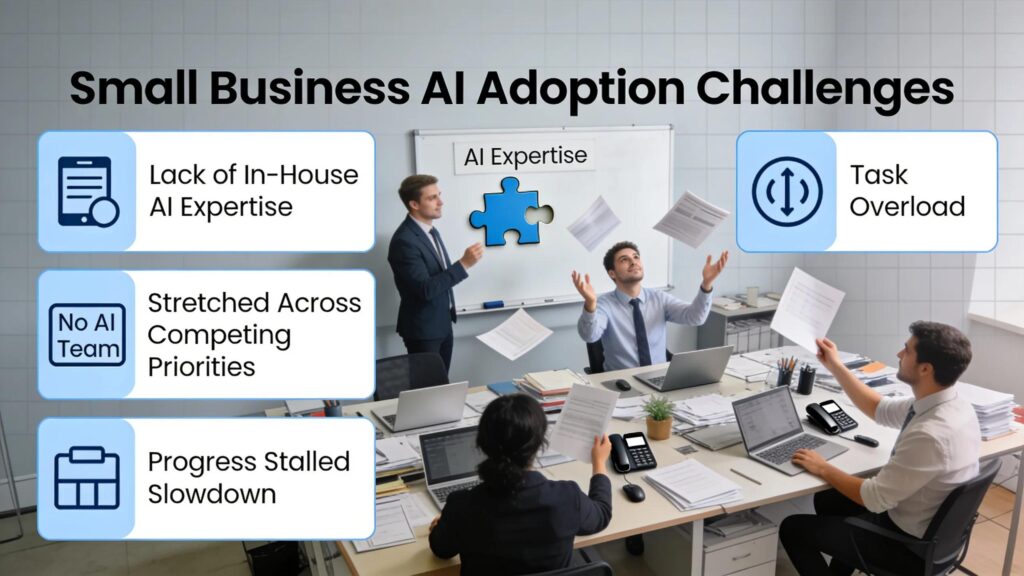
Analysis paralysis in AI strategy is a predictable result when complexity, vendor choices, and unclear governance collide with limited time and budgets. The mechanism is straightforward: too many technical options and unclear success metrics create decision fatigue, which delays pilots and prevents pilots from starting. For SMBs this is compounded by talent constraints and competing operational priorities, which shift AI to the back burner despite clear potential value. Understanding these root causes helps leaders design interventions—like time-boxed sprints and prioritized pilots—that reduce ambiguity and accelerate adoption.
What follows are the common causes and observable signs that will help leaders diagnose paralysis quickly and take corrective action.
What Are the Common Signs of AI Decision Fatigue and Overthinking?

Decision fatigue in AI programs shows up as stalled initiatives, repeated vendor shortlists, and postponed pilots that never start. Teams often cycle through long RFPs without committing to minimum-viable experiments, which wastes time and morale. Executives may express uncertainty about ROI and governance while employees show low confidence in AI projects, leading to fractured sponsorship. These symptoms create missed opportunities and deferred savings, and spotting them early allows leaders to apply time-boxing and small-experiment frameworks to restore momentum.
These operational and human signs point directly to remedies such as limiting options, clarifying KPIs, and assigning a dedicated decision owner for quick approvals.
How Do Overwhelming Options and Fear of Failure Stall AI Implementation?
Choice overload and risk aversion paralyze progress because every vendor or model choice appears irreversible and high-stakes without pilots. The psychological mechanism is simple: when perceived downside dominates perceived upside, teams avoid commitment and default to “wait and see.” Practical mitigation uses hypothesis-driven pilots, rapid validation with small data slices, and governance guardrails to limit experiments to safe, reversible scope. Time-boxing decisions and insisting on measurable success criteria reduce perceived risk and create a culture where learning is valued over perfection.
Framing AI work as a series of controlled, short-cycle experiments reframes failure as learning and makes commitment less risky, which directly reduces analysis paralysis.
How Does eMediaAI’s 10-Day AI Opportunity Blueprint™ Overcome Analysis Paralysis?

The 10-Day AI Opportunity Blueprint™ is a time-boxed sprint designed to convert uncertainty into a prioritized, people-first AI roadmap with clear next steps. The sprint forces executive decisions by focusing on top-impact, low-drag use cases, delivering ROI estimates, risk assessments, and tech-stack recommendations in ten business days. The mechanism is to compress discovery, prioritization, and action planning into a sequence that yields tangible artifacts executives can approve quickly. This structure reduces options to a manageable shortlist and creates accountability through defined roles and deliverables.
Below is a concise summary of the sprint’s daily phases and how each day produces artifacts that reduce risk and enable rapid adoption.
What Are the Key Phases of the 10-Day Sprint for Rapid AI Roadmapping?
The sprint groups work into three core phases: focused discovery, rapid prioritization, and an executable action plan with immediate pilots. During discovery (Days 1–3) stakeholders align on goals, constraints, and data availability. Prioritization (Days 4–7) scores use cases by impact and effort, producing a prioritized shortlist and ROI estimates. The action plan (Days 8–10) produces implementation steps, quick-win pilot designs, and technology recommendations to start deployment within 30–90 days.
- Discovery (Days 1–3): Align leadership, map workflows, and surface candidate use cases.
- Prioritization (Days 4–7): Score use cases, estimate ROI, and recommend pilots.
- Action Plan (Days 8–10): Deliver roadmap, tech stack suggestions, and pilot specs.
These phases create a rapid decision loop so teams leave the sprint with a funded pilot plan rather than another open-ended research task.
How Does a People-First and Ethical AI Approach Enable Faster Adoption?
A people-first approach places employee workflows, transparency, and clear user benefits at the center of each use case, which increases trust and lowers resistance to change. Ethical guardrails—privacy boundaries, fairness checks, and governance checkpoints—reduce fear of failure and regulatory risk by making trade-offs explicit and manageable. Training and role-based enablement ensure that users understand how AI augments their work rather than replaces them, which improves adoption velocity. When teams see immediate, low-friction benefits and clear protections, they champion pilots and accelerate scaling.
Aligning ethical practices with quick wins creates both social license and measurable outcomes, enabling a smoother path from pilot to production.
HRM’s Critical Role in Human-Centric AI Adoption and Digital Transformation
The rapid advancement of Artificial Intelligence (AI) in the business sector has led to a new era of digital transformation. AI is transforming processes, functions, and practices throughout organizations creating system and process efficiencies, performing advanced data analysis, and contributing to the value creation process of the organization. However, the implementation and adoption of AI systems in the organization is not without challenges, ranging from technical issues to human-related barriers, leading to failed AI transformation efforts or lower than expected gains. We argue that while engineers and data scientists excel in handling AI and data-related tasks, they often lack insights into the nuanced human aspects critical for organizational AI success. Thus, Human Resource Management (HRM) emerges as a crucial facilitator, ensuring AI implementation and adoption are aligned with human values and organizational goals. This paper explores the critical role of HRM in harmonizing AI’s technological capabilities with human-centric needs within organizations while achieving business objectives. Our positioning paper delves into HRM’s multifaceted potential to contribute toward AI organizational success, including enabling digital transformation, humanizing AI usage decisions, providing strategic foresight regarding AI, and facilitating AI adoption by addressing concerns related to fears, ethics, and employee well-being. It reviews key considerations and best practices for operationalizing human-centric AI through culture, leadership, knowledge, policies, and tools. By focusing on what HRM can realistically achieve today, we emphasize its role in reshaping roles, advancing skill sets, and curating workplace dynamics to accommodate human-centric AI implementation. This repositioning involves an active HRM role in ensuring that the aspirations, rights, and needs of individuals are integral to the economic, social, and environmental policies within the organizat
How eMediaAI’s AI Opportunity Blueprint™ sprint is structured into specific daily artifacts and recommended next steps to eliminate analysis paralysis while preserving human oversight and ethical guardrails.
| Day Range | Activities & Artifacts Delivered | Business Impact / Next Step |
|---|---|---|
| Days 1–3 | Stakeholder interviews, data inventory, initial use-case list | Aligns priorities and surfaces feasible pilots |
| Days 4–7 | Use-case scoring, ROI estimates, risk assessment | Shortlist of 1–3 pilot opportunities with cost/benefit |
| Days 8–10 | Roadmap, tech-stack recommendations, pilot specs | Clear implementation plan enabling 30–90 day pilots |
This day-by-day structure turns indecision into an executable plan and highlights immediate pilots that reduce risk and produce measurable results.
For SMBs seeking a practical, priced option, eMediaAI offers the AI Opportunity Blueprint™ as a 10-day engagement priced at $5,000. This option is expressly designed to rapidly deliver a prioritized roadmap, ROI estimates, and pilot-ready artifacts so leadership can approve short-cycle experiments with confidence. The offering emphasizes people-first adoption, ethical guardrails, and rapid, actionable roadmaps that lower stress and accelerate measurable ROI.
Mentioning this sprint early helps decision makers see a concrete, low-drag pathway from uncertainty to prioritized action and understand the commitment required to escape analysis paralysis.
What Tangible Outcomes Can SMBs Expect from the 10-Day AI Sprint?
The 10-day sprint delivers a compact set of deliverables that map directly to business value: a prioritized use-case list, ROI estimates, pilot specs, technology recommendations, and a risk/ethics checklist. Mechanically, the sprint narrows options to high-impact pilots and creates measurable KPIs—time saved, conversion uplift, or cost reduction—that can be tracked within 90 days of pilot start. The process reduces stress by giving teams a validated plan, clear ownership, and short cycles for measurement.
Below is a concise comparison of representative use cases, expected time-to-value, and outcome estimates to help leaders weigh priorities.
Use case comparisons and expected outcomes from the sprint help executives choose pilots that fit their appetite for effort and time-to-value.
| Use Case | Time-to-Value / Effort | Expected ROI / Outcome |
|---|---|---|
| E-commerce personalization | 30–60 days / low effort | 5–15% conversion uplift; increased AOV |
| Content repurposing & automation | 30–45 days / low effort | 30–60% faster content throughput; cost savings |
| Customer support triage (AI-assisted) | 45–90 days / medium effort | 20–40% reduction in response time; cost per ticket down |
| Video ad production automation | 30–60 days / medium effort | 50% faster production; lower creative spend per asset |
This table translates sprint outputs into near-term business outcomes and shows how prioritized pilots map to measurable ROI in a 90-day window.
Which High-Impact AI Use Cases Are Identified During the Sprint?
Typical high-impact, low-drag use cases surfaced in sprints focus on repetitive tasks, customer experience, and content velocity because these areas offer clear metrics and quick wins. Common categories include marketing personalization, automated content creation and repurposing, customer service triage, and production automation for media. Selection criteria emphasize immediate business impact, data availability, and implementation complexity to maximize short-cycle wins. These choices prioritize measurable benefits over theoretical use cases, which helps achieve adoption and visible ROI.
Identifying the right use cases during the sprint ensures pilots are relevant, measurable, and aligned with business goals rather than speculative experiments.
- Marketing Personalization: Tailors messaging and drives conversion through targeted content.
- Content Repurposing: Converts existing assets into multiple formats to boost reach.
- Support Triage: Uses AI to categorize and route tickets for faster resolution.
- Creative Production Automation: Speeds video and ad creation to lower cost per asset.
Each use case is assessed for impact and effort so leadership can approve pilots that reliably deliver measurable outcomes.
How Is Measurable ROI Delivered Within 90 Days of Implementation?
Measurable ROI follows a disciplined sequence: pilot specification from the sprint, rapid deployment of a minimum viable pipeline, and weekly KPI tracking against defined metrics. The sprint delivers pilot specs that include success criteria and measurement plans, enabling teams to start experiments within 30 days and collect significant data within 60–90 days. Typical KPIs include time saved per task, conversion rate change, cost per ticket, and total cost of creative production. Governance checkpoints and quick retrospectives allow course correction and rapid scaling when pilots show positive results.
Designing pilots for measurable outcomes ensures early wins build confidence and justify further investment, closing the loop from roadmap to ROI.
| Deliverable | Business Value | Typical 90-Day KPI |
|---|---|---|
| Prioritized pilot specs | Low-risk validation | Pilot conversion or time-saved metrics |
| ROI estimates | Funding justification | % lift or $ savings realized |
| Tech-stack recommendations | Faster deployment | Reduced integration time |
This mapping clarifies how sprint artifacts directly translate into measurable business improvements in the first 90 days.
How Can Fractional Chief AI Officer Services Sustain AI Success Beyond the Sprint?
A Fractional Chief AI Officer (fCAIO) provides part-time executive oversight that keeps AI efforts prioritized, governed, and aligned with business strategy without the cost of a full-time hire. The core responsibilities include governance cadences, vendor selection oversight, roadmap prioritization, and alignment of pilots to business KPIs. Because the fCAIO role focuses on decision velocity and accountability, it prevents the re-emergence of analysis paralysis by maintaining regular reviews and rapid escalation paths for blockers. This model is especially effective for SMBs that need strategic leadership without hiring a costly executive.
Sustained momentum after a 10-day sprint often requires this kind of part-time strategic ownership to translate initial pilots into scaled value.
What Role Does Fractional CAIO Play in Preventing Future Analysis Paralysis?
The fCAIO institutes governance routines—regular roadmap reviews, KPI dashboards, and prioritization frameworks—that make decisions fast and data-informed. By owning vendor evaluations, risk assessments, and pilot approvals on a part-time basis, the fCAIO reduces the friction that typically stalls projects. The role also enforces ethical guardrails and ensures workforce enablement is linked to rollout plans, which improves trust and long-term adoption. For SMBs, the fCAIO balances strategic oversight with pragmatic operational focus to keep initiatives moving forward.
Embedding part-time executive leadership aligns day-to-day execution with the strategic intent defined during the sprint and prevents past patterns of indecision from returning.
| Responsibility | Frequency / Duration | Business Benefit / KPI Impact |
|---|---|---|
| Roadmap reviews | Bi-weekly to monthly | Faster reprioritization; reduced time-to-decision |
| Vendor & tech oversight | As-needed with quarterly reviews | Lower integration risk; improved cost control |
| Governance & ethics checks | Monthly | Reduced compliance and reputational risk |
| Workforce enablement | Ongoing coaching sessions | Higher adoption rates and productivity gains |
This table shows how a fractional leader’s responsibilities map to operational cadence and measurable benefits for SMBs.
How Does Ongoing AI Workforce Training Enhance Adoption and Productivity?
Workforce training focuses on tooling, prompt best practices, and change management to make AI useful in daily workflows. Hands-on coaching, domain-specific playbooks, and champion programs help users internalize new processes and create internal advocates for scaling. Measurement of adoption uses usage metrics, time-saved analyses, and qualitative feedback loops to refine training. When employees feel equipped and see tangible productivity gains, adoption accelerates and pilots transition more smoothly into production.
Training that ties directly to pilots and measurable KPIs closes the gap between technical deployment and realized business value.
What Real-World Results Demonstrate the Effectiveness of the 10-Day Sprint?
Real-world results from time-boxed sprints typically show faster time-to-value, reduced production costs, and improved team satisfaction when compared with open-ended exploratory projects. Anonymized snapshots from engagements indicate measurable lifts—like increased conversion rates from personalization pilots or reduced creative production hours from automation—when pilots follow a prioritized sprint roadmap. These outcomes are replicable across industries with an emphasis on selecting use cases that have available data and clear KPIs. The evidence supports a repeatable approach: time-boxed sprint produces prioritized pilots, pilots produce measurable KPIs, and KPIs validate scale.
Below are anonymized outcome patterns and industry snapshots that illustrate sprint-to-value timelines and typical benefits.
How Have SMBs Improved ROI and Reduced Stress Using eMediaAI’s Blueprint?
SMBs using a compact roadmap often report faster decision cycles and clearer prioritization, which translate into reduced time spent on vendor evaluation and greater clarity for resource allocation. Operationally, teams see reduced cycle times and faster creative throughput when automation pilots succeed, and employees report less stress because expectations and metrics are explicit. These gains combine qualitative benefits—improved confidence and reduced friction—with quantifiable ROI such as time-saved percentages and conversion lifts that can be credited back to the sprint’s prioritized pilots.
The combined effect is that leadership gains decision clarity and teams gain immediate, tangible wins that sustain longer-term adoption.
Which Industry Use Cases Showcase Rapid AI Implementation Success?
Certain industries consistently benefit from sprint-driven pilots: e-commerce for personalization, digital advertising and media for production automation, and customer-facing services for support triage. In e-commerce, personalization pilots can lift conversion by measurable percentages within 30–60 days. In media production, automating repetitive editing or ad assembly reduces per-asset costs and speeds time-to-market. Customer service pilots that triage and route requests using AI reduce response times and operational cost per ticket. These industry snapshots show the sprint approach is broadly applicable when pilots focus on measurable KPIs and available data.
These use cases demonstrate how sprint-led prioritization converts abstract AI potential into concrete, industry-specific outcomes.
Is the 10-Day Sprint the Right AI Strategy Solution for Your SMB?
A 10-day sprint is the right fit when an SMB faces limited time, unclear priorities, or the need for rapid, low-drag pilots that demonstrate ROI. The sprint is not a substitute for long-term governance, but it is ideal for breaking decision logjams and producing actionable roadmaps with clear owners. Leaders who need a pragmatic path from curiosity to funded pilots, who value human-centric design, and who want ethics built into deployment will find the sprint especially useful. The decision comes down to appetite for a short, focused commitment that yields measurable next steps versus continuing broad research that rarely produces approvals.
Use the checklist below to quickly decide fit and next steps for booking an AI Opportunity Blueprint™.
What SMB Challenges Does the Sprint Specifically Address?
The sprint directly addresses resource constraints, uncertainty about ROI, and the absence of governance that typically create paralysis. It packages discovery, prioritization, and action planning into a focused timeline so leaders can make informed, fast decisions. For SMBs worried about adoption risk, the sprint embeds people-first design and ethical guardrails to ensure pilots are practical and trust-building. If your primary challenges are indecision, vendor overload, or lack of measurable outcomes, the sprint reduces those blockers by delivering a prioritized, pilot-ready roadmap.
- Resource Constraints: Produces a low-effort shortlist of high-impact pilots.
- ROI Uncertainty: Delivers ROI estimates and measurement plans for quick validation.
- Governance Gaps: Embeds ethical checks and decision cadences to reduce risk.
This checklist helps leaders judge whether a time-boxed roadmap is the fastest path to measurable AI value for their business.
How Can Business Leaders Book Their AI Opportunity Blueprint™ Today?
Booking the AI Opportunity Blueprint™ begins with a brief readiness conversation to outline objectives, identify stakeholders, and confirm commitment for the 10-day engagement. Expect to commit key stakeholders for short, focused sessions during the sprint and to provide basic data and process access needed for discovery. The sprint delivers a prioritized roadmap, ROI estimates, and pilot specs designed to enable immediate action after delivery. Leaders ready for a practical, people-first path out of analysis paralysis can request the AI Opportunity Blueprint™; eMediaAI positions this engagement as a clear, priced entry point to rapid, human-centric AI adoption.
- Prepare leadership and data access: Identify 1–3 stakeholders and basic data sources.
- Commit short, focused time: Expect brief daily or alternate-day working sessions during the sprint.
- Review deliverables and approve pilots: Use sprint artifacts to fund and start 30–90 day pilots.
These steps make the path from booking to pilot execution clear and manageable for SMB leadership.
Frequently Asked Questions
What is the role of a Fractional Chief AI Officer in AI strategy?
A Fractional Chief AI Officer (fCAIO) provides part-time executive oversight to ensure that AI initiatives align with business strategy and governance. This role is crucial for maintaining decision velocity and accountability, preventing analysis paralysis by instituting regular reviews and prioritization frameworks. The fCAIO oversees vendor evaluations, risk assessments, and pilot approvals, ensuring that AI projects remain on track and that ethical considerations are integrated into the decision-making process. This model is particularly beneficial for SMBs that require strategic leadership without the expense of a full-time hire.
How can organizations measure the success of their AI pilots?
Success measurement for AI pilots typically involves defining clear Key Performance Indicators (KPIs) during the sprint phase. These KPIs can include metrics such as time saved per task, conversion rate changes, and cost reductions. Organizations should track these metrics weekly against the defined success criteria to assess pilot performance. Regular retrospectives allow teams to make necessary adjustments and scale successful pilots. By focusing on measurable outcomes, organizations can validate their investments and justify further AI initiatives.
What are the common pitfalls to avoid during AI implementation?
Common pitfalls in AI implementation include lack of clear objectives, insufficient stakeholder engagement, and failure to establish governance frameworks. Organizations often fall into the trap of overloading teams with too many options, leading to decision fatigue. Additionally, neglecting to align AI initiatives with business goals can result in wasted resources and missed opportunities. To avoid these pitfalls, it’s essential to maintain a focused approach, prioritize high-impact use cases, and ensure that all stakeholders are involved and informed throughout the process.
How does a people-first approach impact AI adoption?
A people-first approach to AI adoption emphasizes the importance of employee workflows, transparency, and user benefits. By centering AI initiatives around the needs and experiences of employees, organizations can foster trust and reduce resistance to change. This approach also includes ethical considerations, such as privacy and fairness, which help mitigate fears associated with AI implementation. When employees see clear advantages and feel supported in their transition to AI-enhanced workflows, adoption rates increase, leading to more successful outcomes and a smoother scaling process.
What types of training are essential for successful AI adoption?
Essential training for successful AI adoption includes hands-on coaching, domain-specific playbooks, and change management strategies. Training should focus on how to effectively use AI tools, best practices for prompt engineering, and the integration of AI into daily workflows. Additionally, creating internal advocates or champions can help facilitate knowledge sharing and encourage broader acceptance among teams. By measuring adoption through usage metrics and feedback, organizations can refine their training programs to ensure that employees feel equipped and confident in utilizing AI technologies.
What are the expected outcomes after completing the 10-Day AI Sprint?
After completing the 10-Day AI Sprint, organizations can expect a prioritized use-case list, ROI estimates, pilot specifications, and technology recommendations. These deliverables are designed to facilitate immediate action and reduce the time to value. Typically, organizations see measurable improvements within 90 days, such as increased conversion rates, reduced operational costs, and enhanced team satisfaction. The sprint structure not only provides clarity and direction but also helps teams transition from indecision to actionable plans that yield tangible business results.
Conclusion
Implementing a 10-day AI Opportunity Blueprint™ can effectively break the cycle of analysis paralysis, enabling SMBs to make swift, informed decisions that drive measurable outcomes. By focusing on prioritized use cases and ethical considerations, organizations can foster a culture of trust and rapid adoption. The structured approach not only clarifies next steps but also empowers teams to achieve tangible results within 90 days. Take the first step towards transforming your AI strategy by booking your AI Opportunity Blueprint™ today.