

10‑Day AI Opportunity Blueprint™: Clear ROI, Real Use Cases, Zero Fluff.

AI Whitepapers for Leaders: Get Smarter, Faster, and More Competitive

Action-ready insights distilled from the noise—so you out-think, out-decide, and out-pace the competition.

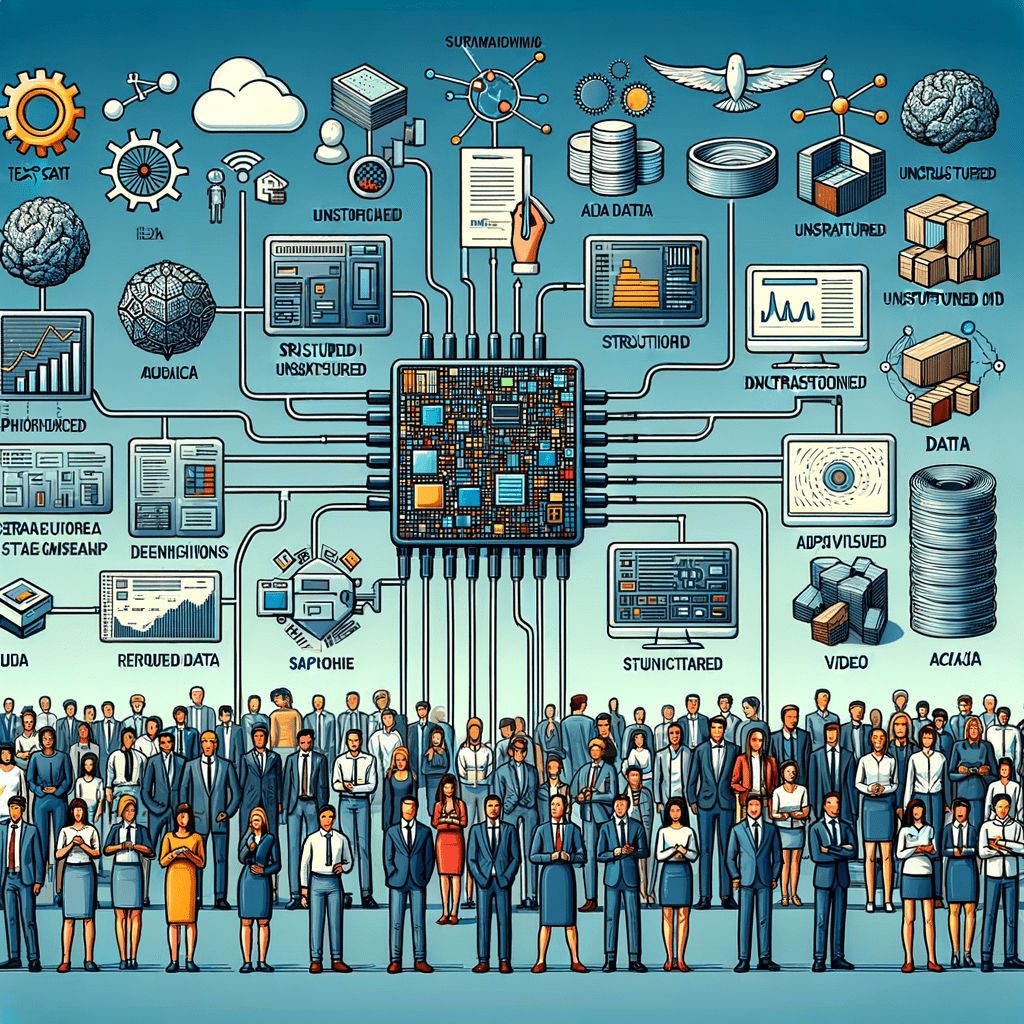
Diverse data types in generative AI illustrated with a central circuit board, surrounded by icons representing structured, unstructured, and semi-structured data, alongside a crowd of professionals in business attire.

What Are the Types of Data in Generative AI? A Guide

So, what are the types of data in generative AI? Generative AI, the technology behind tools like ChatGPT and DALL-E 2, creates text, images, music, and code. This creative power hinges on the data it receives. Understanding this data is crucial, as it forms the core of generative AI models. This knowledge can empower you to enhance productivity and gain a competitive edge.

Data: The Foundation of Generative AI

Generative AI models, like variational autoencoders, learn by identifying patterns in data. These AI algorithms require vast amounts of data, sometimes terabytes, to generate impressive outputs. A generative AI model’s effectiveness directly relates to the quality of its training data.

Structured Data

Structured data resides in spreadsheets and databases. This organized data, comprising numbers, dates, and categories, is easily processed by AI. Structured data fuels models tackling tasks with defined parameters. It also enables financial modeling, relying on financial records as the foundation.

Unstructured Data

Unstructured data constitutes most of the world’s data. This includes text, audio, and video. Generative AI decodes this format to gain insights. Unstructured data, particularly in natural language processing, is essential for language models like GPT-4, enabling the creation of realistic images from unstructured data sources.

What are the Types of Data in Generative AI: A Breakdown

Data TypeDescriptionUse Cases
TextWords, sentences, paragraphs, codeChatbots, content creation, language translation, code generation
ImagesPhotographs, drawings, digital artImage generation, image editing, style transfer
AudioSpeech, music, sound effectsMusic composition, speech synthesis, audio enhancement
VideoMovies, clips, animationsVideo generation, video editing, special effects
CodeProgramming code in various languagesCode generation, code completion, bug detection
Other Structured DataNumerical and categorical data (think of sensor output or shopping behaviors).Enhancing AI insights to assist outputs or refine existing ones.

OpenAI’s Sora, a text-to-video model, showcases the fusion of data types. This model combines textual descriptions with visual concepts to generate video content.

Training Data vs. Input Data: Distinct Roles

Training data establishes a model’s foundational knowledge. This process is similar to a student’s education before exams. Input data, however, is like on-the-job experience, applied after training. In content generation with Bard, input data, such as text prompts and examples, guides the creation process, like crafting a college essay on quantum physics using relevant texts on quantum mechanics.

Data Quality: The Unsung Hero of Generative AI

Low-quality or poorly formatted training data yields subpar results in generative AI models. This includes flawed outputs and inaccurate models. Adversarial networks also contribute to data refinement.

Strategies for Better Data

  • Curation: Selecting high-quality data, much like choosing the best ingredients, improves long-term generative AI accuracy. Hand-picking high-quality data from existing datasets plays an essential role in enhancing a generative model’s learning process and avoiding potential data biases introduced by automated selection methods.
  • Cleaning and Preprocessing: Correcting errors and ensuring consistency in data prepares it for effective AI training. Data preprocessing involves data cleaning to fix inconsistencies, handling missing data by imputation, or removal, transforming the data like data normalization to remove scales or eliminate irrelevant data points.
  • Augmentation: Expanding existing datasets through techniques like data augmentation and regularization enhances AI model performance. Transformations, like adding blur to photos or rephrasing sentences, create larger datasets, providing generative AI models with more examples to learn patterns and relations from, and produce richer data for adversarial network architectures. This strengthens models and enhances output dependability.

Business Applications: Data’s Impact on Real-World AI

McKinsey’s research reveals increasing organizational adoption of generative AI. Gartner projects over 80% adoption by 2026. Generative AI could contribute trillions to the global economy, benefiting businesses from small blogs to large enterprises. Various popular generative ai tools rely heavily on data types.

Real-World Examples of Data-Driven Success

Personalized marketing leverages generative AI to tailor user experiences. By combining user preferences, demographics, website behavior, and search history, businesses create personalized emails and ads, improving customer experience and boosting engagement. Personalized experiences significantly impact user engagement and conversions.

Content creation benefits greatly from generative AI and its large language models (LLMs). LLMs process large amounts of textual data, enabling content creation, rewriting, and refinement at an unprecedented pace. This streamlines workflows for content creators, including bloggers and copywriters, increasing site engagement and revenue. Furthermore, generative AI can create personalized audio content, like custom intro music for videos. What are the types of data in generative AI that enable this? The models rely heavily on large audio datasets and use training data which includes aspects like melody, harmony, and rhythm, often paired with specific parameters like desired style.

Ethical Considerations and Data Bias

Data reflects human biases, leading to prejudiced outputs in generative AI models. A lawyer’s use of generative AI in court resulted in fabricated cases, highlighting the importance of ethical data usage. Synthetic data can offer solutions in such scenarios.

Promoting diversity in data, along with careful analysis and selection of training and input data, are critical for reducing bias. Developing tools and metrics to detect and mitigate bias in AI models is essential. This proactive approach addresses prejudices and raises awareness of sensitive information handling. Government oversight plays a vital role in regulating these data systems. A business might generate synthetic training data by studying the properties of a subset of their customer’s personally identifiable information, and using this subset to train generative models which then create data with statistical similarities but without the sensitive or private data elements included. In this way, synthetic training data creates a privacy preserving outcome where learning models have large data quantities while respecting privacy.

The Future of Generative AI: Data’s Evolving Role

Generative AI’s future depends on accessing high-quality, diverse, and unbiased data. This access can unlock further potential in various fields, from art and music to medicine and mathematics. The core data types—text, images, audio, video, and code—remain crucial for generative pre-trained models. However, future AI might incorporate new data forms, like sensory experiences or location information from navigation datasets, expanding its capabilities beyond current understanding. As machine learning advances, training data could include physical sensations or abstract concepts, allowing AI models to create increasingly nuanced and unique forms of content, moving beyond simply text generation.

FAQs about what are the types of data in generative ai

FAQ 1: What type of data is used for generative AI?

Generative AI utilizes various data types, including text, images, audio, video, and code, for model training and content generation. The specific type depends on the task. For example, chatbots utilize text, image generators use images, and music composition employs audio data.

FAQ 2: What are the types of data in generative AI: structured, unstructured?

Generative AI utilizes both structured data, readily processed by AI due to its organization (like databases), and unstructured data (text and images) which requires more complex processing for meaningful extraction. Financial modeling relies on structured data like financial records while content generation leverages unstructured data like text from books. Deep learning approaches in this content generation domain allow models to find more granular relations like the phrase “what are the types of data in generative AI”.

FAQ 3: What are types of data in AI?

Beyond generative AI’s focus on text, images, audio, video, code, and structured types, broader AI data categories exist. These include time-series data, sensor data, graphs, and location data.

FAQ 4: What are the four types of generative AI?

While some debate exists, four widely recognized categories of generative AI are Generative Adversarial Networks (GANs), Variational Autoencoders (VAEs), transformer-based architectures, and diffusion models.

Wrapping Up Generative AI Data Insights

So, what are the types of data in generative AI? The data powering generative AI is its fundamental building block. From text and images to emerging forms like location and sensor data, these elements fuel generative AI’s creative potential. As AI evolves, the data it uses will continue to shape its innovative and impactful applications.

Understanding these data types empowers businesses and individuals to leverage generative AI effectively. This knowledge enhances content creation, personalizes marketing campaigns, and ultimately enriches user experiences without negatively impacting budgets.
Facebook
Twitter
LinkedIn
Related Post
Lee Pomerantz, founder of eMediaAI, smiling in a cozy library setting, emphasizing human-centric AI consulting for SMBs.

Lee Pomerantz

Lee Pomerantz is the founder of eMediaAI, where the mantra “AI-Driven, People-Focused” guides every project. A Certified Chief AI Officer and CAIO Fellow, Lee helps organizations reclaim time through human-centric AI roadmaps, implementations, and upskilling programs. With two decades of entrepreneurial success - including running a high-performance marketing firm - he brings a proven track record of scaling businesses sustainably. His mission: to ensure AI fuels creativity, connection, and growth without stealing evenings from the people who make it all possible.

Summarize This Page With Your Favorite AI

© 2025 eMediaAI.com. All rights reserved. Terms and Conditions | Privacy Policy 

Mini Case Study: Personalized AI Recommendations Boost E-Commerce Sales | eMediaAI

Mini Case Study: Personalized AI Recommendations
Boost E-Commerce Sales

Problem

Competing with giants like Amazon made it difficult for a small but growing e-commerce brand to deliver the kind of personalized shopping experience customers expect. Their existing recommendation engine produced generic suggestions that ignored customer intent, seasonality, and browsing behavior — resulting in low conversion rates and high cart abandonment.

Solution

The brand implemented a bespoke AI recommendation agent that delivered real-time personalization across their digital storefront and email campaigns.

  1. The AI analyzed browsing history, purchase patterns, session duration, abandoned carts, and delivery preferences.
  2. It then generated dynamic product suggestions optimized for cross-selling and upselling opportunities.
  3. Personalized recommendations extended to marketing emails, highlighting products relevant to each customer's unique shopping journey.
  4. The system continuously improved by learning from user engagement and conversion outcomes.

Key Capabilities: Real-time personalization • Behavioral analysis • Cross-sell optimization • Continuous learning from user engagement

Results

Average Cart Value

+35%

Increase driven by intelligent upselling and cross-selling.

Email Conversion

+60%

Lift in email conversion rates with personalized product highlights.

Cart Abandonment

Reduced

Significant reduction in cart abandonment, boosting total sales performance.

ROI Timeline

3 Months

The AI system paid for itself through improved revenue efficiency.

Strategy

In today's market, one-size-fits-all recommendations no longer work. Tailored AI systems designed around your customer data deliver the kind of personalized, dynamic experiences that drive loyalty and repeat purchases — helping niche e-commerce brands compete effectively against industry giants.

Why This Matters

  • Customer Expectations: Modern shoppers expect Amazon-level personalization regardless of brand size.
  • Competitive Edge: AI-powered recommendations level the playing field against larger competitors.
  • Data-Driven Insights: Continuous learning means the system gets smarter with every interaction.
  • Revenue Multiplication: Small improvements in conversion and cart value compound dramatically over time.
  • Customer Lifetime Value: Personalized experiences drive repeat purchases and brand loyalty.
Customer Story: AI-Powered Video Ad Production at Scale

Marketing Team Generates High-Quality
Video Ads in Hours, Not Weeks

AI-powered video production reduces campaign creation time by 95% using Google Veo

Customer Overview

Industry
Travel & Entertainment
Use Case
Generative AI Video Production
Campaign Type
Destination Marketing
Distribution
Digital & In-Flight

A marketing team responsible for promoting global travel destinations needed to produce a constant stream of fresh, high-quality video content for in-flight entertainment and digital advertising campaigns. With hundreds of destinations to showcase across multiple markets, traditional production methods couldn't keep pace with demand.

Challenge

Traditional production — involving creative agencies, travel shoots, and post-production — was costly, time-consuming, and logistically complex, often taking weeks to produce a single 30-second ad. This limited the team's ability to adapt campaigns quickly to market trends or seasonal travel spikes.

Key Challenges

  • Traditional video production required 3–4 weeks per 30-second ad
  • Physical location shoots created high costs and logistical complexity
  • Limited content volume constrained campaign variety and testing
  • Slow turnaround prevented rapid response to seasonal travel trends
  • Agency dependencies created bottlenecks and budget constraints
  • Maintaining brand consistency across dozens of destination videos

Solution

The marketing team implemented an AI-powered video production pipeline using Google's latest generative AI technologies:

Google Cloud Products Used

Google Veo
Vertex AI
Gemini for Workspace

Technical Architecture

→ Destination selection & campaign brief
→ Gemini for Workspace → Script generation
→ Style guides + reference imagery compiled
→ Google Veo → Cinematic video generation
→ Human review & approval
→ Deployment to digital & in-flight channels

Implementation Workflow

  1. The team selected a destination to promote (e.g., "Kyoto in Autumn").
  2. They used Gemini for Workspace to brainstorm and generate a compelling 30-second video script highlighting the city's cultural and visual appeal.
  3. The script, along with style guides and reference imagery, was fed into Veo, Google's generative video model.
  4. Veo produced a high-quality cinematic video clip that captured the desired tone and visuals — all in hours rather than weeks.
  5. The final assets were quickly reviewed, approved, and deployed across digital channels and in-flight entertainment systems.
Example Campaign: "Kyoto in Autumn"

Script generated by Gemini highlighting cultural landmarks, fall foliage, and traditional experiences. Veo created cinematic footage showing temples, cherry blossoms, and street scenes — all without a physical production crew.

Results & Business Impact

Time Efficiency

95%

Reduced ad production time from 3–4 weeks to under 1 day.

Cost Savings

80%

Eliminated physical shoots and editing labor, saving ≈ $50,000 annually for mid-size campaigns.

Creative Scalability

10x Output

Enabled production of dozens of destination videos per month with brand consistency.

Engagement Lift

+25%

Increased click-through rates on destination ads due to richer, faster content rotation.

Key Benefits

  • Rapid campaign iteration enables A/B testing and seasonal responsiveness
  • Dramatically lower production costs allow coverage of niche destinations
  • Consistent brand voice and visual quality across all generated content
  • Reduced dependency on external agencies and production crews
  • Faster time-to-market improves competitive positioning in travel marketing
  • Environmental benefits from eliminating unnecessary travel and location shoots

"Google Veo has fundamentally changed how we approach video content creation. We can now test dozens of creative concepts in the time it used to take to produce a single video. The quality is cinematic, the turnaround is lightning-fast, and our engagement metrics have never been better."

— Director of Digital Marketing, Travel & Entertainment Company

Looking Ahead

The marketing team plans to expand their AI-powered production capabilities to include:

  • Personalized destination videos tailored to customer preferences and travel history
  • Multi-language versions of campaigns generated automatically for global markets
  • Real-time content updates based on seasonal events and local festivals
  • Integration with customer data platforms for hyper-targeted advertising

By leveraging Google Cloud's generative AI capabilities, the organization has transformed video production from a bottleneck into a competitive advantage — enabling creative agility at scale.

Customer Story: Automated Podcast Creation from Live Sports Commentary

Sports Broadcaster Transforms Live Commentary
into Same-Day Highlight Podcasts

Automated podcast creation reduces production time by 93% using Google Cloud AI

Customer Overview

Industry
Sports Broadcasting & Media
Use Case
Content Automation
Size
Mid-sized Sports Network
Region
North America

A regional sports broadcaster manages hours of live event commentary daily across multiple sporting events. The organization needed to transform raw commentary into engaging, shareable content that could be distributed to fans immediately after events concluded.

Challenge

Creating highlight reels and post-event summaries manually was slow and resource-intensive, often taking an entire production team several hours per event. By the time the recap was ready, fan interest and social engagement had already peaked — leading to missed opportunities for timely content distribution and reduced viewer retention.

Key Challenges

  • Manual transcription and editing required 5+ hours per event
  • Delayed content release reduced fan engagement and social media reach
  • High production costs limited content output for smaller events
  • Inconsistent quality across multiple simultaneous events
  • Limited scalability during peak sports seasons

Solution

The broadcaster implemented an automated podcast creation pipeline using Google Cloud AI and serverless technologies:

Google Cloud Products Used

Cloud Storage
Speech-to-Text API
Vertex AI
Cloud Functions

Technical Architecture

→ Live commentary audio → Cloud Storage
→ Cloud Function trigger → Speech-to-Text
→ Time-stamped transcript generated
→ Vertex AI analyzes transcript for exciting moments
→ AI generates 30-second highlight scripts
→ Polished podcast ready for distribution

Implementation Workflow

  1. Live commentary audio was captured and stored in Cloud Storage.
  2. A Cloud Function triggered Speech-to-Text to generate a full, time-stamped transcript.
  3. The transcript was sent to a Vertex AI generative model with a prompt to detect the top 5 exciting moments using cues like keywords ("goal," "crash," "overtake"), exclamations, and sentiment.
  4. Vertex AI generated short 30-second highlight scripts for each key moment.
  5. These scripts were converted into audio using text-to-speech or recorded by a human host — producing a polished "daily highlights" podcast in minutes instead of hours.

Results & Business Impact

Time Savings

93%

Reduced highlight production from ~5 hours per event to 20 minutes.

Cost Reduction

70%

Automated workflows cut production costs, saving an estimated $30,000 annually.

Fan Engagement

+45%

Same-day release of highlight podcasts boosted daily listens and social media shares.

Scalability

Multi-Event

System scaled effortlessly across multiple sports events year-round.

Key Benefits

  • Same-day content delivery captures peak fan interest and engagement
  • Smaller production teams can maintain consistent output across multiple events
  • Automated quality and formatting ensures professional results at scale
  • Reduced time-to-market improves competitive positioning in sports media
  • Lower operational costs enable coverage of more sporting events

"Google Cloud's AI capabilities transformed our production workflow. What used to take our team an entire afternoon now happens automatically in minutes. We're able to deliver content while fans are still talking about the game, which has completely changed our engagement metrics."

— Head of Digital Content, Sports Broadcasting Network