How to Choose the Right Fractional AI Officer: A Comprehensive Guide to Hiring Expert AI Leadership
Choosing the right fractional Chief AI Officer (CAIO) gives SMBs executive AI leadership without the full-time cost of a C-suite hire, and it accelerates measurable impact by focusing strategy, governance, and implementation. This guide explains what a fractional CAIO does, why small and mid-sized businesses should consider one, and how to evaluate candidates against technical, ethical, and business-alignment criteria. You will learn practical steps for onboarding fractional AI leadership, building internal capabilities, measuring ROI, and weighing cost models like retainers versus full-time salaries. The guide also includes vendor evaluation checklists, EAV-style comparison tables to standardize decision-making, and a focused vendor profile describing how a fractional CAIO engagement can validate opportunities quickly. Use the sections below to decide which mix of expertise, people-first change management, and governance best fits your organization’s AI priorities while keeping time-to-value and risk front and center.
What Is a Fractional Chief AI Officer and Why Does Your SMB Need One?
A fractional Chief AI Officer is a senior AI leader who provides strategic direction, governance, and implementation oversight on a part-time or retainer basis, enabling SMBs to access executive AI capabilities without hiring a full-time CAIO. This arrangement works because the fractional CAIO delivers prioritized AI roadmaps, vendor selection guidance, and measurable KPIs that shorten time-to-value. For SMBs, the core benefits are faster ROI, reduced hiring risk, and access to cross-domain expertise that larger companies typically reserve for full-time executives. Comparing fractional engagements to consultants and full-time hires clarifies when to use each model and helps set expectations for scope and continuity.
Research underscores the growing recognition of the Chief AI Officer role, particularly for small and mid-sized businesses navigating the complexities of AI governance.
Defining the Chief AI Officer Role for SMBs
We investigate governance roles related to AI use in practice, and undertake first steps to define the role profiles of a Chief AI Officer (CAIO) and an AI Risk Officer (AIRO). We base our inquiry on two sources: a literature review and evaluative interviews with nine AI professionals from small- and medium-sized companies. We find that, whereas the roles and activities associated with the CAIO and AIRO are commonly deemed relevant for such companies in the long run, today only a few companies have implemented them. Especially the creation of the CAIO position seems justified, due to the complexity of AI and the need for extensive interaction and coordination related to AI governance.
AI governance: are Chief AI Officers and AI Risk Officers needed?, M Schäfer, 2022
Fractional CAIO benefits include cost-effectiveness, immediate access to experience, and governance leadership that supports responsible AI adoption. The next subsection outlines the core responsibilities a fractional CAIO typically assumes to produce these benefits.
What Are the Core Responsibilities of a Fractional CAIO?

A fractional CAIO defines AI strategy, prioritizes use cases, and establishes governance frameworks to ensure safe, responsible deployment. They create AI roadmaps, set KPIs and KRIs, coordinate vendors and internal teams, and oversee model validation and monitoring to protect data privacy and fairness. In practice, a fractional CAIO might lead a pilot that automates a customer-facing workflow, then translate pilot metrics into operational KPIs to scale the solution. This combination of strategy, governance, and hands-on coordination produces measurable outcomes and prepares your organization for sustained AI adoption.
These responsibilities create the foundation for addressing talent gaps and cost constraints that many SMBs face when attempting to scale AI programs.
The broader challenge of a significant AI talent gap across industries further underscores the need for strategic leadership to navigate these constraints.
Addressing the AI Talent Gap in Organizations
The effective deployment of AI technologies is constrained by a significant talent gap, as the demand for AI-skilled professionals far exceeds the current supply. This gap is particularly pronounced in the supply chain sector, where specialized knowledge in both AI and supply chain operations is essential. Bridging this talent gap is crucial for industries aiming to leverage AI for competitive advantage, yet achieving this requires a collaborative approach involving multiple stakeholders. This explores the opportunities for collaboration between industry, academia, and public-private partnerships to address the AI talent shortage in supply chain management.
Bridging the AI Talent Gap in Supply Chain Management: Opportunities for Collaboration, ZS Olanihun, 2025
How Does a Fractional AI Officer Address the AI Talent Gap and Cost Challenges for SMBs?
Fractional AI leadership reduces hiring risk by providing senior-level experience without the compensation and benefits of a full-time CAIO, enabling SMBs to redirect budget into implementation. Typical cost comparisons show fractional retainers are a fraction of the annual cost of a full-time executive while delivering governance, strategy, and vendor management. Access to specialized skills via a fractional CAIO also eliminates lengthy recruitment cycles and accelerates pilot launches, improving time-to-value. For SMBs with limited internal AI talent, a fractional CAIO acts as an interim leader and mentor, transferring knowledge while delivering outcomes.
Indeed, studies confirm that AI-driven solutions are vital for addressing the talent shortages that often disproportionately affect smaller firms.
AI Solutions for Talent Gaps in Small Firms
AI-driven solutions can help bridge the talent gaps faced by organizations. This involves examining the various AI applications and strategies that can be implemented to optimize workforce planning, recruitment, training, and retention. While large corporations have often offered substantial benefits, smaller firms with limited resources often struggle to attract and retain top AI talent, exacerbating the talent shortage.
Bridging the Gap: Leveraging AI to Address Talent Shortages in Organizations., M ZEESHAN, 2025
With cost and talent hurdles minimized, companies can focus on selecting vendors and evaluating ROI; the next section provides a structured checklist for that selection process.
What Are the Key Factors to Consider When Hiring a Fractional AI Officer?
When evaluating fractional AI leadership, use a structured checklist that balances domain expertise, business alignment, people-first practices, and engagement flexibility. Assess candidates against measurable outcomes, governance experience, and evidence of workforce enablement to ensure the hire will prioritize ROI and ethical deployment. This section provides practical evaluation steps, verification signals, and a comparative EAV table to make candidate assessment systematic and repeatable.
Consider this checklist when screening candidates and service firms:
- Expertise and Track Record: Request case studies that demonstrate measurable business results and relevant vertical experience.
- Business Alignment and ROI Orientation: Look for explicit KPI-setting and time-to-value commitments.
- People-First and Ethical Practices: Confirm adoption of Responsible AI Principles and change-management tactics.
- Flexibility and Scalability: Ensure the engagement model supports retainer, project work, and knowledge transfer.
These four criteria are the primary filters; the following table helps map candidate attributes to evidence you should request.
The table below compares candidate attributes, the evidence to request, and practical validation points to use during interviews.
| Candidate Attribute | Evidence to Request | What to Look For |
|---|---|---|
| Technical & Domain Expertise | Case studies, architecture docs, references | Measurable outcomes, relevant vertical work |
| Governance & Responsible AI | Governance frameworks, audits, policies | Clear audits, explainability approach, privacy controls |
| People-First Track Record | Change-management plans, training materials | Mentorship, adoption metrics, stakeholder engagement |
This EAV-style comparison makes candidate evaluation objective and repeatable. Use the next subsections to operationalize each checklist item during due diligence.
How to Evaluate Expertise and Industry Experience in AI Leadership?
To validate expertise, ask candidates for specific outcomes, architecture diagrams, and references that show domain relevance and repeatable delivery patterns. Seek quantifiable results—revenue lift, efficiency gains, or time-to-market improvements—and probe for the candidate’s role in achieving them. Red flags include vague metrics, unclear governance practices, or an inability to name vendor integrations used. A rigorous evaluation balances technical depth with evidence of execution and handoff to internal teams, ensuring the fractional CAIO can both lead pilots and transfer ownership.
Evaluating experience this way leads naturally to ensuring the candidate ties activity to business outcomes; the next subsection explains how to verify ROI orientation.
Why Is Alignment with Business Goals and ROI Focus Critical?
Alignment ensures AI work targets measurable improvements to customer metrics, operations, or product features rather than technology for its own sake. A ROI-focused fractional CAIO ties use cases to specific KPIs such as time-to-value, conversion rate lift, or operational cost reduction and establishes a 30/60/90-day measurement cadence. Ask candidates to present a prioritized backlog with estimated impact and time-to-value windows to confirm they can deliver measurable outcomes. When AI initiatives are prioritized by business impact, teams avoid resource dilution and accelerate adoption.
ROI focus naturally intersects with people-first practices that reduce resistance and speed adoption; the next subsection addresses those practices.
How Does a People-First and Ethical AI Approach Impact AI Adoption?
A people-first approach centers employees and stakeholders in design, reducing fear and improving uptake by emphasizing augmentation over replacement. Responsible AI practices—such as fairness audits, privacy safeguards, and clear explainability—build trust among users and regulators and lower implementation risk. Ask candidates for training plans, stakeholder communication templates, and adoption metrics that show prior success in increasing user acceptance. Embedding people-first tactics within governance increases the likelihood that AI projects scale sustainably and produce the intended business benefits.
Scalability and flexible engagement terms determine whether a fractional CAIO can grow with your needs; the next subsection outlines expected models and signals of scale-readiness.
What Flexibility and Scalability Should You Expect from Fractional AI Leadership?
Expect engagement models that include retainer oversight, project-based deliverables, and short validation engagements that transition into longer partnerships as needs grow. Scalable providers offer training, repeatable playbooks, vendor networks, and mentorship to build internal capability. Recommended contract terms include clear milestones, termination clauses, and knowledge-transfer commitments that protect your institution’s continuity. Signals of scalable providers include documented playbooks, measured adoption metrics, and the ability to staff across strategy and implementation.
The EAV table above and these checklist items will help you select candidates who can both deliver results and scale; the next section shows how one provider maps to these criteria.
How Does eMediaAI’s Fractional CAIO Service Stand Out?
eMediaAI offers fractional Chief AI Officer services built around a people-first methodology, a fixed-entry validation product called the AI Opportunity Blueprint™, and a commitment to measurable ROI in under 90 days. The firm emphasizes Done-With-You partnerships that combine strategic oversight with hands-on implementation and workforce enablement. Founder Lee Pomerantz is a Certified Chief AI Officer and positions engagements to prioritize ethical governance and rapid prioritization of high-impact use cases. For SMBs evaluating fractional CAIO options, eMediaAI’s combination of a low-risk blueprint, people-first change management, and measurable short-term outcomes aligns directly with the decision criteria outlined earlier.
What Is the AI Opportunity Blueprint™ and How Does It Drive Fast ROI?
The AI Opportunity Blueprint™ is a 10-day discovery and prioritization engagement designed to identify high-impact AI use cases, produce a practical implementation roadmap, and assess risks and tech-stack fit for a fixed price of $5,000. Deliverables include prioritized use cases, an implementation plan with milestones, a risk assessment, and a vendor integration outline that accelerates decision-making. For SMBs uncertain about where to start, this low-risk, time-boxed engagement validates opportunity and establishes short-term KPI targets. The Blueprint is intended for teams that want a rapid assessment to commit budget and resources with clarity and reduced risk.
By validating opportunities quickly, the Blueprint supports faster pilot launches and clearer ROI expectations; next we’ll see how people-first practices support adoption.
How Does eMediaAI’s People-First Methodology Ensure Successful AI Adoption?
eMediaAI’s people-first methodology emphasizes designing AI to complement work, running training and mentorship programs, and integrating stakeholder feedback into deployment. The approach reduces resistance by focusing pilots on reducing drudgery and enhancing employee productivity while providing clear adoption metrics and training curricula. Deliverables commonly include playbooks, role-based training sessions, and change-management checkpoints that transfer ownership to internal teams. This combination of technical delivery and human-centered change management helps accelerate adoption and sustain long-term value.
What Case Studies Demonstrate Measurable Results from eMediaAI’s Fractional AI Leadership?
eMediaAI’s engagements have produced quantifiable results in areas like e-commerce personalization and creative production efficiency. Examples include an anonymized e-commerce client that realized a 35% increase in average order value after personalized recommendations were prioritized and an advertising operations client that reduced video ad production time substantially through automated workflows. Another engagement automated podcast highlight generation to streamline content repurposing and reduce manual editing time. These anonymized outcomes illustrate the firm’s claim of measurable ROI in under 90 days and provide concrete validation for SMBs considering fractional CAIO services.
These case outcomes demonstrate the link between prioritized use cases and measurable business impact; the next major section explains how to implement and sustain leadership once hired.
How to Implement and Sustain AI Leadership with a Fractional CAIO?
Successful implementation combines a structured onboarding timeline, knowledge transfer practices, and continuous optimization cycles to keep models and governance aligned with business needs. Onboarding should include a kickoff, stakeholder alignment, and quick-win pilots, followed by training and documentation that build internal ownership. Sustaining leadership requires regular KPI reviews, governance audits, and a roadmap for model upgrades and vendor changes. The table below operationalizes onboarding, training, and KPI expectations so SMBs can set realistic timelines and outcomes.
Introductory table for implementation expectations:
| Phase | Timeline | Expected Outcome |
|---|---|---|
| Onboarding & Kickoff | 2–4 weeks | Aligned stakeholders, prioritized pilot backlog |
| Training & Knowledge Transfer | 1–3 months | Staff capable of operating/monitoring models |
| KPI & Governance Setup | Ongoing (30/60/90-day cadence) | Clear metrics, audit trails, adoption tracking |
This EAV-style table clarifies timing and deliverables so teams can plan staff involvement and governance rhythms. The next subsections provide checklists and tactics for onboarding, capability building, and continuous optimization.
What Are Best Practices for Seamless Onboarding and Team Integration?
Begin with a focused kickoff that aligns leadership, product, and operations around prioritized use cases, defining clear owners and success metrics for each pilot. Week 1 should set immediate reporting cadences and quick-win criteria; weeks 2–12 should focus on pilot execution, documentation, and stakeholder demos that build momentum. Communication plans that include regular demos and adoption checkpoints reduce ambiguity and foster ownership. Early wins should feed back into a prioritized roadmap to ensure momentum continues and that the fractional CAIO can transition responsibilities to internal leads over time.
Effective onboarding creates a foundation for training and capability building, described next.
How Can a Fractional AI Officer Build Internal AI Capabilities and Workforce Training?
A fractional CAIO should implement a train-the-trainer program, create playbooks, and run role-specific workshops to embed capabilities internally. Training formats include hands-on workshops, shadowing during pilot execution, and documented SOPs for model monitoring and incident response. Milestones include certified internal champions, documented playbooks, and a gradual reduction in external support as competence increases. These practices ensure knowledge transfer is measurable and that the organization can scale AI work without indefinite external dependency.
With teams trained, continuous optimization ensures models and governance remain fit-for-purpose; the next subsection outlines that cycle.
How to Ensure Continuous Optimization and Future-Proof Your AI Strategy?
Set a recurring review cadence—30/60/90 days initially and quarterly thereafter—to evaluate performance, drift, and regulatory changes, and to prioritize upgrades. Maintain a performance dashboard tracking time-to-value, adoption rate, revenue lift, and model accuracy to guide investment decisions. Plan for model retraining, vendor reassessments, and governance updates as part of the roadmap to address evolving data and compliance needs. Building these review cycles into your operating rhythm future-proofs the strategy and reduces technical and regulatory surprises.
The following section translates implementation and capability building into cost comparisons and expected ROI metrics.
What Are the Cost Considerations and Benefits of Hiring a Fractional AI Officer?
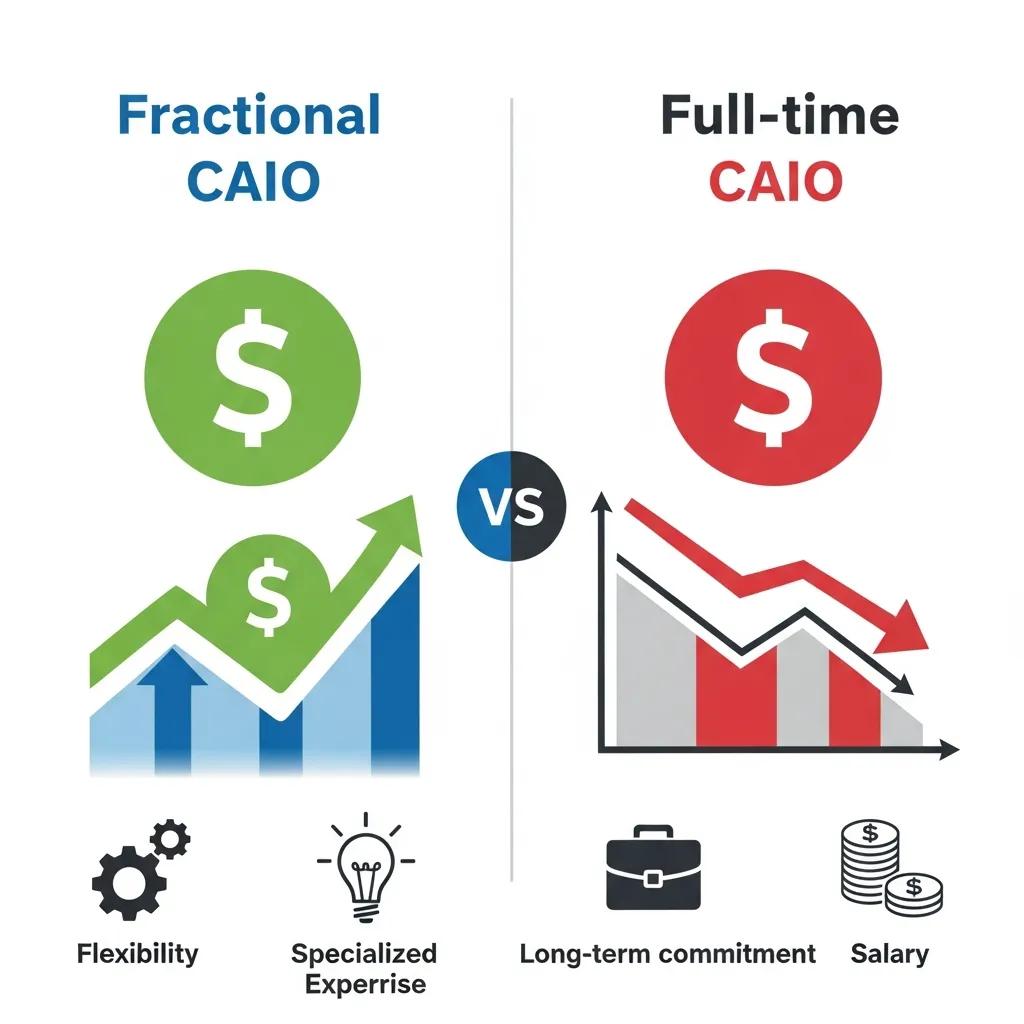
Understanding the cost trade-offs between fractional and full-time CAIO models helps SMBs allocate budget effectively while tracking ROI expectations. Fractional arrangements typically use retainers or fixed-scope blueprints to validate value before larger commitments, while full-time hires require significant salary and benefits investments. The EAV table below compares typical cost structures to clarify expected savings and financial trade-offs when choosing fractional leadership.
Cost comparison table:
| Role | Typical Cost | Notes |
|---|---|---|
| Full-time CAIO | $300k–$500k base (annual) | High continuity, full-time governance |
| Fractional CAIO | $10k–$30k per month (retainer range) | Flexible, outcome-focused engagement |
| Estimated Savings | 40–70% | Depends on scope and duration of engagement |
This comparison shows how fractional models can deliver senior expertise at materially lower cost while preserving governance and strategic value. After cost comparison, measure ROI with focused KPIs described below.
How Does Fractional AI Leadership Offer Cost Savings Compared to Full-Time CAIOs?
Fractional leadership reduces fixed overhead by shifting to variable spending while providing governance and strategy; typical fractional retainers fall well below the total compensation of a full-time CAIO when annualized. Savings arise from avoiding recruitment, benefits, and long-term compensation commitments, and from faster pilot-to-value cycles that accelerate payback. Fractional engagements also let SMBs test hypotheses and de-risk investment before scaling to full-time leadership. When AI is not yet core to product or operations, fractional is often the more cost-effective option.
What Are the Expected ROI Timelines and Performance Metrics?
Track early wins with a 30/60/90-day cadence and evaluate longer-term impact quarterly; meaningful early KPIs include time-to-value, adoption rate, process time savings, and initial revenue or AOV lift. Example KPIs to monitor:
- Time-to-value (days to measurable improvement)
- Adoption rate (percentage of users adopting the AI tool)
- Revenue impact (e.g., AOV or conversion rate lift)
- Operational efficiency (process time or cost savings)
These metrics provide a balanced view of short-term outcomes and long-term impact and align decision-making about scaling or hiring full-time leadership.
Following cost and ROI planning, consider the remaining common questions organizations ask when selecting fractional AI leadership.
Frequently Asked Questions
What qualifications should I look for in a fractional CAIO?
When hiring a fractional Chief AI Officer, prioritize candidates with a strong background in AI strategy, governance, and implementation. Look for qualifications such as advanced degrees in AI, data science, or related fields, along with proven experience in leading AI initiatives in similar industries. Additionally, assess their track record in delivering measurable business outcomes, their understanding of ethical AI practices, and their ability to foster collaboration among cross-functional teams. Strong communication skills and a people-first approach are also essential for effective stakeholder engagement.
How can I measure the success of a fractional CAIO?
To measure the success of a fractional CAIO, establish clear KPIs aligned with your business goals from the outset. Key performance indicators may include time-to-value for AI initiatives, adoption rates of AI tools among staff, and improvements in operational efficiency or revenue metrics. Regular reviews—such as 30/60/90-day check-ins—can help track progress and adjust strategies as needed. Additionally, gathering feedback from team members on the CAIO’s leadership and the impact of AI initiatives can provide qualitative insights into their effectiveness.
What are the common challenges faced when working with a fractional CAIO?
Common challenges when working with a fractional CAIO include potential misalignment with internal teams due to their part-time status, which can lead to communication gaps. Additionally, there may be resistance to change from employees who are uncertain about the new AI initiatives. To mitigate these issues, ensure that the fractional CAIO is integrated into the company culture and maintains regular communication with stakeholders. Establishing clear expectations and fostering a collaborative environment can also help overcome these challenges.
How does a fractional CAIO support ethical AI practices?
A fractional CAIO plays a crucial role in embedding ethical AI practices within an organization. They are responsible for implementing governance frameworks that prioritize fairness, transparency, and accountability in AI deployments. This includes conducting regular audits, ensuring compliance with privacy regulations, and establishing protocols for bias testing. By promoting responsible AI use, a fractional CAIO helps build trust among stakeholders and mitigates risks associated with AI technologies, ultimately leading to more sustainable and accepted AI solutions.
What is the typical engagement duration for a fractional CAIO?
The engagement duration for a fractional CAIO can vary widely based on the specific needs of the organization. Typically, these engagements can range from a few months for targeted projects to ongoing arrangements lasting a year or more for continuous support and strategy development. Initial contracts may start with a defined scope, such as a pilot project or a specific implementation phase, with the option to extend based on the outcomes and evolving business needs. Flexibility in engagement terms is a key advantage of fractional leadership.
Can a fractional CAIO help with vendor selection for AI tools?
Yes, a fractional CAIO can significantly assist with vendor selection for AI tools. They bring expertise in evaluating different AI solutions based on your organization’s specific needs and strategic goals. A fractional CAIO can help create a structured evaluation process, including criteria for assessing vendor capabilities, alignment with business objectives, and cost-effectiveness. Their experience in the industry allows them to identify reputable vendors and negotiate favorable terms, ensuring that the selected tools will effectively support your AI initiatives.
What Is the Difference Between a Fractional CAIO and Other AI Roles?
A fractional CAIO provides part-time executive leadership focused on strategy, governance, and cross-functional coordination, whereas consultants tend to be project-focused and data scientists or ML engineers execute models internally. The fractional CAIO sets roadmaps, defines KPI governance, and ensures responsible deployment while enabling internal teams to carry operational tasks. Choose consultants for short-term implementation depth, fractional CAIOs for strategic leadership with governance, and full-time technical hires when AI is core to product or operations.
Understanding these distinctions helps ensure you select the appropriate mix of roles for current needs and future scale.
How Do Responsible AI Principles Influence Fractional AI Leadership?
Responsible AI Principles—fairness, safety, privacy, transparency, and governance—shape decision-making at every stage from use-case selection to deployment and monitoring. A fractional CAIO should implement audits, explainability practices, and privacy safeguards as part of standard operating procedures. Practical controls include model documentation, bias testing, access controls, and incident response plans that reduce regulatory and reputational risk. Embedding these principles increases stakeholder trust and reduces the probability of costly corrections post-deployment.
Responsible AI practices also support employee acceptance and regulatory readiness, which ties back to people-first adoption strategies.
When Should SMBs Consider Hiring a Full-Time CAIO Instead?
Consider a full-time CAIO when AI becomes core to product differentiation, when your AI headcount grows substantially, or when continuous, organization-wide governance requires daily oversight. Measurable thresholds include a large portfolio of active AI models, multi-million-dollar AI-influenced revenue streams, or regulatory obligations demanding dedicated leadership. Until those thresholds are met, fractional leadership often provides the necessary strategy and governance while enabling you to scale responsibly.
This last decision point frames when to move from fractional to full-time leadership based on scale, complexity, and regulatory needs.
Conclusion
Engaging a fractional Chief AI Officer empowers SMBs to harness expert AI leadership without the financial burden of a full-time hire, ensuring strategic governance and accelerated implementation. This approach not only mitigates hiring risks but also provides immediate access to specialized skills that drive measurable outcomes. By prioritizing ethical practices and aligning AI initiatives with business goals, organizations can achieve sustainable growth and innovation. Discover how our fractional CAIO services can transform your AI strategy today.