Understanding the Role of a Fractional Chief AI Officer: Definition, Benefits, and Services for SMBs
A fractional Chief AI Officer (fCAIO) is an executive-level AI leader engaged part time to align AI strategy, governance, and deployment with business objectives for small and mid-sized businesses (SMBs), filling talent gaps without the cost of a full-time hire. This article explains what a fractional CAIO does, why SMBs hire one, and how that role converts AI opportunity into measurable business outcomes while preserving employee well-being. Readers will learn a concise definition and core functions, the primary benefits and typical timelines to ROI, a detailed responsibilities map with deliverables, and how a people-first provider structures a pathway from rapid assessment to deployment. The piece also compares fractional CAIOs to full-time CAIOs and traditional consultants, offers scenario-based hiring guidance, and shows how an engagement can be structured to deliver measurable ROI in under 90 days. Throughout, keywords such as fractional chief ai officer role, fractional CAIO, and AI governance for SMBs are used to provide practical guidance and semantic clarity for decision-makers.
What is a Fractional Chief AI Officer? Definition and Core Functions
A fractional Chief AI Officer is a senior AI executive who delivers strategic leadership, governance oversight, and deployment supervision on a part-time or retainer basis so that SMBs can access C-suite-level AI expertise without the overhead of a full-time hire. The mechanism of value is executive prioritization: the fCAIO evaluates business processes, identifies high-impact use cases, and designs governance and implementation plans that reduce risk and accelerate deployment. The result is focused AI roadmaps, vendor-agnostic decisions, and team enablement that produce measurable outcomes while keeping people-first adoption front and center. This role bridges AI strategy and execution by translating product and technical choices into business KPIs and by guiding change management so teams adopt AI tools effectively. Understanding these core functions clarifies how a fractional approach fits different organizational needs and when to escalate to a full-time executive.
The core functions of a fractional CAIO commonly include:
- Strategy development and prioritization of AI use cases that align with business goals and measurable KPIs.
- AI governance creation, including policy frameworks, risk assessments, and responsible AI guardrails.
- Technology and vendor selection, balancing vendor capabilities, costs, and long-term maintainability.
- Implementation oversight and integration management to minimize rework and technical debt.
- Team enablement through AI literacy workshops, role-based training, and change management support.
These functions together define the practical scope of an fCAIO and lead naturally to how a fractional engagement differs from a full-time CAIO and from project-based consulting.
How does a fractional CAIO differ from a full-time Chief AI Officer?
A fractional CAIO differs from a full-time Chief AI Officer primarily in time allocation, cost structure, and breadth of organizational embedding. Fractional engagement typically provides focused weekly or monthly hours and a retainer model that scales with need, enabling SMBs to gain senior leadership without long-term payroll commitments. Full-time CAIOs are embedded executives responsible for day-to-day leadership, deeper organizational change, and long-horizon initiatives, while fractional CAIOs concentrate on rapid roadmapping, governance setup, and enabling internal teams to operate independently over time. The choice depends on situational fit: SMBs needing executive guidance, prioritized pilots, and governance often choose fractional support; organizations planning enterprise-wide AI transformation may prefer a full-time CAIO. Evaluating the tradeoffs—cost, continuity, and depth of embedding—helps leaders choose the model that best mitigates risk and delivers early value.
What are the key responsibilities of a fractional CAIO?
A fractional CAIO typically carries responsibilities spanning strategy, governance, and delivery oversight with clear, tangible deliverables that an SMB can measure and act on. Responsibilities include conducting discovery to map AI opportunities, developing a prioritized AI roadmap, defining governance policies and audit checklists, selecting vendors or architectures, and enabling staff via training and workshops. Typical deliverables tied to these responsibilities are actionable roadmaps, pilot plans with success metrics, governance policies and controls, vendor shortlists and integration plans, and AI literacy curricula for teams. These responsibilities and deliverables provide a direct link between executive guidance and operational results, which is critical for achieving rapid ROI and sustainable adoption across the organization.
What are the Benefits of Hiring a Fractional Chief AI Officer for SMBs?
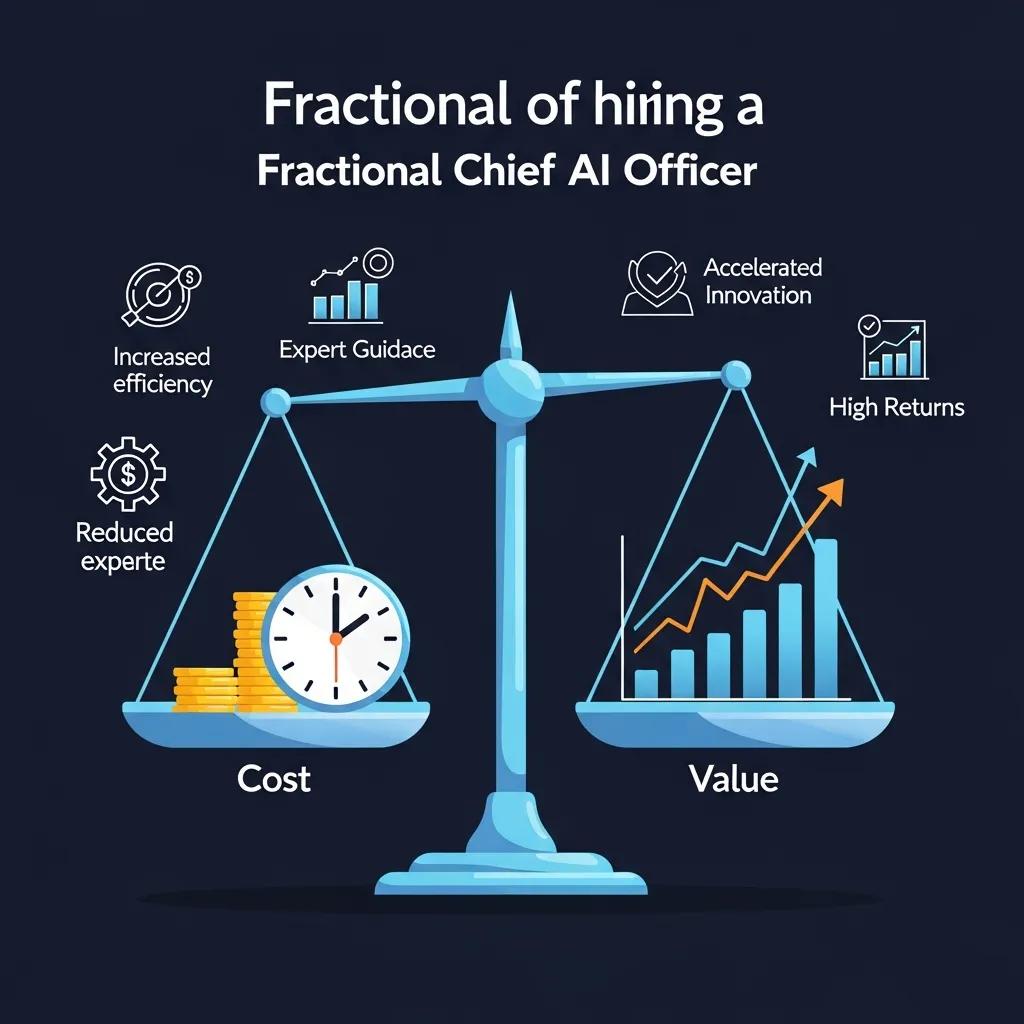
Hiring a fractional Chief AI Officer gives SMBs access to senior AI leadership that reduces cost, speeds time-to-value, and mitigates governance and ethical risk while preserving employee well-being. The mechanism is efficient executive prioritization: an fCAIO focuses resources on high-impact, low-friction use cases and establishes governance that prevents costly rework. That approach produces measurable outcomes such as faster pilot-to-production cycles and clearer ROI tracking, enabling leaders to evaluate AI investments with operational metrics rather than hopeful projections. The people-first emphasis ensures that automation enhances employee productivity and reduces stress, which improves adoption and long-term sustainment of AI initiatives. Below is a practical summary of the primary benefit categories and typical indicators of success to help compare options.
Indeed, research consistently highlights how AI can empower SMBs to streamline operations and enhance their market position.
AI Opportunities for SMBs: Streamlining Operations & Boosting Competitiveness
AI, in particular, offers unique opportunities for SMBs. By implementing AI-powered tools, such as chatbots for customer support or predictive analytics, SMBs can streamline operations, enhance customer experiences, and gain a competitive edge.
The Role of Information Technology and AI in Digitalizing Small and Medium-Sized Businesses, J Salluh, 2024
The primary benefits include:
- Cost-effectiveness: Senior expertise at a fraction of full-time executive cost, enabling budget-conscious leadership.
- Speed to value: Prioritization and governance accelerate deployment and reduce time-to-ROI.
- Expertise on demand: Access to C-suite AI experience without long hiring cycles or retention overhead.
- Risk reduction: Governance and ethical oversight limit compliance and reputational risks.
Different benefit types and typical indicators:
| Benefit Type | Indicator | Typical Outcome |
|---|---|---|
| Cost | Reduced hiring overhead | Fractional model lowers executive expense compared to full-time payroll |
| Speed | Time-to-deployment | Prioritized pilots reach production more quickly (weeks to months) |
| Expertise | Senior leadership access | Strategic decisions and vendor selections reflect executive experience |
| Governance | Policy and controls | Reduced rework and compliance incidents through defined guardrails |
This table highlights how each benefit translates into measurable outcomes: lower cost, faster deployments, stronger decisions, and safer AI operations. Understanding these outcomes helps SMBs weigh the value of fractional leadership versus alternative approaches.
How does a fractional CAIO provide cost-effective AI leadership?
A fractional CAIO provides cost-effective leadership by converting executive-level decision-making into a time-boxed engagement model, such as a retainer or project-based period, rather than a full-time salary commitment. This model reduces fixed personnel costs while delivering strategic deliverables—roadmaps, pilot plans, governance documents—that remain valuable after the engagement ends. Cost-effectiveness also hinges on prioritizing high-impact, low-effort use cases so that initial investments produce visible returns quickly, and on steering vendor choices to balance licensing and integration costs against expected ROI. For SMBs, the fractional approach reduces the financial barrier to executive AI governance and lets leadership test strategic directions before committing to permanent headcount.
In what ways does a fractional CAIO accelerate AI adoption and ROI?
A fractional CAIO accelerates adoption and ROI by focusing on rapid discovery, pragmatic prioritization, and governance that prevents common integration mistakes. The typical acceleration pathway starts with a rapid opportunity assessment, then selects 1–3 pilot use cases that offer measurable business impact and straightforward integration, and finally applies governance and change management to ensure adoption. This structured process reduces rework and shifts pilot projects into production more quickly, which shortens time-to-value. The result is a portfolio approach where early wins fund subsequent scaling, enabling SMBs to see measurable ROI in compressed timelines.
What Responsibilities Does a Fractional Chief AI Officer Hold?
A fractional CAIO holds responsibilities that span strategic planning, governance, technology selection, deployment oversight, and people enablement—each mapped to concrete deliverables that drive measurable progress. The mechanism for value is domain translation: the fCAIO translates technical possibilities into prioritized business initiatives and creates the governance and operational scaffolding necessary for safe, scalable deployment. Typical deliverables include strategic roadmaps, governance policies and audit checklists, pilot plans with KPIs, vendor integration plans, and training programs to build internal capability. The combination of strategy and delivery oversight makes the fCAIO accountable for both planning and the early phases of execution, aligning technical work with business outcomes.
The responsibilities and their typical deliverables are summarized below.
| Responsibility | Typical Deliverable | Example Outcome |
|---|---|---|
| AI strategy & roadmap | Prioritized AI roadmap with KPIs | Clear 90–180 day plan for pilots and metrics |
| AI governance | Policy, controls, audit checklist | Compliance-aligned guardrails and risk registers |
| Vendor selection & integration | Vendor shortlists and integration plan | Reduced vendor risk and smoother deployment |
| Team enablement | AI literacy workshops and role-based training | Faster adoption and reduced change resistance |
How does a fractional CAIO develop and execute AI strategy?
A fractional CAIO develops strategy through a structured sequence: discovery and opportunity assessment, alignment with business goals, prioritization using an impact/effort framework, roadmap creation with KPIs, and pilot planning with clear success criteria. The discovery phase maps processes and data assets to potential AI use cases, then the fCAIO ranks those use cases by expected business impact and implementation complexity to select pilots. Execution emphasizes short, measurable sprints where outcomes inform subsequent scaling decisions. Deliverables typically include a prioritized roadmap document, pilot timelines, and KPI dashboards to track progress and validate ROI during early deployments.
What role does a fractional CAIO play in AI governance and ethical AI leadership?

A fractional CAIO establishes governance frameworks that define policy, controls, and ongoing risk assessment to ensure responsible and compliant AI use across the organization. Governance activities include developing policy templates, designing audit checklists, performing data and model risk assessments, and instituting transparency practices for model decisions where appropriate. Ethical leadership involves embedding fairness, explainability, and privacy protections into both procurement choices and operational processes, and training teams to follow these principles. The governance checklist becomes a living artifact that guides development, deployment, and monitoring, reducing operational risk and improving stakeholder confidence in AI initiatives.
However, as research indicates, realizing these benefits requires careful management of potential risks such as data quality, algorithmic bias, and privacy concerns.
AI-Driven Innovation for SMEs: Actionable Insights & Competitive Edge
Findings reveal that AI-driven assessments based on data analysis, pattern recognition, and predictive modeling significantly benefit SMEs by offering actionable insights and recommendations, enabling efficient decision-making, and promoting competitive dynamism. However, limitations such as data quality, algorithmic bias, and privacy concerns must be carefully managed to avoid potential risks associated with AI implementation.
Business innovation self-assessment with artificial intelligence support for small and medium-sized enterprises, JC Proenca, 2024
How Does eMediaAI Deliver Fractional Chief AI Officer Services?
eMediaAI provides fractional Chief AI Officer services with a people-first methodology that emphasizes rapid opportunity assessment, governance, and measurable ROI while protecting employee well-being and adoption. The firm uses a structured entry offering—the AI Opportunity Blueprint™—a 10-day engagement priced at $5,000 that rapidly surfaces prioritized use cases and a clear path to ROI. eMediaAI’s approach pairs executive-level oversight with team enablement, ensuring that strategic recommendations translate into operational pilots and sustainable practices. As a lead generation and information hub with a people-first stance, eMediaAI frames AI projects to save time, reduce stress, and achieve measurable ROI while keeping employees central to automation design.
Below is a concise engagement-phase mapping that shows expected activities and outcomes across the typical pathway from assessment to ongoing fractional leadership.
| Engagement Phase | Activities | Expected Outcome/Metric |
|---|---|---|
| AI Opportunity Blueprint™ (10-Day) | Rapid discovery, prioritized use-case list, ROI hypothesis | Prioritized pilots and ROI estimate; roadmap starter |
| Pilot & Deployment | Pilot implementation, governance setup, adoption training | Working pilot with success metrics and adoption plan |
| Scale & Ongoing Leadership | Fractional CAIO oversight, governance maintenance, scaling support | Scaled deployments and maintained governance; client ROI tracked |
What is eMediaAI's people-first approach to fractional CAIO services?
eMediaAI’s people-first approach centers on designing AI solutions that reduce employee stress, save time, and foster sustainable adoption by pairing technical recommendations with change management and training. Practically, this means including stakeholders early in discovery, developing role-specific training and literacy workshops, and measuring adoption and well-being metrics as part of project KPIs. The approach privileges inclusive design—tools that augment human work rather than replace essential roles—so that pilots emphasize augmenting capacity and improving job satisfaction. By aligning AI outcomes with employee experience, the people-first methodology increases the likelihood of sustained benefits and reduces resistance during deployment.
What is the process of engagement from AI Opportunity Blueprint™ to deployment?
eMediaAI’s engagement process begins with the AI Opportunity Blueprint™—a 10-day assessment that surfaces prioritized use cases and ROI hypotheses—followed by focused pilot implementation, governance setup, and scaling under fractional CAIO oversight. The typical timeline starts with the 10-day Blueprint that delivers a prioritized roadmap and pilot recommendations, then moves to a short pilot cycle designed to validate hypotheses and measure early ROI, and finally transitions to fractional leadership that oversees governance, ongoing optimization, and scaling. Expected metrics include prioritized use-case lists, pilot success criteria, and measurable ROI within an accelerated timeframe, with eMediaAI citing client ROI in under 90 days as an outcome of this structured pathway.
When and Why Should SMBs Hire a Fractional Chief AI Officer?
SMBs should consider hiring a fractional Chief AI Officer when internal AI efforts lack direction, pilots stall before production, or governance and compliance risks threaten adoption. The core mechanism is gap remediation: the fCAIO supplies executive prioritization and governance that internal teams often cannot sustain due to resource constraints. Hiring an fCAIO is particularly appropriate when leadership needs strategic decision-making, vendor selection, and change management without committing to full-time executive overhead. Evaluating readiness involves checking for indicators such as unclear ROI metrics, stalled projects, or insufficient governance—each a signal that fractional expertise can convert inertia into measurable outcomes.
Common scenarios indicating the need for fractional CAIO expertise include:
- Stalled AI pilots that never move to production due to lack of prioritization or governance.
- Absence of an AI roadmap, leaving teams to trial tools without business alignment.
- Emerging regulatory or ethical risk exposure without policy frameworks in place.
What scenarios indicate the need for fractional CAIO expertise?
Specific indicators for engaging a fractional CAIO include repeated pilot failures, lack of measurable KPIs for AI efforts, unclear data readiness, and early signs of regulatory exposure related to AI use. When pilots fail to produce repeatable outcomes or when teams struggle to prioritize work against business metrics, a fractional CAIO can perform a rapid assessment, set priorities, and institute governance to stabilize initiatives. This targeted leadership converts ambiguous projects into prioritized sprints with success criteria, enabling SMBs to evaluate AI investments more objectively and reduce operational and compliance risk.
How does fractional CAIO service mitigate AI talent gaps and budget constraints?
Fractional CAIO services mitigate talent gaps by delivering senior-level decision-making and mentorship on a retainer or project basis, enabling SMBs to access expertise without the fixed cost of a full-time executive. Engagement models typically include time-boxed retainer hours, project-based assessments like a 10-day Blueprint, and flexible fractional oversight that scales with need. This flexibility lets organizations allocate scarce budget to strategy and pilots that show ROI while postponing or avoiding long-term executive hiring. By balancing cost, time, and capability, fractional models help SMBs bridge capability gaps and make better-informed long-term staffing decisions.
How Does a Fractional Chief AI Officer Compare to Full-Time CAIOs and AI Consultants?
Comparing fractional CAIOs to full-time Chief AI Officers and traditional consultants clarifies tradeoffs in cost, continuity, and accountability. Fractional CAIOs provide ongoing executive leadership on a limited-time basis, balancing governance and strategy with hands-on oversight, while full-time CAIOs provide continuous internal leadership and deeper organizational embedding. Traditional AI consultants often focus on project execution and technical build but do not provide the same level of sustained governance or accountability for long-term adoption. Choosing among these models depends on an SMB’s need for continuity, budget constraints, and the degree of internal capability they wish to develop.
Key comparative points include cost, flexibility, and continuity:
- Fractional CAIOs offer flexible, lower-cost executive guidance that supports governance and prioritization.
- Full-time CAIOs deliver continuous leadership and are best for large-scale, permanent AI transformations.
- Traditional consultants excel at executing specific projects but typically do not provide ongoing executive-level governance.
What are the cost and flexibility differences between fractional and full-time CAIOs?
Cost and flexibility tradeoffs are central: fractional CAIOs reduce fixed labor cost by offering part-time executive bandwidth, whereas full-time CAIOs require permanent compensation and deeper organizational commitment. Fractional models are flexible—engagements can scale up or down depending on the pipeline of AI projects—while full-time roles provide continuity that supports enterprise-wide transformations. SMBs with limited budgets or short-term scaling goals often prefer fractional arrangements to buy leadership while they build internal capability; those planning extensive AI integration across many functions may budget for a full-time CAIO to ensure long-term alignment and governance continuity.
How does fractional CAIO expertise differ from traditional AI consulting services?
Fractional CAIO expertise differs from traditional AI consulting in orientation and accountability: fractional CAIOs focus on leadership, governance, and long-term operationalization, taking responsibility for aligning AI initiatives with business strategy and maintaining governance. Traditional consultants typically concentrate on project execution—modeling, system integration, and deliverable handoffs—without assuming ongoing executive ownership. Fractional CAIOs therefore combine strategy and operational oversight with accountability for adoption and governance, while consultants provide technical depth for discrete projects. For SMBs seeking both immediate execution and sustained governance, a blended approach—consultants for implementation guided by a fractional CAIO for oversight—often yields the best outcomes.
- Strategic Alignment: Fractional CAIOs ensure AI projects align with business KPIs.
- Governance Ownership: Fractional CAIOs create and maintain governance frameworks over time.
- Implementation Focus: Traditional consultants deliver technical builds but usually do not own long-term governance.
These comparative distinctions help decision-makers craft engagement models that balance technical delivery with sustainable leadership and accountability. The final practical step for interested SMBs is to consider a rapid diagnostic such as an AI Opportunity Blueprint™ to surface prioritized use cases and ROI hypotheses before committing to larger investments; eMediaAI’s 10-day Blueprint priced at $5,000 is an example of such an entry offering that bridges assessment and execution under a people-first framework guided by leadership such as Lee Pomerantz.
Final practical step and call to action
If your organization faces stalled AI work, unclear ROI, or governance gaps, consider a short diagnostic engagement to prioritize use cases and estimate time-to-value; a structured 10-day assessment can identify pilots and governance steps that often yield measurable ROI within 90 days. For SMBs seeking executive-level AI leadership without full-time hiring, fractional CAIO services combine strategic direction, governance, and team enablement to accelerate adoption while protecting employee well-being. Lee Pomerantz and the team at eMediaAI offer a people-first pathway from rapid assessment to fractional leadership designed to convert prioritized AI opportunity into measurable business outcomes.
Frequently Asked Questions
What qualifications should a fractional CAIO have?
A fractional Chief AI Officer should possess a strong background in artificial intelligence, data science, and business strategy. Typically, they hold advanced degrees in relevant fields such as computer science, engineering, or business administration. Additionally, experience in leadership roles, particularly in AI governance and implementation, is crucial. Familiarity with industry-specific challenges faced by SMBs and a proven track record of successful AI project management are also important. This combination of technical expertise and strategic insight enables them to effectively guide organizations in leveraging AI for business growth.
How can SMBs measure the success of a fractional CAIO engagement?
SMBs can measure the success of a fractional CAIO engagement through several key performance indicators (KPIs). These may include the speed of AI project deployment, the number of successful pilot projects transitioned to production, and the overall return on investment (ROI) achieved within a specified timeframe. Additionally, tracking employee adoption rates of AI tools, improvements in operational efficiency, and reductions in compliance risks can provide valuable insights. Regular feedback from stakeholders and team members can also help assess the effectiveness of the fractional CAIO’s strategies and governance frameworks.
What industries can benefit most from hiring a fractional CAIO?
While many industries can benefit from hiring a fractional CAIO, sectors such as healthcare, finance, retail, and manufacturing often see significant advantages. These industries typically deal with large volumes of data and require robust AI governance to ensure compliance and ethical use. Additionally, companies in rapidly evolving tech landscapes, such as e-commerce and logistics, can leverage fractional CAIO expertise to stay competitive. Ultimately, any SMB looking to integrate AI into their operations and improve decision-making can find value in engaging a fractional CAIO.
What are common challenges faced by SMBs when implementing AI?
Common challenges faced by SMBs when implementing AI include limited resources, lack of technical expertise, and difficulties in aligning AI initiatives with business objectives. Many organizations struggle with data quality and availability, which can hinder the effectiveness of AI models. Additionally, resistance to change among employees and insufficient governance frameworks can lead to stalled projects. Addressing these challenges often requires strategic oversight, which is where a fractional CAIO can provide valuable guidance and support to ensure successful AI adoption and integration.
How does a fractional CAIO support change management during AI adoption?
A fractional CAIO supports change management during AI adoption by developing tailored training programs and communication strategies that address employee concerns and promote buy-in. They facilitate workshops to enhance AI literacy and ensure that team members understand the benefits and functionalities of new tools. By involving stakeholders early in the process and providing ongoing support, the fractional CAIO helps to create a culture of collaboration and openness. This approach not only eases the transition but also fosters a positive environment for sustained AI adoption and innovation.
What is the typical timeline for seeing results from a fractional CAIO engagement?
The typical timeline for seeing results from a fractional CAIO engagement can vary based on the organization’s specific needs and the complexity of the AI initiatives. However, many SMBs report measurable outcomes within 90 days of engagement. Initial phases often focus on rapid assessments and pilot projects, which can yield quick wins and validate ROI hypotheses. As the fractional CAIO implements governance frameworks and enables teams, organizations can expect to see improvements in efficiency, project success rates, and overall business performance as they scale their AI efforts.
Conclusion
Engaging a fractional Chief AI Officer empowers SMBs to harness AI’s potential while minimizing costs and risks associated with full-time hires. This strategic approach accelerates deployment, enhances governance, and fosters employee well-being, ensuring that AI initiatives align with business objectives. By prioritizing high-impact use cases, organizations can achieve measurable ROI in under 90 days. Discover how eMediaAI’s tailored services can transform your AI strategy today.