Unleash SMB Growth Through Strategic AI Leadership
Strategic AI leadership is the practice of aligning AI investments, governance, and talent with measurable business outcomes so organizations capture value quickly and sustainably. It works by prioritizing high-impact use cases, establishing governance and measurement, and orchestrating change management so AI moves from experiments to production with clear ROI. For SMBs this alignment shortens time-to-value, reduces costly tech sprawl, and improves employee adoption by designing systems around people rather than replacing them. This article explains what strategic AI leadership entails, how it drives competitive advantage, practical people-first adoption steps for SMBs, the role of fractional AI executives, and how an ROI-driven 10-day roadmap can accelerate results. Readers will learn governance essentials, a checklist for people-first adoption, tangible fractional Chief AI Officer (fCAIO) engagement models, and measurement frameworks to quantify impact. Throughout, the piece draws on responsible AI principles, modern tooling such as Vertex AI, Gemini, and Google Vertex AI, and real-world approaches to operationalize AI in ways that are measurable and employee-centered.
What Is Strategic AI Leadership and Why Does It Matter for Business Growth?
Strategic AI leadership is the executive practice of governing AI investments so that models, data, and pilots link directly to prioritized business objectives and measurable outcomes. It matters because leadership defines which use-cases get resources, establishes risk controls, and removes organizational friction that otherwise delays value capture. Without that strategic orientation, firms face technology sprawl, duplicated pilots, unclear ownership, and missed ROI opportunities as investments fail to scale. Recent market signals show organizations with strong AI governance achieve faster production cycles and higher adoption, translating into measurable efficiency and revenue gains for SMBs.
Further research underscores the critical role of strategic leadership and data-driven decision-making in leveraging AI for enhanced corporate performance and sustainable growth.
AI & Strategic Leadership: Driving Business Growth & Competitive Advantage
The integration of Artificial Intelligence (AI) and Machine Learning (ML) into company operations and leadership initiatives is pivotal to this transition. This research examines the influence of data-driven decision-making and strategic leadership on improving corporate performance using AI-powered solutions. This research explores the synergies between AI technology and leadership techniques, demonstrating how businesses may leverage data to enhance decision-making, promote innovation, and maintain development in a competitive environment.
Data-Driven Decision-Making and Strategic Leadership: AI-Powered Business Operations for Competitive Advantage and Sustainable Growth, S MAHABUB, 2025
Strategic AI leadership delivers concrete business benefits by focusing on alignment, oversight, and measurement rather than tech-for-tech’s-sake. The first mechanism of value is use-case prioritization, which maps effort to measurable KPIs; next is governance, which ensures safe, repeatable model deployment; and finally change management, which secures adoption and operational continuity. Neglecting leadership increases compliance exposure and slows digital transformation.
Strategic AI leadership creates three primary advantages for SMBs:
- Competitive differentiation through faster product and service improvements.
- Cost and efficiency gains via automation of repetitive tasks and decision support.
- Employee enablement by designing AI tools that reduce workload and increase job satisfaction.
These benefits cascade into accelerated time-to-value and sustained growth when leadership pairs strategy with measurement and people-first implementation. Understanding how leadership drives transformation leads naturally to how it creates competitive advantage and supports digital transformation.
How Does AI Leadership Drive Competitive Advantage and Digital Transformation?
AI leadership drives competitive advantage by prioritizing high-value use-cases and shortening the path from pilot to production, enabling SMBs to innovate faster than competitors constrained by conventional decision cycles. Leadership enforces data strategy—ensuring data quality, integrations, and pipelines—so predictive capabilities become reliable and actionable, which in turn improves pricing, personalization, and operational forecasting. Cross-functional leaders remove organizational bottlenecks, enabling teams from sales to operations to deploy AI-assisted workflows that yield real efficiency and revenue improvements. For example, a retailer that prioritizes checkout friction-first use-cases can increase conversion rates while another that invests in back-office automation reduces processing costs; both outcomes derive from targeted leadership decisions.
By coordinating vendor selection, tooling (including platforms like Vertex AI, Gemini, and Google Vertex AI), and in-house capabilities, strategic leaders control execution speed and risk exposure. That governance also ensures models meet regulatory and ethical expectations, which preserves customer trust as digital transformation accelerates. The next essential element is the set of components that make such leadership effective in practice.
What Are the Key Components of Effective AI Leadership Strategy?
Effective AI leadership rests on five core components: a clear vision tied to business outcomes, governance and risk management, talent and AI literacy, repeatable processes for prioritizing use-cases, and KPI-driven measurement plans. Vision aligns stakeholders on the “why” and creates a short list of business outcomes to chase, while governance establishes policies, escalation paths, and vendor controls that mitigate risk. Talent strategies combine hiring, training, and fractional expertise to fill skill gaps quickly without oversized fixed costs. Process-wise, leaders implement prioritization matrices that score use-cases by ROI, effort, and risk to ensure limited resources target quick wins. Finally, KPIs and dashboards close the loop by tracking baseline vs. post-deployment performance and enabling continuous optimization.
Practical actions include creating a one-page AI charter, running a governance cadence with quarterly reviews, launching targeted literacy programs for frontline users, and instituting a use-case intake form that feeds a prioritization matrix. These components together provide the scaffolding that converts experimental projects into measurable business outcomes and prepare SMBs to adopt people-first AI pathways.
How Can SMBs Successfully Adopt AI with a People-First Approach?
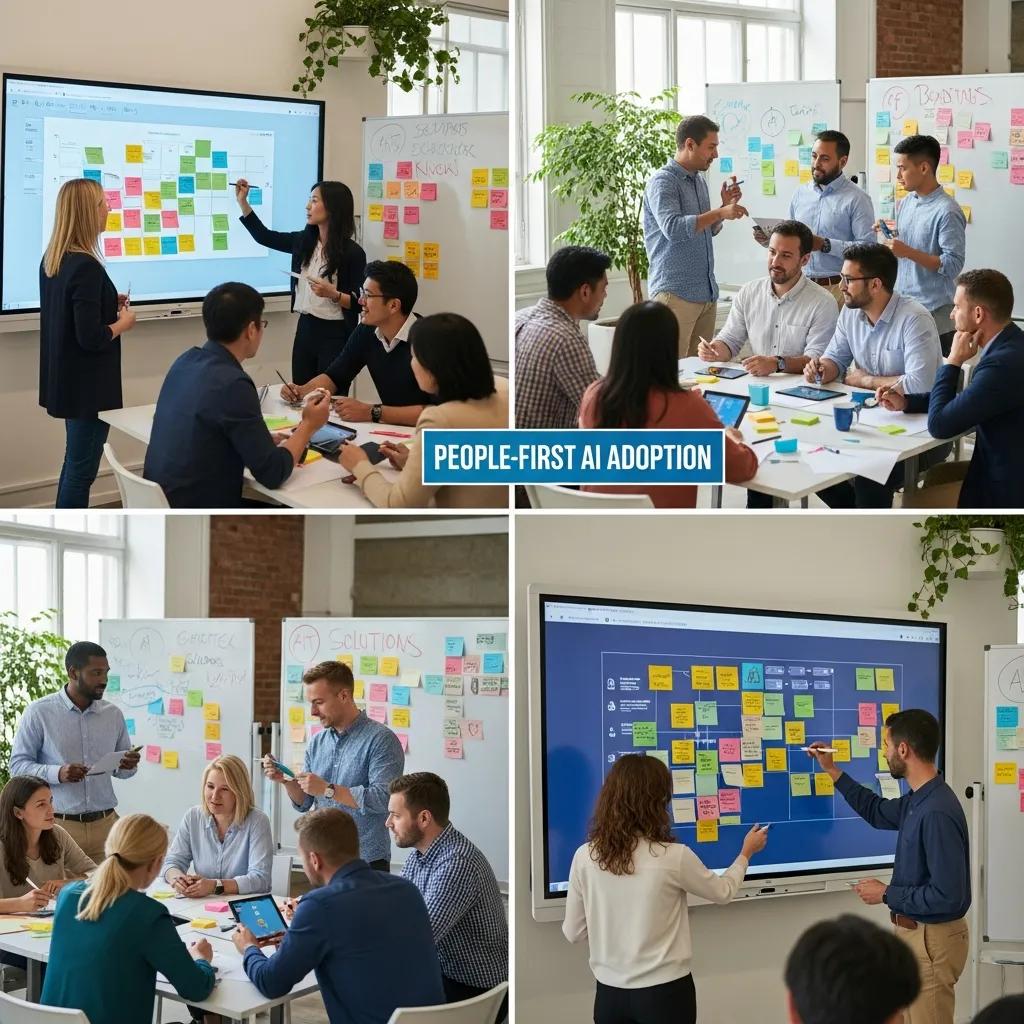
Adopting AI with a people-first approach means starting from employee pain points and designing AI to augment roles rather than displace them, ensuring faster adoption and measurable improvements in well-being and productivity. This approach reduces resistance, improves quality of outputs, and yields better downstream ROI because users see direct time savings and reduced cognitive load. Practical adoption emphasizes co-design workshops, iterative pilots, and layered training so employees develop trust and competence with AI tools. Measuring people-centered outcomes—such as time saved, satisfaction, and error reduction—keeps adoption focused on human benefits and informs scale decisions.
This people-first philosophy is echoed in broader discussions about ethical technology and participatory design, emphasizing human empowerment in the digital transformation.
People-First AI: Ethical Tech & Participatory Design
The PEOPLE-FIRST session aims to promote the development of digital and industrial technologies that are centred around people and uphold ethical principles. This session aligns with the overarching objective of building a strong, inclusive, and democratic society that is well-equipped for the challenges of digital transition. At the heart of our initiative is the empowerment of end-users and workers, actively involving them in the development lifecycle of technologies, fostering a participatory design process.
Digital Humanism: Towards a People-First Digital Transformation, 2025
A concise four-step checklist helps SMBs operationalize people-first adoption:
- Define outcome-focused use-cases based on employee pain points and business priorities.
- Run rapid, supported pilots with frontline users and iterate based on feedback.
- Embed human-in-the-loop controls and training modules to build competency and trust.
- Measure people-centered KPIs and expand pilots into phased rollouts when targets are met.
Following this checklist reduces adoption risk and aligns AI with operational reality. The most common adoption obstacles and mitigation tactics explain how to keep momentum during early implementation.
What Are the Challenges SMBs Face in AI Adoption and How to Overcome Them?
SMBs face predictable challenges: skills gaps, data quality issues, constrained budgets, and organizational resistance; each can be mitigated with targeted, low-cost tactics. Skills and literacy gaps respond well to focused coaching and role-based training that equip employees with the specific capabilities they need to use AI tools effectively. Data readiness can be addressed by creating minimum viable datasets and simple data hygiene practices that make models reliable quickly without large engineering projects. Cost constraints are best managed by prioritizing small, high-ROI pilots and leveraging fractional expertise to avoid full-time executive costs. Resistance is mitigated through transparent communication, incentives for early adopters, and co-design sessions that involve users in solution design.
Concrete quick wins include automating repetitive form processing to free up staff time, standardizing data fields to improve model input quality, and running A/B tests to demonstrate measurable gains. Addressing these practical challenges early builds credibility for AI initiatives and lays the groundwork for sustainable scaling. Those human factors lead directly into why employee well-being is critical for implementation success.
How Does Employee Well-Being Influence AI Implementation Success?
Employee well-being strongly influences adoption rates, productivity, and retention when AI is introduced; tools that reduce stress and cognitive load tend to gain faster acceptance and deliver stronger ROI. Well-designed AI that saves time on repetitive tasks, supports decision-making, and includes clear escalation paths decreases frustration and raises perceived value among users. Measuring well-being via simple surveys and time-savings metrics during pilots helps leaders tune features and workflows so employees experience net gains. Interventions like role redesign, clear guarantees around job transitions, and upskilling programs increase trust and reduce fears of displacement.
When leaders prioritize well-being, adoption becomes an enabler of engagement rather than a perceived threat, and that positive cycle supports long-term digital transformation. Clear governance and oversight are the next logical element for ensuring these implementations remain safe, ethical, and effective.
What Is the Role and Benefit of a Fractional Chief AI Officer in SMBs?

A Fractional Chief AI Officer (fCAIO) is a part-time executive who provides strategic oversight, governance, and delivery guidance for an organization’s AI initiatives, enabling SMBs to access senior-level expertise without the cost of a full-time C-suite hire. An fCAIO defines AI strategy, establishes governance frameworks, prioritizes use-cases, oversees vendor selection, and sets KPI measurement cadences that link investments to business outcomes. For many SMBs, fractional engagements accelerate time-to-value and reduce risk by injecting seasoned decision-making into early-stage projects. They are especially valuable when internal teams lack the strategic experience to scale pilots into measurable production outcomes.
Engagements typically focus on rapid strategy, governance setup, and pilot oversight—delivering roadmaps, policy playbooks, and KPI dashboards that prepare teams for execution. The following table compares common engagement types, typical deliverables, and indicative durations/cost structures to help decision-makers evaluate options.
| Engagement Type | Typical Deliverables | Typical Duration / Cost |
|---|---|---|
| Strategy Sprint | Prioritized AI roadmap, executive briefing, use-case valuation | 4–6 weeks / advisory-based pricing |
| Governance Setup | Policies, risk matrix, vendor checklist, escalation workflow | 1–3 months / project fee or retainer |
| Pilot Oversight | Pilot plan, measurement design, model deployment checklist | 3–6 months / phased engagement |
| Ongoing Advisory | KPI dashboards, quarterly reviews, vendor governance | Ongoing retainer / monthly advisory fee |
How Does a Fractional CAIO Provide Strategic Oversight and AI Governance?
A fractional CAIO establishes practical governance by defining policies, monitoring risk, and creating decision cadences that embed AI into operational workflows while maintaining accountability. Typical activities include building an AI charter, setting model validation and testing standards, defining vendor due-diligence criteria, and setting up monitoring dashboards that track fairness, performance, and drift. The fCAIO also schedules governance cadences—regular checkpoint meetings that align stakeholders and escalate issues before they become material. This oversight ensures that technical deployments remain aligned to business outcomes and that responsibility for AI artifacts is clearly assigned across the organization.
By combining strategy with operational templates, a fractional CAIO accelerates safe deployments and creates repeatable processes that in-house teams can adopt. That governance capability directly supports the deliverables and durations described previously and connects naturally to short ROI-driven roadmaps.
What Are Typical Engagements and Deliverables of a Fractional CAIO?
Typical fractional engagements deliver a mix of strategic artifacts and operational playbooks that prepare an SMB to run AI at scale while preserving budget flexibility. Deliverables often include a prioritized use-case roadmap, governance playbook, KPI dashboard templates, pilot playbooks, and training plans for frontline employees. Engagement durations vary by scope—short sprints to define strategy, multi-month governance rollouts, or ongoing advisory retainers to support execution and vendor management. These packaged deliverables convert strategic intent into operationally actionable steps that internal teams can implement with coaching and oversight.
The deliverables are intentionally practical: roadmaps show which projects to run first, playbooks capture repeatable processes, and KPI dashboards quantify impact for executive decision-making. Fractional engagement models thus make high-level leadership accessible to SMBs while preserving capital and reducing hiring risk. Understanding roadmaps leads to the specific mechanism of a 10-day AI Opportunity Blueprint™ that many SMBs use to jumpstart ROI-driven AI work.
How Does the AI Opportunity Blueprint™ Enable ROI-Driven AI Roadmaps?
The AI Opportunity Blueprint™ is a structured 10-day roadmap designed to identify high-impact, low-friction AI use-cases and produce a prioritized implementation plan with measurable ROI expectations. It accelerates decision-making by compressing discovery, valuation, and roadmapping into a short, focused engagement that surfaces quick wins and practical pilots. The Blueprint’s mechanism is straightforward: scope business outcomes, map processes, quantify potential value, and produce an execution plan with governance and measurement artifacts ready for handoff. This process reduces ambiguity, creates business cases to secure budget, and provides the artifacts necessary for either internal teams or fractional leadership to execute.
Below is a concise table summarizing the Blueprint’s key attributes to help decision-makers evaluate fit and timeline.
| Blueprint Attribute | Characteristic | Typical Output |
|---|---|---|
| Duration | 10 days | Prioritized roadmap and pilot plans |
| Cost | Fixed engagement fee | Approximately $5,000 (as reported for Blueprint) |
| Deliverable | ROI use-cases & implementation plan | Use-case valuations, governance checklist |
| Handoff | Execution-ready artifacts | KPI templates, stakeholder commitments |
What Is the 10-Day AI Opportunity Blueprint™ Process for Identifying High-Impact Use Cases?
The 10-day Blueprint follows a compact sequence: rapid scoping and discovery, structured use-case identification and valuation, roadmap creation, and handoff with measurement plans. Days 1–2 focus on scoping—interviewing stakeholders, mapping processes, and collecting baseline metrics. Days 3–6 identify and quantify candidate use-cases using a prioritization matrix that balances ROI, effort, and risk. Days 7–10 refine the roadmap, design pilot plans, define KPIs, and prepare governance and handoff artifacts so teams can begin execution immediately. Typical stakeholder time commitment is concentrated: 2–4 hours of focused input per key stakeholder during discovery, plus short validation sessions later in the engagement.
This tightly structured cadence produces concrete artifacts—use-case valuations and an execution plan—that reduce decision latency and create alignment between business leaders and technical teams. The Blueprint’s ability to align stakeholders and produce actionable outputs accelerates ROI realization, as described in the next subsection.
How Does the Blueprint Reduce AI Adoption Friction and Accelerate ROI?
The Blueprint reduces adoption friction by prioritizing implementable use-cases, creating clear business cases to unlock budget, and defining quick-win pilots that demonstrate measurable value. Prioritization removes ambiguity and prevents resource waste on low-impact pilots, while a clear roadmap and governance artifacts give teams a repeatable playbook for scaling. By producing pilot designs with defined KPIs and success criteria, the Blueprint enables teams to run tightly controlled tests that attribute gains to AI initiatives and secure executive buy-in for scaling. Mini-case examples often show time-to-value shortening from months to weeks because pilots are scoped for operational readiness rather than exploratory research.
These outcomes are consistent with people-first methodology: pilots are designed with frontline users involved, measurement includes employee-centric KPIs, and governance artifacts ensure safe, explainable deployment. For SMBs that want to move fast with lower risk, a Blueprint paired with fractional oversight provides a pragmatic path to measurable AI impact.
How to Build and Implement a Responsible AI Framework for Sustainable Business Growth?
A responsible AI framework for SMBs marries people-first principles with lightweight operational controls so organizations can scale AI while managing privacy, bias, and operational risk. The framework starts with clear principles—transparency, human oversight, privacy-by-design, and accountability—and translates them into pragmatic controls like consent practices, bias testing checklists, and audit trails. Governance roles should be small but clear, assigning ownership for data, model validation, and incident response. Lightweight processes—regular fairness checks, logging for critical decisions, and simple vendor due diligence—make compliance manageable for SMB scale.
Operationalization focuses on simple, repeatable practices that create safety and trust without heavy overhead. The next subsection lists people-first principles and one-line operational tips for each to make the framework actionable.
What Are People-First Responsible AI Principles for SMBs?
People-first responsible AI principles center on transparency, human-in-the-loop design, employee time-savings, and clear accountability to preserve trust and usability. Transparency means explaining model outcomes in employee-facing contexts so users understand why a recommendation was made. Human-in-the-loop design ensures employees can override or escalate model suggestions and keeps humans responsible for sensitive decisions. Designing for time-savings and reduced cognitive load prioritizes user experience and adoption because tools that demonstrably help employees get adopted more quickly. Accountability assigns owners for data and model outcomes so issues are traceable and remediable.
Operational tips include using plain-language explanations for model outputs, embedding escalation paths in workflows, measuring time-savings during pilots, and documenting ownership for each deployed model. These simple practices help SMBs achieve ethical, usable AI without excessive overhead. Practical mitigation tactics for bias and privacy follow next.
How Can SMBs Mitigate AI Bias and Ensure Data Privacy?
SMBs can mitigate bias and protect privacy by adopting basic, repeatable controls: data minimization, simple bias tests, consent practices, and vendor contractual clauses that require transparency and logging. Data minimization reduces exposure by collecting only what is necessary for model performance and retaining data for minimal periods. Bias testing can begin with simple subgroup performance checks and fairness metrics during pilot validation, coupled with remediation steps when disparities appear. Vendor due diligence should include questions on data handling, model explainability, and incident response. Logging and audit trails for model decisions provide an actionable record if issues arise and facilitate remediation.
Practical checklists—testing for disparate impact, documenting data sources, and including privacy-by-design clauses in contracts—enable SMBs to reduce risk while still extracting value from AI. These controls support measurement practices that demonstrate both operational and people-centered impact.
How to Measure AI Impact: Quantifying ROI and Operational Excellence?
Measuring AI impact requires a consistent framework that links use-cases to baseline metrics, selects relevant KPIs across financial, operational, and people-centered categories, and defines a cadence for reporting and attribution. Effective measurement uses baseline vs. post-deployment comparisons, A/B tests or control groups when possible, and dashboards that present executive-level KPIs alongside operational metrics. Clear attribution practices—like time-series analysis and controlled experiments—help distinguish AI-driven improvements from external factors. Reporting cadences should balance frequency with decision-making needs: weekly operational checks for pilots and monthly executive summaries for strategy.
The table below standardizes common SMB metrics and measurement methods to make impact assessment repeatable.
| Use Case / Metric | KPI | Measurement Method |
|---|---|---|
| Automation / Efficiency | Time saved per task (hours) | Baseline time audit vs. post-deployment logs |
| Revenue / Conversion | Conversion uplift (%) | A/B testing or pre/post period comparison |
| Cost Reduction | Cost per transaction ($) | Financial tracking vs. baseline month |
| People / Well-being | Employee satisfaction score | Pulse surveys before and after pilot |
| Compliance / Risk | Incident rate | Logged incidents per 1,000 decisions |
What KPIs and Metrics Demonstrate AI Success in SMBs?
AI success is demonstrated through a balanced set of KPIs that reflect financial, operational, people, and compliance outcomes; common examples include time saved, revenue lift, conversion rate increase, cost per acquisition, employee satisfaction, and incident reduction. Each KPI requires a clear measurement method: time saved is captured by task time audits or system logs; revenue lift is validated through controlled A/B tests or time-series analysis; conversion improvements use baseline conversion rates and post-deployment metrics. Employee satisfaction should be measured with pulse surveys tied to pilot cohorts, while compliance metrics track incidents and false positives. Collectively, these KPIs provide a multi-dimensional view of AI impact that informs scaling decisions.
A consistent measurement plan integrates baseline collection, target setting, and reporting cadence so leaders can evaluate progress against concrete goals. These metrics then become the basis for telling the story of impact, as illustrated in brief case vignettes.
How Do Case Studies Illustrate Strategic AI Leadership Driving Business Growth?
Short, anonymized vignettes show how strategic leadership and a people-first approach turn pilots into measurable gains. Example one: an e-commerce SMB prioritized checkout friction and implemented a recommendation model, achieving a 35% increase in average order value through targeted offers while maintaining customer experience standards. Example two: a marketing team adopted an automated video-ad editing workflow using modern tooling and reduced production time by 95%, enabling more rapid campaign iteration and stronger targeting. Example three: a content team applied transcript automation for podcasts and saw a 93% reduction in manual editing time, freeing creators for higher-value tasks.
Each vignette follows problem → leadership approach → selected use-case → measured outcome, demonstrating how prioritization, governance, and people-centered design produce quantifiable business results. These examples reinforce that clear leadership, measured pilots, and operational controls are the levers that produce sustainable AI-driven growth.
For SMBs ready to accelerate, a structured 10-day roadmap and fractional leadership offer pragmatic, people-focused pathways to measurable ROI. eMediaAI, a Fort Wayne-based firm with a people-first methodology—summarized as “AI-Driven. People-Focused.”—offers services including a 10-day AI Opportunity Blueprint™ (priced at approximately $5,000 as reported) and Fractional Chief AI Officer engagements that emphasize measurable ROI in under 90 days and responsible AI practices. Founder Lee Pomerantz, a Certified Chief AI Officer, positions these offerings as done-with-you partnerships that combine rapid roadmapping with governance and execution support to move SMBs from discovery to measurable outcomes.
Frequently Asked Questions
What are the common misconceptions about AI adoption in SMBs?
Many SMBs believe that AI adoption requires extensive resources and expertise, which can deter them from exploring AI solutions. In reality, AI can be implemented incrementally, starting with small, high-impact projects that require minimal investment. Additionally, some think AI will replace human jobs, but a people-first approach emphasizes augmenting roles and enhancing employee productivity. By addressing these misconceptions, SMBs can better understand the potential of AI to drive growth and efficiency without overwhelming their existing structures.
How can SMBs ensure ethical AI practices during implementation?
To ensure ethical AI practices, SMBs should adopt a responsible AI framework that includes principles like transparency, accountability, and human oversight. This involves creating clear guidelines for data usage, implementing bias testing, and ensuring that AI systems are designed to support rather than replace human roles. Regular audits and stakeholder feedback can help maintain ethical standards. By prioritizing ethical considerations, SMBs can build trust with employees and customers, ultimately leading to more successful AI initiatives.
What role does employee training play in successful AI adoption?
Employee training is crucial for successful AI adoption as it equips staff with the necessary skills to effectively use AI tools. Training programs should focus on building AI literacy, understanding the technology’s capabilities, and addressing any concerns about job displacement. By involving employees in the design and implementation process, organizations can foster a culture of collaboration and trust. This not only enhances user competence but also increases overall acceptance and satisfaction with AI solutions, leading to better outcomes.
How can SMBs measure the success of their AI initiatives?
SMBs can measure the success of their AI initiatives by establishing clear KPIs that align with business objectives. Common metrics include time saved, revenue growth, and employee satisfaction scores. Implementing a structured measurement framework that compares baseline performance to post-deployment results is essential. Regular reporting and analysis of these metrics will help organizations assess the impact of AI on their operations and make informed decisions about scaling or adjusting their AI strategies.
What are the potential risks associated with AI implementation for SMBs?
Potential risks of AI implementation for SMBs include data privacy concerns, algorithmic bias, and the possibility of operational disruptions. Without proper governance and oversight, AI systems may inadvertently perpetuate biases or violate privacy regulations. Additionally, poorly designed AI tools can lead to inefficiencies or employee frustration. To mitigate these risks, SMBs should establish robust governance frameworks, conduct regular audits, and ensure that AI solutions are developed with ethical considerations in mind.
How can fractional AI leadership benefit SMBs?
Fractional AI leadership provides SMBs with access to experienced professionals who can guide AI strategy and implementation without the cost of a full-time executive. This model allows organizations to benefit from expert oversight in governance, risk management, and project execution. Fractional leaders can help prioritize use-cases, establish measurement frameworks, and ensure that AI initiatives align with business goals. This flexibility enables SMBs to scale their AI efforts effectively while managing costs and resources efficiently.
Conclusion
Strategic AI leadership empowers SMBs to harness AI effectively, driving competitive advantage and sustainable growth through focused governance and people-first adoption. By prioritizing high-impact use cases and ensuring employee well-being, organizations can achieve measurable improvements in efficiency and satisfaction. Embracing a structured approach, such as the 10-day AI Opportunity Blueprint™, can accelerate time-to-value and reduce implementation risks. Discover how our tailored solutions can help your business thrive in the AI landscape today.